Wave Properties & the Wave Equation
A wave carries energy from one place to another without any matter travelling with it. Everything in this topic — sound, light, water ripples, radio signals — comes back to that one idea, and this lesson sets out the vocabulary and the single equation you need to describe any of them.
What a progressive wave actually is
Picture a long rope, pinned at one end, with someone flicking the free end up and down. A hump of displacement travels along the rope, but no piece of the rope moves from one end to the other — each bit just oscillates about its own fixed position, passing that motion on to its neighbour a moment later. That's the mechanism of a progressive wave: energy is transferred through a medium by the oscillation of its particles, without any net transfer of the particles themselves.
The same idea holds for waves that don't need a medium, like light — there it's an oscillating electric and magnetic field being passed along rather than physical particles, but the description is otherwise identical: something oscillates locally, and the pattern propagates outward, carrying energy with it.
Describing an oscillation
Each particle of the medium (or point in the field) moves back and forth about a fixed equilibrium position. A handful of quantities describe that motion completely.
Displacement, $x$, is how far a particle has moved from equilibrium at a given instant, in metres — signed, positive on one side and negative on the other.
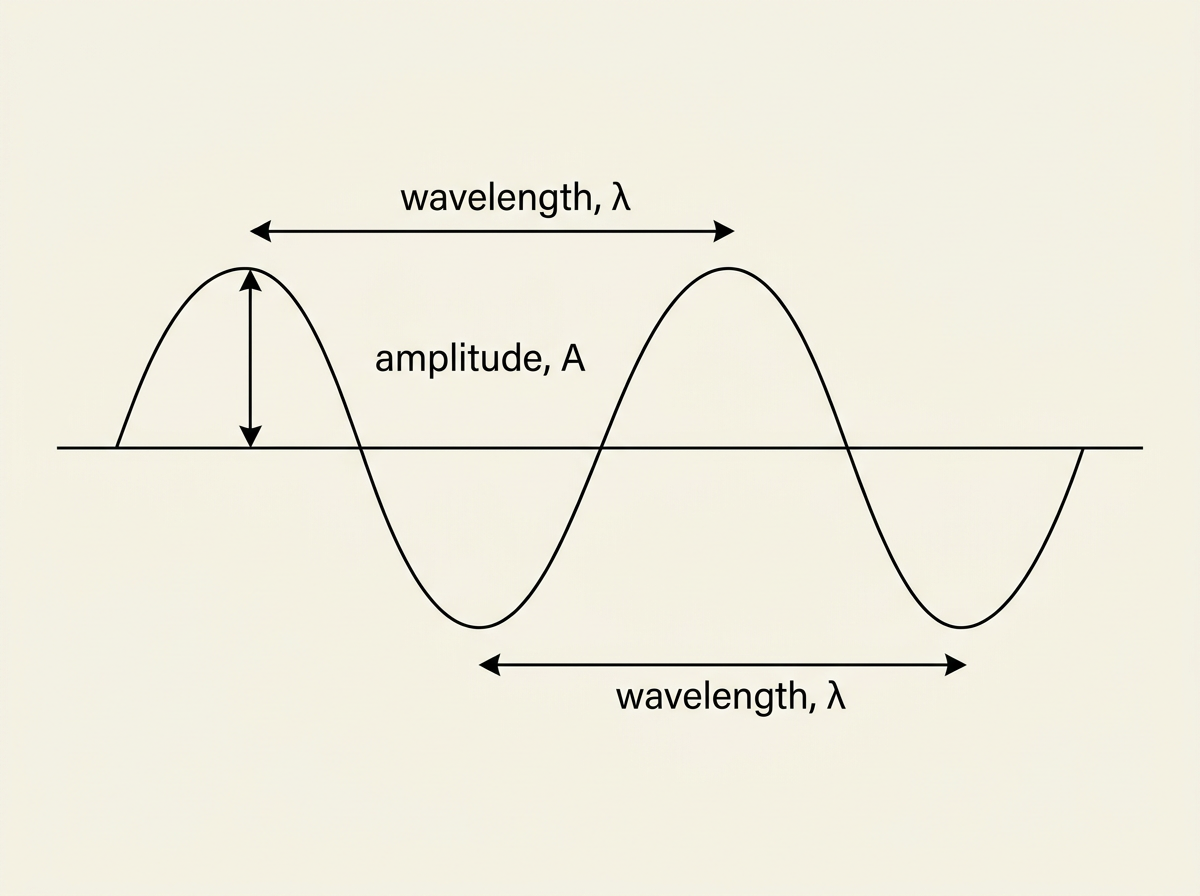
Amplitude, $A$, is the maximum displacement from equilibrium, in metres, always taken as positive.
Period, $T$, is the time for one particle to complete one full cycle, in seconds. Frequency, $f$, is the number of complete oscillations per second, in hertz. They're reciprocals:
Wavelength, $\lambda$, is the distance between two adjacent points oscillating in exact step — from one crest to the next, or one compression to the next.
Wave speed, $c$ (sometimes $v$), is the speed at which the wave pattern itself moves through the medium. Keep it mentally separate from particle speed: the wave pattern can travel at a completely different speed from the up-and-down speed of any individual particle carrying it.
Intensity
A wave carries energy, and intensity, $I$, measures how concentrated that energy flow is — power delivered per unit area, over an area perpendicular to the direction of travel:
where $P$ is power (watts) and $A$ is the cross-sectional area (m2), giving units of W m−2. The same power spread over a smaller area means higher intensity — why a lens focusing sunlight can burn paper without creating extra power.
Intensity depends on amplitude, but not proportionally. Each oscillating particle behaves like a mass on a spring, and the total energy of an oscillator scales with the square of its amplitude. Since intensity measures energy delivered per second, the same relationship carries over:
Doubling amplitude quadruples intensity; tripling it gives nine times the intensity.
This connects to how intensity falls off with distance from a source radiating equally in all directions, like a light bulb. The same total power spreads over the surface of an ever-larger sphere, and since sphere surface area scales with $r^2$, intensity obeys an inverse-square law, $I \propto 1/r^2$. Combined with $I\propto A^2$, amplitude itself falls off as $A \propto 1/r$.
Phase and phase difference
Every particle in a wave goes through the same repeating cycle, just starting at different times, so it's useful to describe where in the cycle a particle currently is. That's what phase describes.
Phase difference compares the stage reached by two different particles. Two particles reaching maximum displacement at the same moment are in phase — phase difference zero (or a whole number of cycles). Two particles that are exact opposites throughout are in antiphase, half a cycle out of step.
Phase difference can be expressed three equivalent ways:
- as a fraction of a cycle — e.g. a quarter of a cycle out of step;
- as an angle in degrees, one full cycle as $360°$ — a quarter cycle is $90°$;
- as an angle in radians, one full cycle as $2\pi$ — a quarter cycle is $\pi/2$.
These describe the same physical gap on different scales, like converting between units for the same length.
Two points on the same wave, one wavelength apart, are always in phase. Two points half a wavelength apart are always in antiphase. More generally, a path difference of $\Delta x$ between two points corresponds to a phase difference of $\dfrac{\Delta x}{\lambda}\times 360°$, or $\dfrac{\Delta x}{\lambda}\times 2\pi$ radians — a relationship that becomes central later in this topic when dealing with interference.
Deriving the wave equation
Wave speed, frequency and wavelength aren't three independent facts about a wave — once you fix any two of them, the third is determined. The relationship between them, the wave equation, falls straight out of their definitions.
This equation connects the four core quantities of any progressive wave, regardless of what the wave is — sound in air, a ripple on water, a radio wave in a vacuum. Given any two of $c$, $f$ and $\lambda$, the third follows immediately.
Frequency is a property of the source, not the medium — a loudspeaker vibrating at 440 Hz produces 440 Hz sound in air, water, or steel. But wave speed depends on the medium, so wavelength must adjust to keep $c = f\lambda$ balanced — why sound changes wavelength (but not pitch) passing from air into a denser material.
Key takeaways
- A progressive wave transfers energy through the oscillation of the particles of a medium (or of oscillating fields, for electromagnetic waves), with no net transfer of matter.
- Amplitude $A$ is the maximum displacement from equilibrium; wavelength $\lambda$ is the distance between two points oscillating in exact step.
- Period and frequency are reciprocals: $f = 1/T$.
- Intensity $I = P/A$ (W m−2) measures power delivered per unit area, and is proportional to amplitude squared, $I \propto A^2$ — doubling amplitude quadruples intensity.
- For a source radiating equally in all directions, intensity follows an inverse-square law, $I \propto 1/r^2$, so amplitude falls off as $A \propto 1/r$.
- Phase difference describes how far out of step two oscillations are, and can be expressed as a fraction of a cycle, in degrees ($360°$ per cycle), or in radians ($2\pi$ per cycle).
- The wave equation $c = f\lambda$ follows directly from the fact that a wave advances one wavelength in each period, combined with $f = 1/T$.
- Frequency is fixed by the source; wave speed depends on the medium; wavelength adjusts to keep $c = f\lambda$ satisfied.