Superposition & Standing Waves
Pluck a guitar string and it doesn't just wobble randomly — it settles into one of a small number of very specific shapes, each with its own fixed pattern of still points and points of maximum motion. That pattern is a standing wave, and it's built entirely from two ordinary progressive waves meeting and adding together.
The principle of superposition
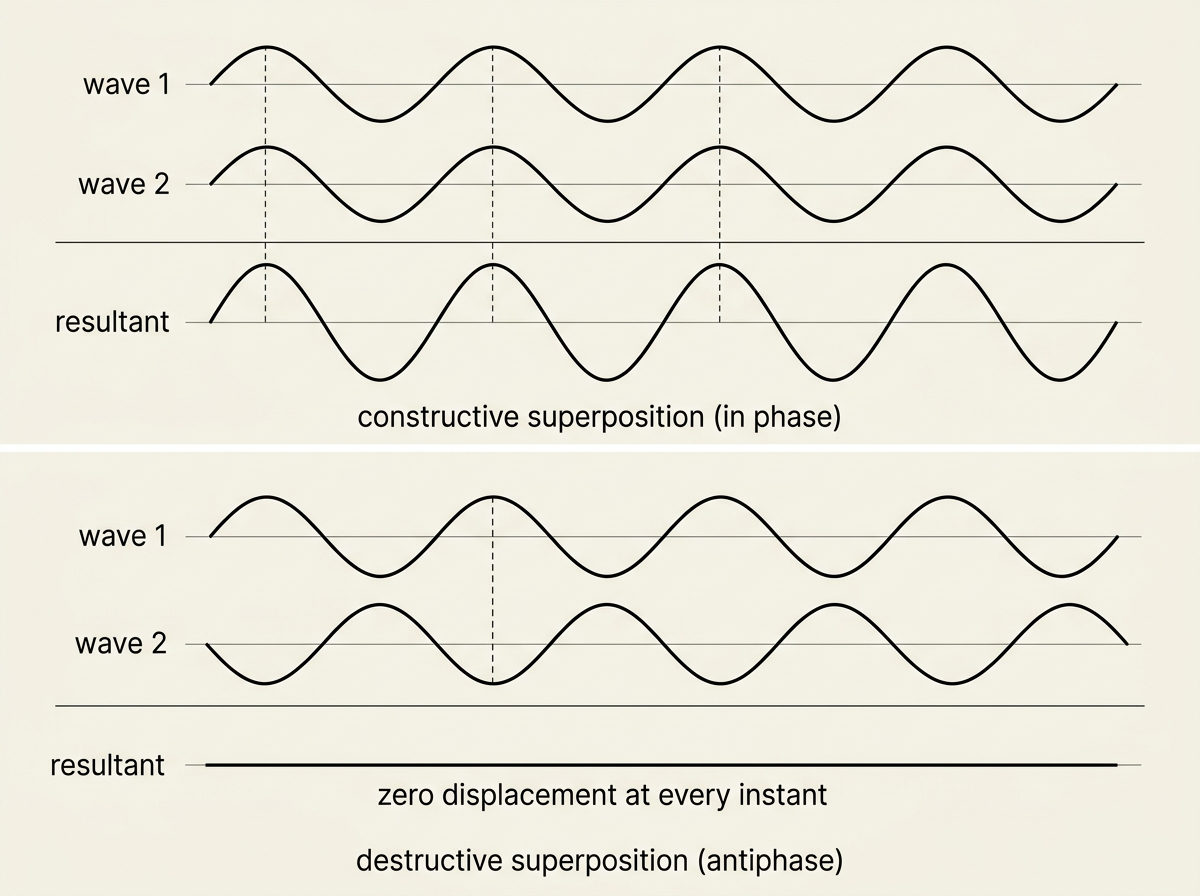
When two or more waves meet at a point, the principle of superposition states that the resultant displacement is the vector sum of the individual displacements each wave would have produced on its own. Where two crests coincide, the displacements add to give a bigger crest; where a crest meets an equal trough, the displacements cancel; anything in between adds algebraically.
This applies no matter how complicated the individual waves are or how many are meeting at once. Once the waves have passed through each other, each continues exactly as if the other had never been there — superposition describes what happens while they overlap, not a permanent change to either wave.
The resultant depends on the phase difference between the two waves. When two waves of equal amplitude are exactly in phase (phase difference $0$, or a whole number of $360°$/$2\pi$ rad), they reinforce at every instant and the resultant amplitude doubles — constructive superposition. When exactly in antiphase (phase difference $180°$/$\pi$ rad), they cancel completely — destructive superposition. Any phase difference in between gives a resultant somewhere between these extremes.
How a stationary wave forms
A stationary (or standing) wave is produced by superposing two progressive waves of the same frequency (and wavelength), travelling through the same region in opposite directions, usually with similar amplitude.
The classic way to produce this on a string is to send a wave down toward a fixed end, which reflects it back with essentially the same frequency and wavelength. Now two waves of equal frequency, travelling in opposite directions, occupy the same string at once, and superposition takes over.
At certain fixed points, the two waves are always in antiphase — a crest of one always arrives when a trough of the other does — so by superposition, the displacement there is always zero. These points are called nodes. Midway between adjacent nodes, the two waves are always in phase, so their displacements reinforce: these antinodes oscillate with maximum amplitude. Everywhere else oscillates somewhere between zero and the maximum.
Adjacent nodes (or adjacent antinodes) are always exactly $\dfrac{\lambda}{2}$ apart.
The result is a pattern that doesn't travel along the string — unlike a progressive wave, no energy is transported from end to end; the pattern oscillates in place. A progressive wave transfers energy from source to destination, while a stationary wave stores it, oscillating locally between fixed nodes.
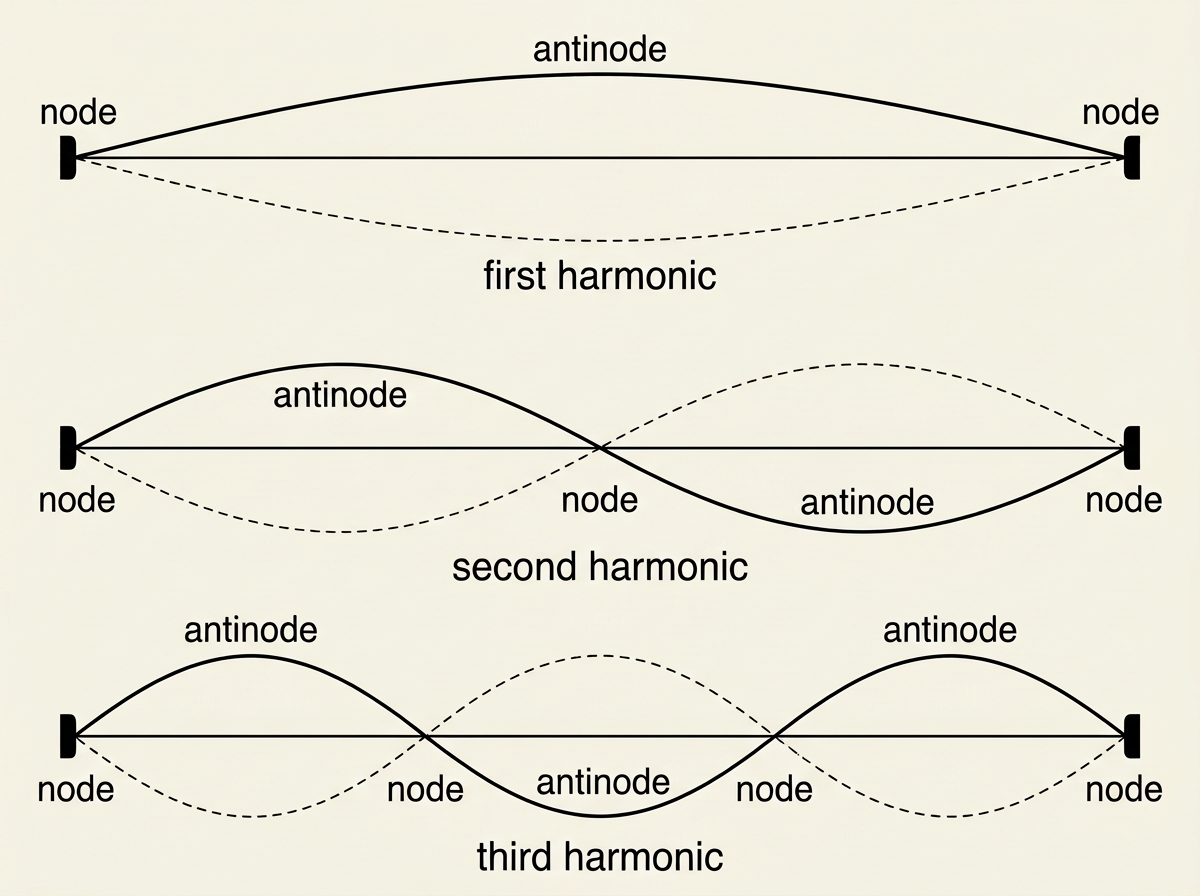
AQA's specification uses only the term harmonics — first harmonic, second harmonic, and so on — not "fundamental frequency" or "overtone." Some other boards use "fundamental" as another name for the first harmonic, but stick to "harmonics" language in AQA answers.
Deriving the first-harmonic frequency
The first harmonic is the simplest standing-wave pattern a stretched string can support: a single loop, with a node at each fixed end and one antinode at the centre — and therefore the lowest possible frequency the string can sustain. The formula for that frequency comes from combining two physical facts.
This formula shows directly why tightening a guitar string raises its pitch (larger $T$, larger $f$), why thicker strings sound lower for the same tension (larger $\mu$, smaller $f$), and why pressing a string shorter raises its pitch (smaller $l$, larger $f$) — all three levers a musician uses are exactly the three variables in this equation.
Required Practical: Stationary Waves on a String
This is AQA's Required Practical 1 (sometimes called Melde's experiment).
Equipment
| Equipment | Purpose |
|---|---|
| Vibration transducer + signal generator | Drives one end of the string at a precisely known, adjustable frequency |
| String or thread | The medium the stationary wave forms on |
| Pulley + clamp | Redirects the string over the bench edge so a mass can hang freely to set the tension |
| Mass hanger + slotted masses | Sets a known tension $T=mg$ in the string |
| Metre ruler | Measures the vibrating length $l$ of the string between nodes |
| Set square | Held against the ruler to read the string's position without parallax error |
| Top-pan balance | Weighs a measured length of the string beforehand to find mass per unit length $\mu$ |
Method
Sources of error and how to minimise them
Reading the ruler from an angle makes the vibrating length appear shorter or longer than it really is. View the ruler at eye level, directly in line with the string, and use a set square held against the string to mark the exact node position.
The pattern grows and shrinks smoothly around resonance rather than switching on sharply, making the "correct" frequency subjective. Sweep slowly past resonance and take the frequency where amplitude is largest and most stable.
A short offcut weighed on the balance may not represent the whole string if it isn't perfectly uniform. Weigh as long a sample as practical, and use the same reel/batch of string for the actual experiment.
Friction at the pulley, or a string not running truly horizontally, makes the tension slightly less than $mg$. Use a low-friction pulley, keep the string horizontal, and let the hanging mass settle before reading.
Key takeaways
- The principle of superposition: where waves meet, the resultant displacement is the vector sum of the individual displacements.
- Two equal-amplitude waves in phase (phase difference $0$) superpose constructively to double the amplitude; in antiphase (phase difference $180°$/$\pi$ rad) they superpose destructively to give zero displacement.
- A stationary wave forms from two waves of the same frequency travelling in opposite directions through the same region, typically via reflection.
- Nodes are fixed points of permanent zero displacement (the two waves are always in antiphase there); antinodes are fixed points of maximum oscillation amplitude (the two waves are always in phase there), midway between adjacent nodes — adjacent nodes are $\lambda/2$ apart, a phase difference of $180°$.
- Unlike a progressive wave, a stationary wave transfers no net energy along its length — the pattern oscillates in place.
- AQA uses only "harmonics" (first harmonic, second harmonic, …) — not "fundamental" or "overtone."
- The first harmonic on a string of length $l$ has $\lambda = 2l$, giving $f = \dfrac{1}{2l}\sqrt{\dfrac{T}{\mu}}$, where $T$ is tension and $\mu$ is mass per unit length.
- Required Practical 1 tests this formula by varying a string's length, tension and mass per unit length in turn and observing the resulting standing-wave frequency.