Interference & Young's Double-Slit Experiment
Shine light through two narrow slits and a screen behind them lights up with evenly spaced bright and dark fringes — one of the most direct pieces of evidence for the wave nature of light. This lesson covers why the pattern appears and how to predict its spacing.
Path difference and coherence
Two waves arriving at the same point have usually travelled different distances to get there. The path difference between them is the difference in the lengths of the two paths, measured in metres or (more often) expressed as a number of wavelengths, since it's the path difference relative to $\lambda$ that matters for interference.
Path difference and phase difference describe the same underlying gap between two waves, just in different units. A path difference of one whole wavelength, $\lambda$, corresponds to a phase difference of one whole cycle — $360°$ or $2\pi$ radians — since the waves are back in step. In general, a path difference of $\Delta x$ corresponds to a phase difference of $\dfrac{\Delta x}{\lambda}\times360°$ (or $\dfrac{\Delta x}{\lambda}\times2\pi$ rad). A path difference of $n\lambda$ therefore always gives a phase difference of $n\times360°$ (the waves are in phase), while a path difference of $(n+\tfrac12)\lambda$ gives a phase difference of $(2n{+}1)\times180°$ (the waves are in antiphase).
Coherence means two waves have the same frequency and a constant phase difference — not necessarily zero, just one that doesn't drift randomly over time. This matters because interference relies on a fixed, reproducible relationship between two waves at every point in space; if the phase difference kept changing randomly, the interference pattern would wash out into a uniform average almost instantly.
Two independent, ordinary light sources are never coherent with each other — each emits light in short, random bursts with no fixed phase relationship between them, which is why two separate light bulbs never produce a visible interference pattern. A laser solves this: it produces light very close to a single frequency (monochromatic) and highly coherent along its beam, making it ideal for demonstrating interference and diffraction.
Young's double-slit experiment
Thomas Young's experiment produces two coherent sources from a single source of light, sidestepping the problem of finding two naturally coherent sources. Monochromatic light (from a laser, or a single source passed through a narrow slit first) is directed at a barrier with two narrow, closely spaced parallel slits. Because both slits are illuminated by the same wavefront, light leaving them stays in phase (or at a constant phase difference) — each slit acts as a coherent secondary source derived from the same original wave.
Beyond the slits, light from each spreads out by diffraction and overlaps. Where a screen catches that overlapping light, an interference pattern appears: bright fringes (constructive interference) separated by dark fringes (destructive interference), evenly spaced along the screen.
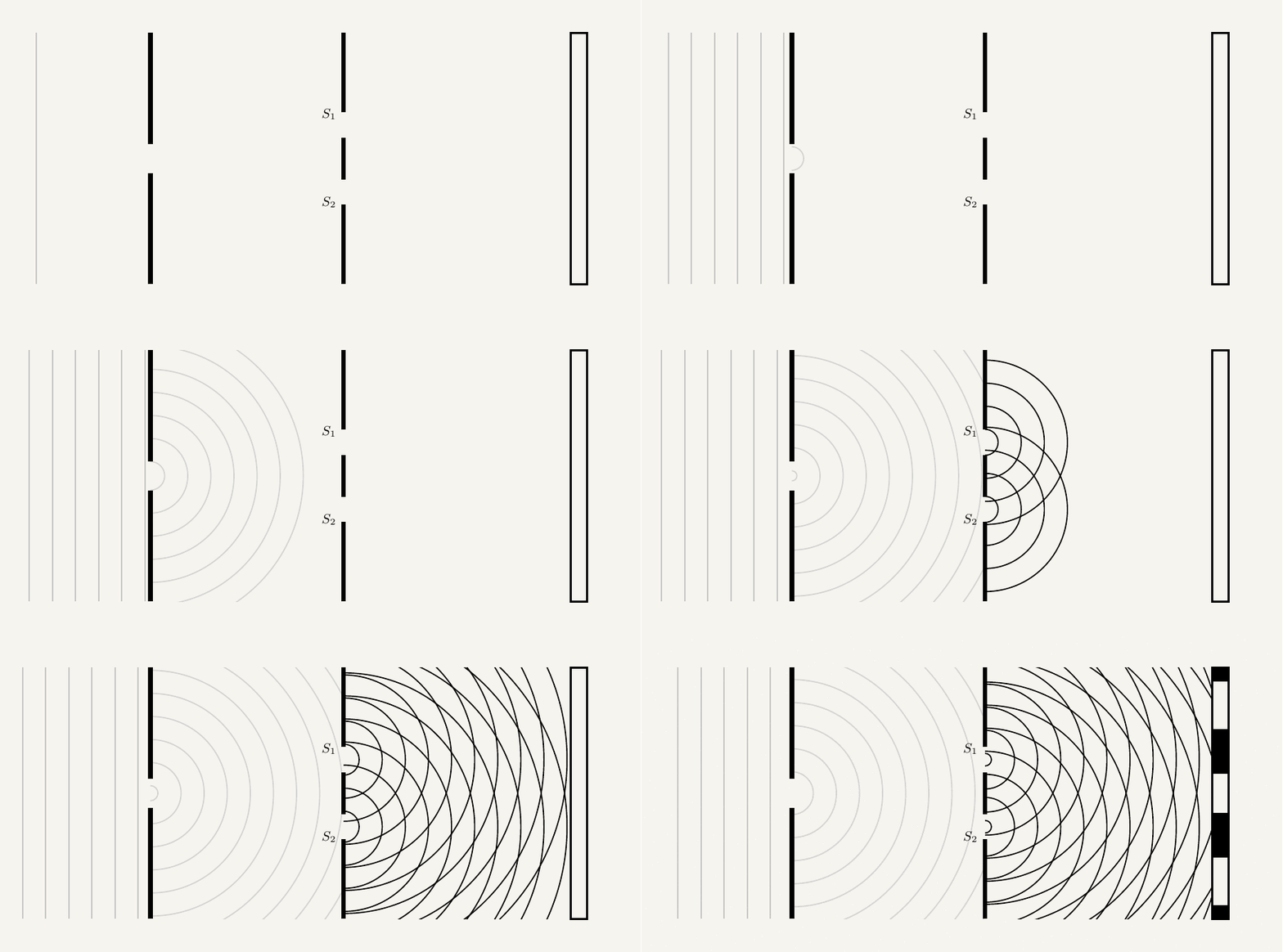
The pattern arises directly from path difference. At a point equally distant from both slits, light from both arrives in phase — a bright fringe sits directly opposite the midpoint of the two slits. Moving away from that central point, the path difference grows steadily, and with it the phase difference between the two waves arriving there. Wherever the path difference equals a whole number of wavelengths ($0, \lambda, 2\lambda, \dots$), the phase difference is a whole number of cycles ($0°, 360°, 720°, \dots$), so the waves arrive in phase again, giving another bright fringe. Wherever the path difference equals a whole number plus a half ($\tfrac12\lambda, \tfrac32\lambda,\dots$), the phase difference is an odd number of half-cycles ($180°, 540°,\dots$), so the waves arrive in antiphase and cancel, giving a dark fringe.
Deriving the fringe-spacing equation
For slits close together compared with their distance to the screen, the spacing between adjacent bright fringes depends on just three quantities.
Here $w$ is the fringe spacing (the distance between adjacent bright, or adjacent dark, fringes), $\lambda$ is the wavelength of the light, $D$ is the distance from the slits to the screen, and $s$ is the separation between the two slits. Because $D$ can be measured accurately and easily made large, and $w$ can be measured directly off the screen, this equation is routinely rearranged to $\lambda = ws/D$ to find the wavelength of light from measurements of the fringe pattern — one of the most direct ways of measuring the wavelength of visible light.
Repeating the experiment with white light still produces an interference pattern, but the fringes look different. Every wavelength in white light produces its own fringe pattern, and since $w=\lambda D/s$, each gives a different spacing. All wavelengths coincide at the central fringe (zero path difference works for every wavelength), so it stays sharp and white. Moving outward, the fringes for different colours drift out of step and overlap, blurring into smears of colour rather than crisp bands.
Required Practical: Interference Effects (Young's Double Slit and Diffraction Grating)
This is AQA's Required Practical 2: measuring the wavelength of light using double-slit interference and/or a diffraction grating.
Equipment
| Equipment | Purpose |
|---|---|
| Laser (low-power, class 2) | Coherent, monochromatic light source needed for a stable interference/diffraction pattern |
| Double slit (known slit separation $s$) | Splits the beam into two coherent secondary sources |
| Diffraction grating (known lines per mm) | Produces sharply defined maxima at angles set by $d\sin\theta=n\lambda$ |
| Screen | Displays the fringe or diffraction pattern for measurement |
| Metre ruler / tape measure | Measures the slit-to-screen or grating-to-screen distance $D$ |
| Vernier calipers or travelling microscope | Measures fringe spacing precisely, across several fringes at once |
| Retort stands and clamps | Hold the laser, slit/grating and screen rigidly in line |
| Laser safety goggles | Eye protection appropriate to the laser class in use |
Method
Sources of error and how to minimise them
A single fringe spacing is small and hard to measure precisely by eye, so a small absolute error in reading it becomes a large percentage error. Measuring across several fringes and dividing by the number of gaps spreads the same absolute reading error over a much larger distance, reducing the percentage uncertainty.
Measure $D$ directly with a tape measure from the plane of the slits/grating to the screen, keeping the whole setup rigidly clamped so nothing shifts between setting up and measuring the pattern.
Bright room lighting makes low-intensity outer fringes hard to see and measure accurately. Dim the room, or shield the screen, to improve contrast.
Because lasers are used directly as a coherent light source in this practical, never look directly into the beam or its reflections, keep the beam below eye level at all times, use the lowest laser class that will do the job, and warn anyone else in the room before switching it on.
Key takeaways
- Path difference is the difference in distance travelled by two waves reaching the same point; a path difference of $\Delta x$ corresponds to a phase difference of $(\Delta x/\lambda)\times360°$. Coherence means constant frequency and constant phase difference.
- A laser provides a monochromatic, coherent source ideal for demonstrating interference and diffraction.
- Young's double-slit experiment uses a single wavefront split by two slits to create two coherent secondary sources, producing an interference pattern on a screen.
- Bright fringes occur where the path difference is a whole number of wavelengths ($n\lambda$, i.e. a phase difference of $n\times360°$); dark fringes occur where it's a whole number plus a half ($(n+\tfrac12)\lambda$, i.e. a phase difference of an odd multiple of $180°$).
- Fringe spacing follows $w = \lambda D/s$, derived from small-angle path-difference geometry — rearranged, this gives a direct way to measure the wavelength of light.
- With white light, the central fringe stays white and sharp, but outer fringes blur into colour because each wavelength has a different fringe spacing.
- Required Practical 2 investigates interference using Young's slits and a diffraction grating; laser safety (never view the beam directly) applies throughout.