Particles, Antiparticles & Photons
Every particle of matter has a mirror-image counterpart made of the same stuff but opposite in charge. This lesson sets out what an antiparticle is, how photons fit into the particle picture of light, and what happens when matter and antimatter meet.
Antiparticles
For every type of particle, there exists a corresponding antiparticle. An antiparticle has exactly the same mass as its particle, and therefore the same rest energy, but has properties like charge that are exactly reversed. The four antiparticles required at this level, alongside the particles they correspond to, are:
| Particle | Antiparticle | Charge (particle → antiparticle) |
|---|---|---|
| Electron | Positron | $-1 \rightarrow +1$ |
| Proton | Antiproton | $+1 \rightarrow -1$ |
| Neutron | Antineutron | $0 \rightarrow 0$ |
| Neutrino | Antineutrino | $0 \rightarrow 0$ |
Even the two neutral particles — the neutron and neutrino — have genuinely distinct antiparticles, despite no charge to reverse. What flips instead is lepton number (for the neutrino) or baryon number (for the neutron): "no charge" doesn't mean "no antiparticle."
| Particle / antiparticle pair | Mass | Rest energy |
|---|---|---|
| Electron / positron | $9.11\times10^{-31}\,\text{kg}$ (equal) | $0.511\,\text{MeV}$ (equal) |
| Proton / antiproton | $1.673\times10^{-27}\,\text{kg}$ (equal) | $938\,\text{MeV}$ (equal) |
A particle and its antiparticle always have identical mass and therefore identical rest energy. What's opposite is charge (where the particle is charged at all) and certain other quantum properties. They are not "the same particle with a minus sign" in every respect — only in the properties that can meaningfully be reversed.
Every major specification requires the same four antiparticle pairs above. Charge-to-mass ratio may be called "specific charge" (the AQA term) — same idea, different framing.
Rest energy and mass-energy equivalence
Mass itself is a form of energy — a particle at rest still represents a store of energy simply by having mass. This is why particle masses above are quoted in MeV as well as kilograms: a particle's rest energy is the energy equivalent of its mass, the natural unit for comparing particles once you start considering particles being created or destroyed. You don't need to calculate with the mass-energy relationship directly at this level — what matters is the concept: every particle's mass corresponds to a definite quantity of energy, allowing mass to convert into other forms of energy and back, in the processes described later.
The photon model of electromagnetic radiation
Electromagnetic radiation can be modelled as a stream of discrete packets of energy called photons, rather than only as a continuous wave. Each photon carries energy fixed by the frequency of the radiation:
where $h$ is the Planck constant, $h = 6.63\times10^{-34}\,\text{J s}$, and $f$ is the frequency in hertz. Higher-frequency radiation — gamma rays, X-rays — is made of individually more energetic photons than lower-frequency radiation such as radio waves, even though both travel at the same speed.
Both forms describe the same quantity — the energy of a single photon — expressed using whichever of frequency or wavelength is given. Higher frequency means shorter wavelength (since $c$ is fixed), and both point toward higher photon energy.
Annihilation
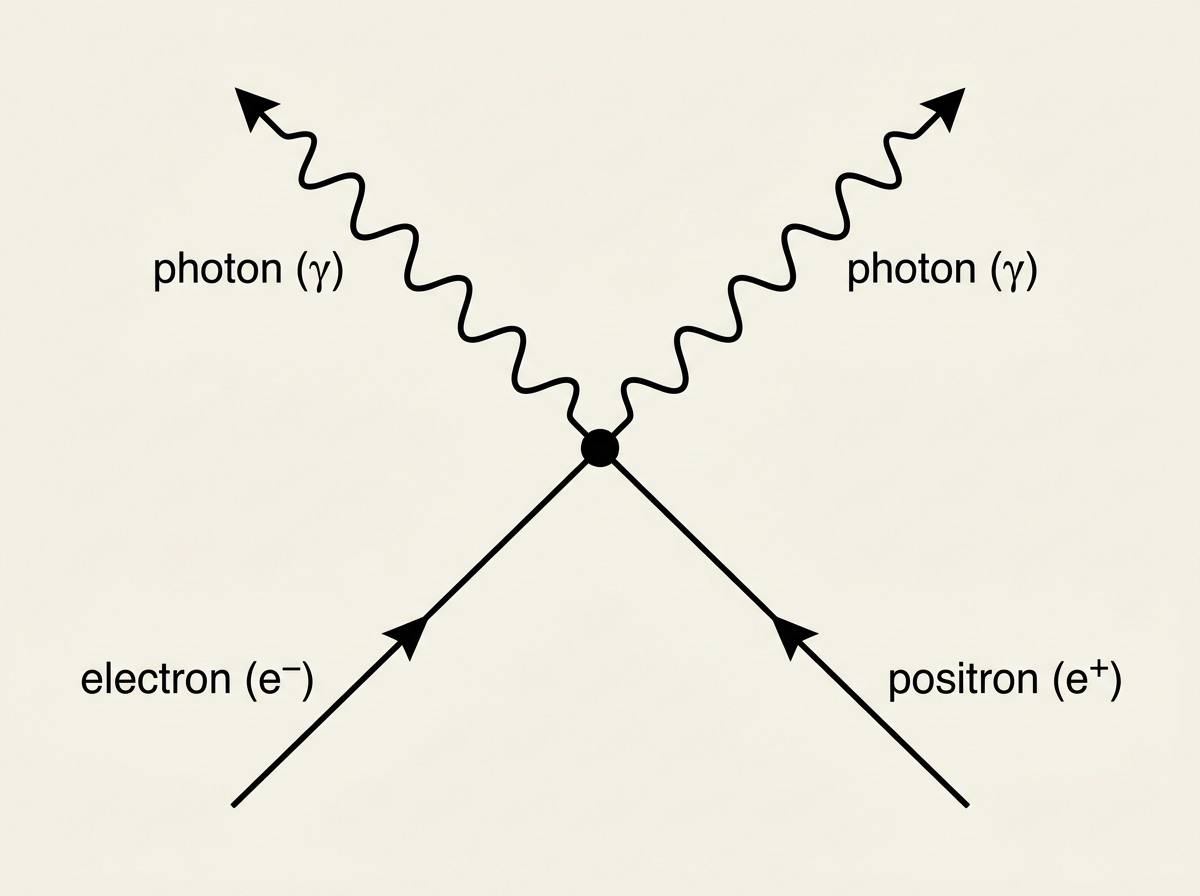
When a particle meets its own antiparticle, the two can undergo annihilation: both particles disappear entirely, and their combined mass is converted into energy, released as electromagnetic radiation.
This is why electron–positron annihilation is written as $e^- + e^+ \rightarrow \gamma + \gamma$, with two photons rather than one — forced by momentum conservation whenever the annihilating particles have negligible momentum beforehand.
Annihilation is drawn differently from the exchange-particle diagrams met in the next lesson, which show a force acting between two separate particles at two separate vertices. Annihilation is a direct conversion, not a force: the incoming electron and positron lines run into a single shared vertex, and the two outgoing photon lines emerge from that same point — one vertex, not two, since there's no go-between particle here, just matter turning directly into radiation.
Pair production
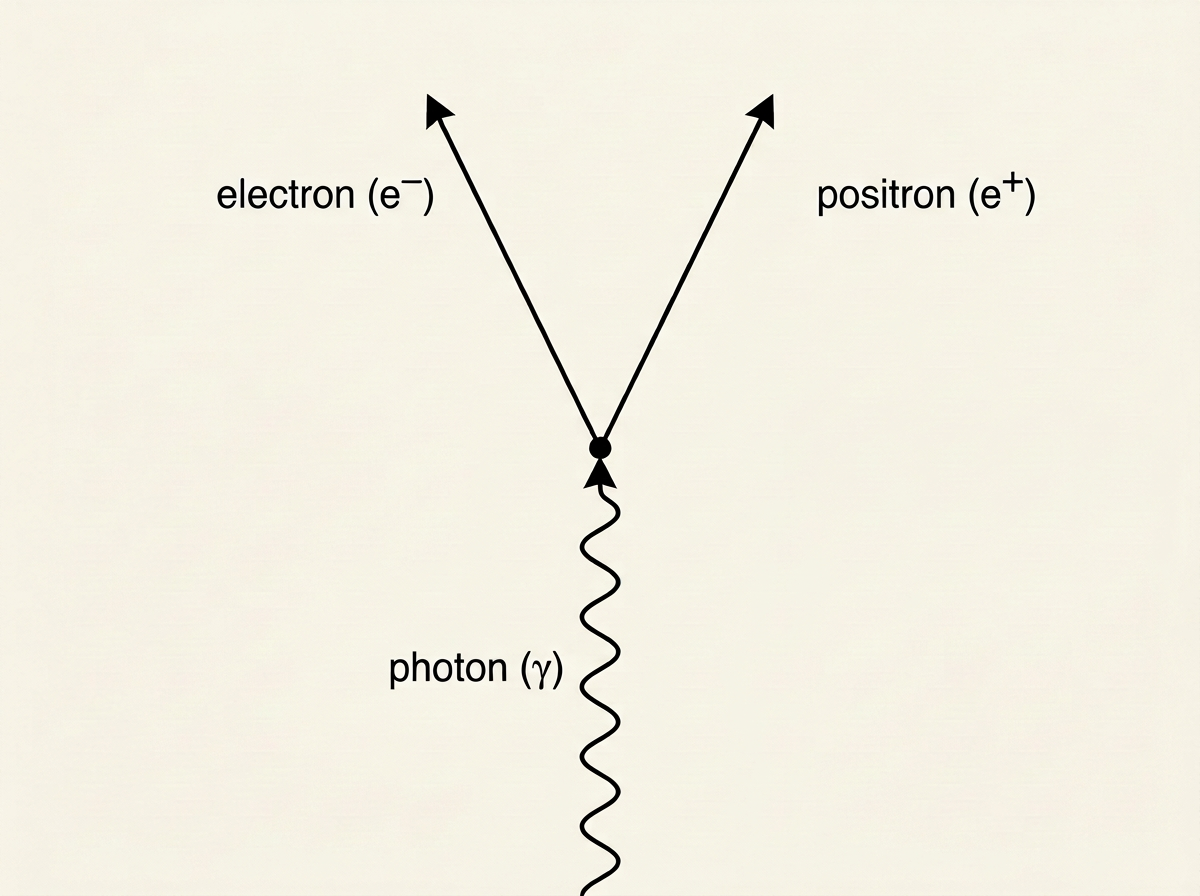
Pair production is the reverse process: a single photon, if it carries enough energy, converts into a particle–antiparticle pair, e.g. $\gamma \rightarrow e^- + e^+$. Since a particle and its antiparticle have equal mass and thus equal rest energy, the photon must supply at least enough energy for the combined rest energy of both particles — the minimum, called the threshold energy. A photon below threshold cannot produce the pair; above threshold, the surplus appears as kinetic energy shared between the two new particles.
A lone photon in empty space cannot convert into a particle–antiparticle pair, even with enough energy, because — as with annihilation — momentum conservation gets in the way: the pair would carry away momentum, but the single incoming photon's momentum can't match it while also satisfying energy conservation. In practice, pair production happens near a nucleus, which absorbs a small amount of momentum, letting both conservation laws be satisfied together.
Key takeaways
- Every particle has an antiparticle with identical mass (and rest energy) but opposite charge and other reversed properties; the four required pairs are electron/positron, proton/antiproton, neutron/antineutron, neutrino/antineutrino.
- Mass and energy are equivalent — every particle's mass corresponds to a rest energy, usually quoted in MeV, though $E=mc^2$ itself isn't required for calculation at this level.
- The photon model treats EM radiation as discrete energy packets: $E = hf = \dfrac{hc}{\lambda}$, using $c = f\lambda$ to connect the two forms. E.g. a 650 nm red-light photon carries $E = 3.06\times10^{-19}\,\text{J} \approx 1.91\,\text{eV}$.
- Annihilation: particle + antiparticle → (usually two) photons; two photons are needed (not one) so that momentum, as well as energy, can be conserved when the initial particles have negligible momentum.
- Pair production: a sufficiently energetic photon → particle + antiparticle, requiring at least the threshold energy equal to the pair's combined rest energy, and typically needs a nearby nucleus to conserve momentum.
- Both are drawn as single-vertex interaction diagrams (matter converting directly to radiation, or radiation to matter) — a different shape from the two-vertex exchange-particle diagrams met in the next lesson, since no force-carrying go-between particle is involved.