Stable & Unstable Nuclei
Packing several positively charged protons into a space a few femtometres across ought to be impossible — like-charges repel each other ferociously at that range. Something else has to be holding the nucleus together, and understanding what that something is, and why it sometimes fails, is the subject of this lesson.
The problem: electrostatic repulsion inside the nucleus
Protons all carry the same positive charge, and by Coulomb's law, like charges pushed this close together — separated by only a few femtometres ($1\,\text{fm} = 10^{-15}\,\text{m}$) — repel each other with enormous force. Gravity between nucleons is far too weak to counteract this, smaller by a factor of roughly $10^{36}$. If electrostatic repulsion and gravity were the only forces at play, no nucleus with more than one proton could hold together. Since stable multi-proton nuclei plainly exist, there must be a third force — one acting only between nucleons, over the tiny distances inside a nucleus.
The strong nuclear force
The strong nuclear force binds nucleons together against their mutual electrostatic repulsion. It has two properties that make it very different from gravity or the electrostatic force.
Below about $0.5\,\text{fm}$ separation, the strong force is strongly repulsive, preventing nucleons from being crushed into one another. Between about $0.5\,\text{fm}$ and $3\,\text{fm}$, it is strongly attractive, overpowering electrostatic repulsion and holding nucleons together. Beyond about $3\,\text{fm}$, it falls away to essentially zero — the strong force has no effect at all on nucleons that aren't practically touching.
Plotted against separation: the force starts large and repulsive at very small separations, then past around $0.5\,\text{fm}$ rapidly switches sign, becoming attractive and growing in strength before reaching its most attractive point, then weakening steadily and falling to zero by around $3\,\text{fm}$. This shape — repulsive at very short range, attractive at intermediate range, negligible beyond a few femtometres — is what makes the strong force fundamentally different from gravitational or electrostatic forces, both of which act (weakly) out to infinite range.
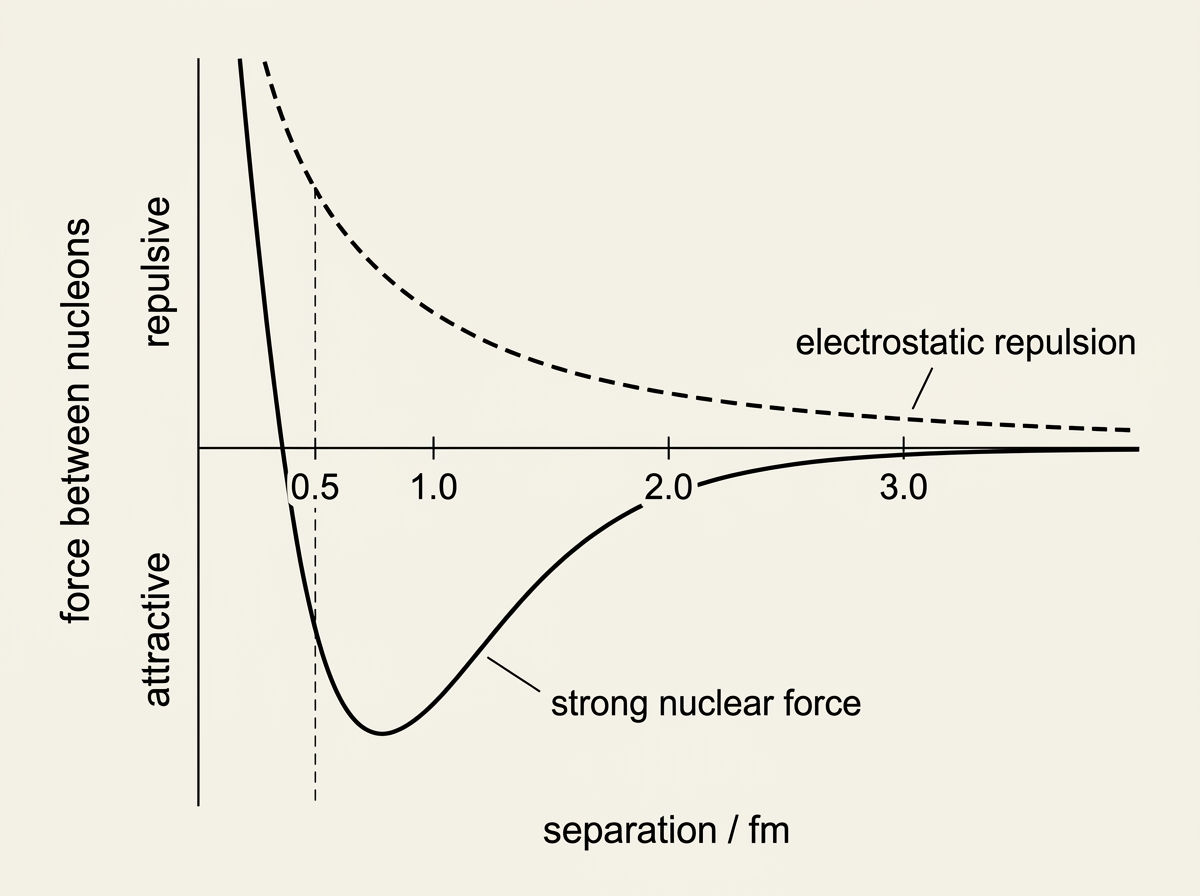
Because the strong force only acts between immediate neighbours, adding more and more protons (each repelling every other proton, at any distance) eventually outpaces the short-range binding available. This is part of why very heavy nuclei tend to be unstable: electrostatic repulsion, summed over many proton pairs, starts to win against a strong force that can only bind close neighbours.
Alpha decay
An unstable nucleus can shed excess mass and charge by emitting an alpha particle — a helium-4 nucleus, two protons and two neutrons bound together, written $^{4}_{2}\alpha$ or $^{4}_{2}\text{He}$. The general equation for alpha decay of a parent nucleus X, producing a daughter nucleus Y, is:
Nucleon number and proton number are both conserved: nucleon number drops by 4, proton number by 2, matching what the alpha particle carries away. Alpha decay tends to occur in very heavy, proton-rich nuclei, where shedding a compact chunk of two protons and two neutrons reduces both nucleon number and destabilising electrostatic repulsion in one step.
Beta-minus decay
Many unstable nuclei instead have too many neutrons relative to protons for stability. These typically undergo beta-minus decay, in which a neutron transforms into a proton, emitting an electron (the beta-minus particle, $^{0}_{-1}\beta$ or $^{0}_{-1}e$) and an antineutrino, $^{0}_{0}\bar\nu_e$:
Applied to a whole nucleus, this raises the proton number by one while leaving the nucleon number unchanged, since a neutron simply becomes a proton within the same nucleus:
Why the neutrino had to be hypothesised
Beta decay wasn't always written with a neutrino in it. Early experiments measured the kinetic energy of emitted electrons and found something troubling: rather than a fixed value, the electrons emerged with a continuous range of energies, from nearly zero up to some maximum.
Proton-rich nuclei can undergo the mirror-image process, beta-plus decay, in which a proton transforms into a neutron, emitting a positron and a neutrino: $^{1}_{1}\text{p} \rightarrow {}^{1}_{0}\text{n} + {}^{0}_{+1}\beta^{+} + {}^{0}_{0}\nu_e$. The same energy-sharing argument applies. Applied to a whole nucleus, the general nuclide equation is the mirror image of the beta-minus case, with proton number falling by one instead of rising:
Alpha, beta and gamma radiation compared
Alpha and beta decay both leave the daughter nucleus in an excited state more often than not — the rearrangement of nucleons releases more energy than the emitted particle alone carries away. A nucleus in an excited state sheds this surplus energy by emitting a gamma ray: a high-energy photon, with no charge and no mass. Since gamma emission is a purely electromagnetic process, not a rearrangement of nucleons, it changes neither proton number nor nucleon number, which is why it's written as accompanying an alpha or beta decay rather than as its own nuclide equation.
Alpha, beta and gamma radiation differ enormously in how strongly they interact with matter, governing how far they travel and how they respond to fields:
| Property | Alpha (α) | Beta-minus (β⁻) | Gamma (γ) |
|---|---|---|---|
| Nature | Helium nucleus, $^{4}_{2}\text{He}$ | Fast electron, $^{0}_{-1}\text{e}$ | High-energy EM photon |
| Charge | $+2$ | $-1$ | $0$ |
| Ionising power | Very strong | Moderate | Weak |
| Range in air | A few cm | ~1 m | Effectively unlimited (intensity falls, never reaches zero) |
| What stops it | A sheet of paper | A few mm of aluminium | Thick lead or many cm of concrete (never fully "stopped", only attenuated) |
| In electric/magnetic fields | Deflects slightly (large mass) | Deflects strongly, opposite sense to α (tiny mass) | No deflection (uncharged) |
Key takeaways
- Electrostatic repulsion between protons would make any multi-proton nucleus fly apart if it were the only force at play — a third, much stronger, short-range force must be responsible for holding nuclei together.
- The strong nuclear force is repulsive below about 0.5 fm (preventing collapse), attractive between about 0.5 fm and 3 fm (providing binding), and negligible beyond about 3 fm.
- A nucleus is stable when nucleon separations settle in the attractive region, balanced between the short-range repulsive core and the falloff of attraction at larger separation.
- Alpha decay: $^{A}_{Z}\text{X} \rightarrow {}^{A-4}_{Z-2}\text{Y} + {}^{4}_{2}\alpha$ — nucleon number falls by 4, proton number falls by 2.
- Beta-minus decay: $^{A}_{Z}\text{X} \rightarrow {}^{A}_{Z+1}\text{Y} + {}^{0}_{-1}\beta + {}^{0}_{0}\bar\nu_e$ — a neutron becomes a proton, proton number rises by 1, nucleon number unchanged.
- Beta-plus decay: $^{A}_{Z}\text{X} \rightarrow {}^{A}_{Z-1}\text{Y} + {}^{0}_{+1}\beta^{+} + {}^{0}_{0}\nu_e$ — a proton becomes a neutron, proton number falls by 1, nucleon number unchanged.
- Gamma radiation is a photon emitted as an excited nucleus (typically left behind after alpha or beta decay) de-excites — it changes neither $A$ nor $Z$. Compared with alpha and beta, gamma has the weakest ionising power but the greatest range, and (being uncharged) is undeflected by electric or magnetic fields, unlike alpha and beta which deflect in opposite directions.
- Specific charge of an alpha particle $= \dfrac{2\times1.60\times10^{-19}}{6.646\times10^{-27}} = 4.82\times10^{7}\,\text{C}\,\text{kg}^{-1}$ — smaller than a lone proton's despite the doubled charge, because the mass increase (×4) dominates.
- The continuous energy spectrum of emitted beta electrons couldn't be explained by a simple two-body decay, which would fix a single definite electron energy — this is why the (anti)neutrino had to be hypothesised, to preserve conservation of energy and momentum by sharing the released energy between two particles in a varying proportion.