Fundamental Forces & Exchange Particles
Every force in nature, however different it looks on the surface, reduces to just four fundamental interactions. This lesson introduces those four forces and the exchange-particle model used to explain how two particles, with nothing physically connecting them, can push or pull on each other at all.
The four fundamental interactions
Every force you'll ever meet in physics — friction, tension, the force between magnets, the pull of gravity, the force that binds a nucleus together — is, at the deepest level, one of just four fundamental interactions:
- Gravity — acts between anything with mass, always attractive, infinite range, but by far the weakest of the four at the scale of individual particles.
- Electromagnetic force — acts between anything with electric charge, attractive or repulsive, infinite range.
- Weak nuclear force — responsible for certain types of radioactive decay and particle interactions, extremely short range.
- Strong nuclear force — binds nucleons together inside the nucleus (met in an earlier lesson), short range.
At the particle scale, gravity is so much weaker than the other three that it's essentially never considered in particle interactions — it only becomes significant when enormous numbers of particles act together, as in a planet or a person.
The exchange-particle model
It's natural to ask how two particles can exert a force on each other when there's genuinely nothing material connecting them — no rod, no string, no direct contact. The model used in particle physics answers this by saying that a force between two particles is the result of a third particle being exchanged between them: emitted by one, and absorbed by the other. These go-between particles are called exchange particles (or gauge bosons, or virtual particles).
A rough mental picture — not a perfect analogy, but a useful starting point — is two people on ice skates throwing a heavy ball back and forth. Throwing the ball pushes the thrower backwards; catching it pushes the catcher backwards too. Without ever touching each other, the two skaters drift apart purely through the act of exchanging something between them. Real exchange particles can produce both repulsive and attractive effects depending on the interaction, so the skater picture only captures part of the story, but the core idea carries over: a force arises from the emission and absorption of a go-between particle, not from direct contact.
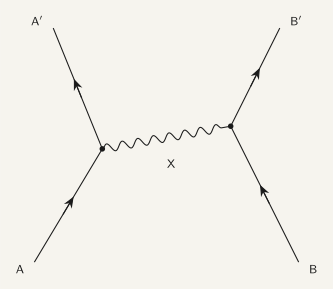
These interactions are often drawn as a simple diagram: two incoming particles enter from one side, a vertex marks the point where an exchange particle is emitted by one incoming particle and absorbed by the other, and two outgoing particles leave from the other side. The exchange particle itself is drawn as a short internal line connecting the two "arms" of the diagram — it is never one of the particles that enters or leaves the interaction from outside, only the go-between that passes across it.
The electromagnetic force: the virtual photon
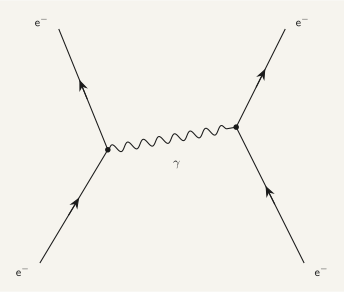
The exchange particle for the electromagnetic force is the virtual photon. Two charged particles — two electrons, say — repel each other by continuously exchanging virtual photons between them. The word "virtual" distinguishes these from the real, observable photons of light met in the previous lesson: a virtual photon exists only fleetingly, as the go-between of the interaction, and is never directly detected the way a real photon can be.
Drawn as an interaction diagram, it follows the same layout as the generic vertex diagram above, with an electron on each incoming and outgoing line. Nothing about either electron changes at its vertex except direction of travel, and the virtual photon carries no charge of its own, so charge is conserved at both vertices individually. It's this exchanged momentum, not any direct contact between the two electrons, that produces the repulsive force each one feels.
The strong nuclear force: the gluon
The exchange particle for the strong nuclear force is the gluon. At this level, you're only required to know its name and that it is the strong force's exchange particle — the details of how gluons act between the quarks inside protons and neutrons go beyond what's needed here.
Some specifications introduce the pion as an exchange particle for the strong force acting between nucleons (i.e. holding the nucleus together as a whole), as distinct from the gluon, which acts at a deeper level between the quarks inside each individual nucleon. If your course or exam board mentions pions in this context, treat it as a complementary description at a different scale, not a contradiction — the gluon is the fundamental exchange particle of the strong interaction, while the pion is a composite particle whose exchange gives a useful effective description of the force between whole nucleons.
The weak interaction: W⁺ and W⁻
The weak interaction is responsible for a specific set of processes: beta-minus decay, beta-plus decay, electron capture, and electron–proton collisions. Its exchange particles are the W⁺ and W⁻ bosons (collectively, W bosons).
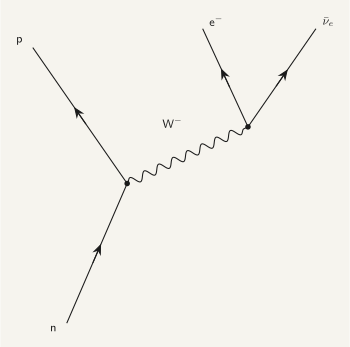
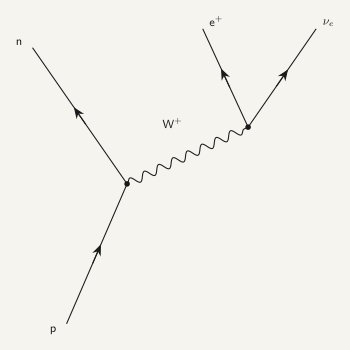
Beta-minus decay, met in an earlier lesson, can be redrawn as an exchange-particle interaction: a neutron emits a W⁻ boson and becomes a proton; the W⁻ boson is short-lived and immediately decays into an electron and an antineutrino, which are what's actually observed leaving the nucleus. Beta-plus decay works the same way with a W⁺ boson: a proton emits a W⁺ and becomes a neutron, and the W⁺ decays into a positron and a neutrino.
Notice this isn't the same layout as the generic exchange diagram or the electron–electron repulsion diagram above, where two separate incoming particles each have their own vertex. Beta decay starts from a single incoming particle (a neutron, or a proton) that transforms into a single outgoing particle at one vertex, emitting a W boson along the way; that W boson then reaches a second vertex on its own and splits into the two particles that are actually detected leaving the nucleus. It's a branching, one-particle-in shape, not a two-particles-meeting shape.
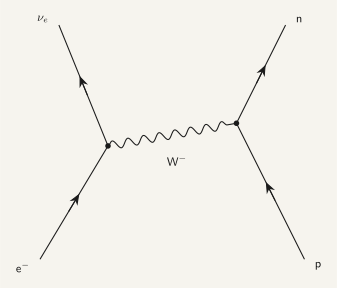
A third named weak-interaction process is electron capture, in which a proton-rich nucleus captures one of its own inner-shell electrons: the electron and a proton combine directly to form a neutron, releasing a neutrino:
Written as an exchange-particle interaction, the incoming electron emits a W⁻ boson which is absorbed by the proton, converting it to a neutron, while the electron itself is absorbed into the vertex and the neutrino is released — equivalently, you can think of the electron and proton exchanging a W boson between them. Unlike beta decay, this one goes back to the two-separate-incoming-particles shape: the electron has its own vertex, the proton has its own vertex, and the W⁻ passes between them. Electron capture has the same overall effect on the nucleus as beta-plus decay — proton number falls by one, nucleon number is unchanged — which is why the two processes often compete with each other in the same proton-rich nuclides.
| Interaction | Exchange particle(s) | Example process |
|---|---|---|
| Electromagnetic | Virtual photon | Repulsion between two electrons |
| Strong nuclear | Gluon | Binding of nucleons in a nucleus |
| Weak nuclear | W⁺, W⁻ | β⁻ decay, β⁺ decay, electron capture |
A quick way to check which W boson is involved: track the charge. In β⁻ decay a neutron (charge 0) becomes a proton (charge +1), so a negative W⁻ must be emitted to keep total charge balanced at the vertex. In β⁺ decay a proton (charge +1) becomes a neutron (charge 0), so a positive W⁺ must be emitted. Charge conservation at every vertex is one of the most reliable checks you have when reasoning through any exchange-particle interaction.
Key takeaways
- All forces reduce to four fundamental interactions: gravity, electromagnetic, weak nuclear, and strong nuclear.
- The exchange-particle model explains a force as the emission and absorption of a virtual (exchange) particle passed between two interacting particles.
- An interaction diagram shows incoming particles meeting at a vertex, an exchange particle passing across that vertex, and outgoing particles leaving — the exchange particle never appears as an incoming or outgoing line itself.
- The electromagnetic force's exchange particle is the virtual photon.
- The strong nuclear force's exchange particle is the gluon (name only, at this level); some boards additionally name the pion as the exchange particle acting between whole nucleons.
- The weak interaction (β⁻ decay, β⁺ decay, electron capture, electron–proton collisions) has exchange particles W⁺ and W⁻; the sign of the W boson emitted follows from conservation of charge at the vertex. Electron capture, $\text{p} + \text{e}^{-} \rightarrow \text{n} + \nu_e$, has the same effect on the nucleus as β⁺ decay.
- Two distinct interaction-diagram shapes appear in this lesson: a "two separate incoming particles" shape (electron–electron repulsion, electron capture), and a "single particle branches into two" shape (β⁻ and β⁺ decay) — the difference reflects whether one particle or two particles are present before the interaction.