Work, Energy & Power
Push a stalled car and you're doing work. Stand and push against a brick wall until your arms shake, and — according to physics, however unfair it feels — you've done no work at all. This lesson pins down exactly what "work" means in physics, and follows it through to energy and power, the two ideas built directly on top of it.
Defining work done
Work is the amount of energy transferred when a force moves an object. In physics, work is done whenever a force causes a displacement — and the precise amount depends not just on how big the force is and how far the object moves, but on the angle between them. The general definition is:
where $F$ is the force, $s$ is the displacement, and $\theta$ is the angle between the direction of the force and the direction of the displacement. Work is measured in joules (J), and despite being built from a force and a displacement — both vectors — work itself is a scalar: it has a size but no direction.
This is counter-intuitive at first. Carry a heavy suitcase at constant height across a level floor and it feels like work, but the force you exert (upward, supporting its weight) is perpendicular to the direction you're moving (horizontal), so by this definition you're doing zero work on the suitcase. That effort goes into muscle tension and heat, none of which counts as mechanical work on the case.
Work from a force-displacement graph
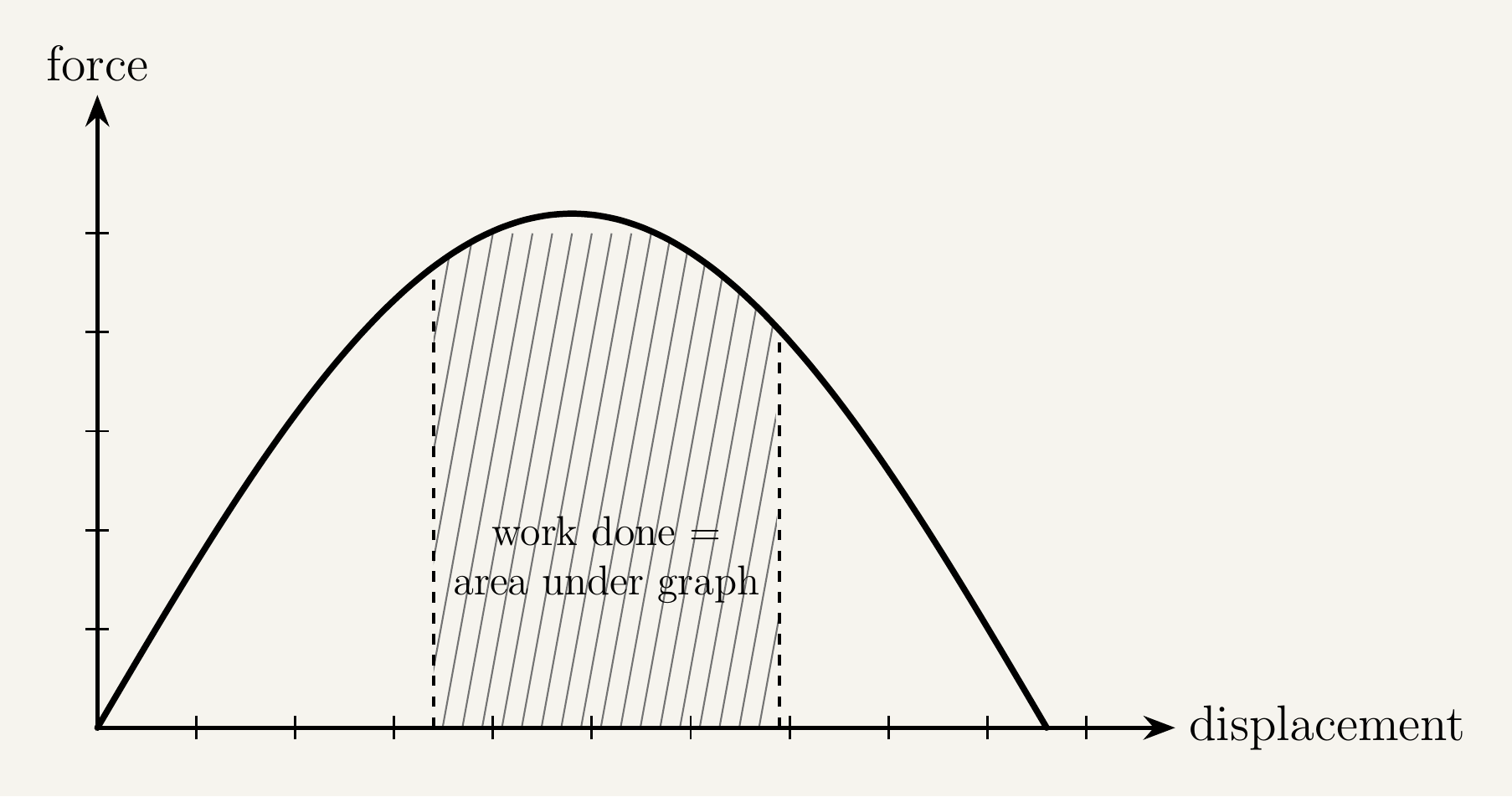
When a force is constant, $W = Fs$ is all you need. But plenty of real forces change as an object moves — a spring pulling harder the further it's stretched. For these, plotting force against displacement and reading the area under the graph gives the work done, whatever shape the curve takes: breaking the motion into tiny steps where the force is essentially constant, the work in each step is a thin sliver of area, and the total is the area under the whole curve.
Power: how quickly work gets done
Two cranes might lift the identical crate to the identical height, doing exactly the same work, but if one takes five seconds and the other fifty, they're not equivalent machines. Power captures that difference: the rate at which work is done, or equivalently the rate at which energy is transferred.
measured in watts (W), where one watt is one joule of work done, or one joule of energy transferred, per second.
Efficiency
No real machine converts all the power fed into it into useful output — some is always lost, typically as heat through friction or resistance. Efficiency measures how much of the input power ends up doing something useful:
often multiplied by 100 for a percentage. Efficiency can never exceed 100%, which would mean getting more useful energy out than you put in, violating conservation of energy.
Conservation of energy
The principle of conservation of energy: energy cannot be created or destroyed, only transferred from one form to another or one place to another. The total energy of an isolated system never changes, even as it shuffles between stores — kinetic, gravitational potential, elastic, thermal. Two of these stores matter enormously for mechanics at this level.
Gravitational potential energy
Lift an object of mass $m$ through a height $\Delta h$, moving it at a slow, constant velocity so nothing is being wasted accelerating it. The change in its gravitational potential energy equals the work you do against gravity to lift it.
Kinetic energy
Kinetic energy is the energy an object has because it's moving. Its formula can be derived from the work-energy theorem — the idea that the work done by a resultant force on an object equals the change in that object's kinetic energy.
Energy conservation in falling, rising, and resisted motion
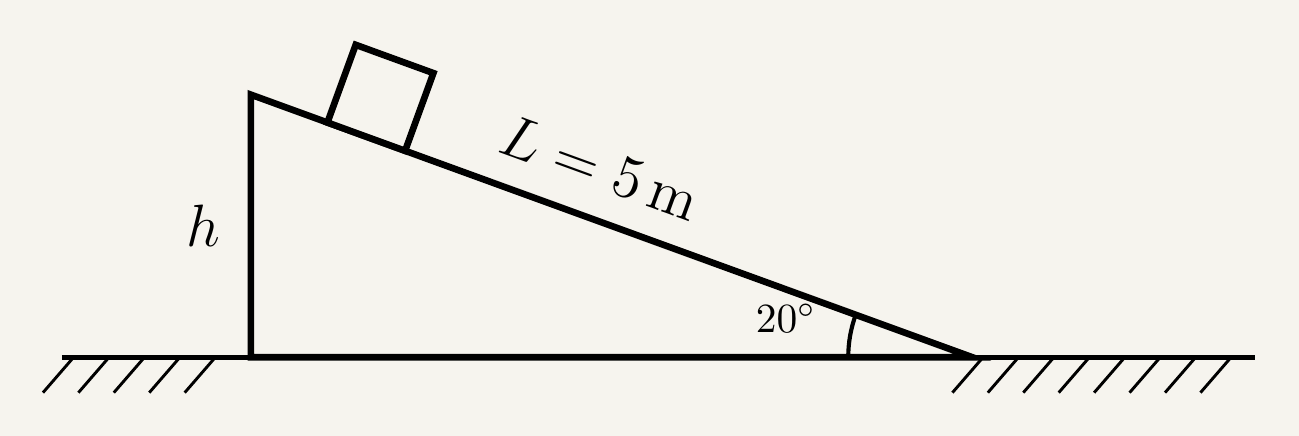
Put gravitational potential energy and kinetic energy together and you get one of the most useful problem-solving ideas in mechanics. For an object falling freely with no resistive forces, mechanical energy — the sum of kinetic and gravitational potential energy — stays exactly constant: whatever $E_p$ is lost reappears exactly as $E_k$ gained. A ball thrown straight up converts kinetic energy into potential energy on the way up and back again on the way down, with the total unchanged at every instant.
Once a resistive force like drag or friction enters, mechanical energy on its own is no longer conserved — some is continuously transferred into heat as the resistive force does negative work. A skydiver at terminal velocity loses gravitational potential energy steadily but gains no kinetic energy, since speed is constant — all that lost $E_p$ converts to heat in the surrounding air. Total energy is still exactly conserved; only the mechanical portion shrinks.
Key takeaways
- Work done is $W = Fs\cos\theta$; only the component of a force along the direction of motion contributes, so a force perpendicular to displacement does zero work.
- Power is the rate of doing work, $P = \Delta W/\Delta t$, and for a constant force in the direction of motion this becomes the useful form $P = Fv$.
- The area under a force-displacement graph gives work done even when the force varies, extending W = Fs to non-constant forces.
- Efficiency is useful output power divided by input power, and can never exceed 100% without violating conservation of energy.
- Conservation of energy: energy is never created or destroyed, only transferred between stores or from place to place.
- Gravitational potential energy change is $\Delta E_p = mg\Delta h$, derived from the work done lifting an object at constant velocity against its weight.
- Kinetic energy is $E_k = \tfrac{1}{2}mv^2$, derived from the work-energy theorem using F = ma and v² = u² + 2as.
- Mechanical energy (kinetic + potential) is conserved only when no resistive forces act; otherwise the "missing" energy is transferred to heat, while total energy remains exactly conserved.