Current, Charge & Potential Difference
Every circuit comes down to three linked ideas: how much charge is moving, how fast, and how much energy it carries as it goes. Get these three straight and the rest of circuits — resistance, power, potential dividers — falls into place far more easily.
What's actually flowing in a wire
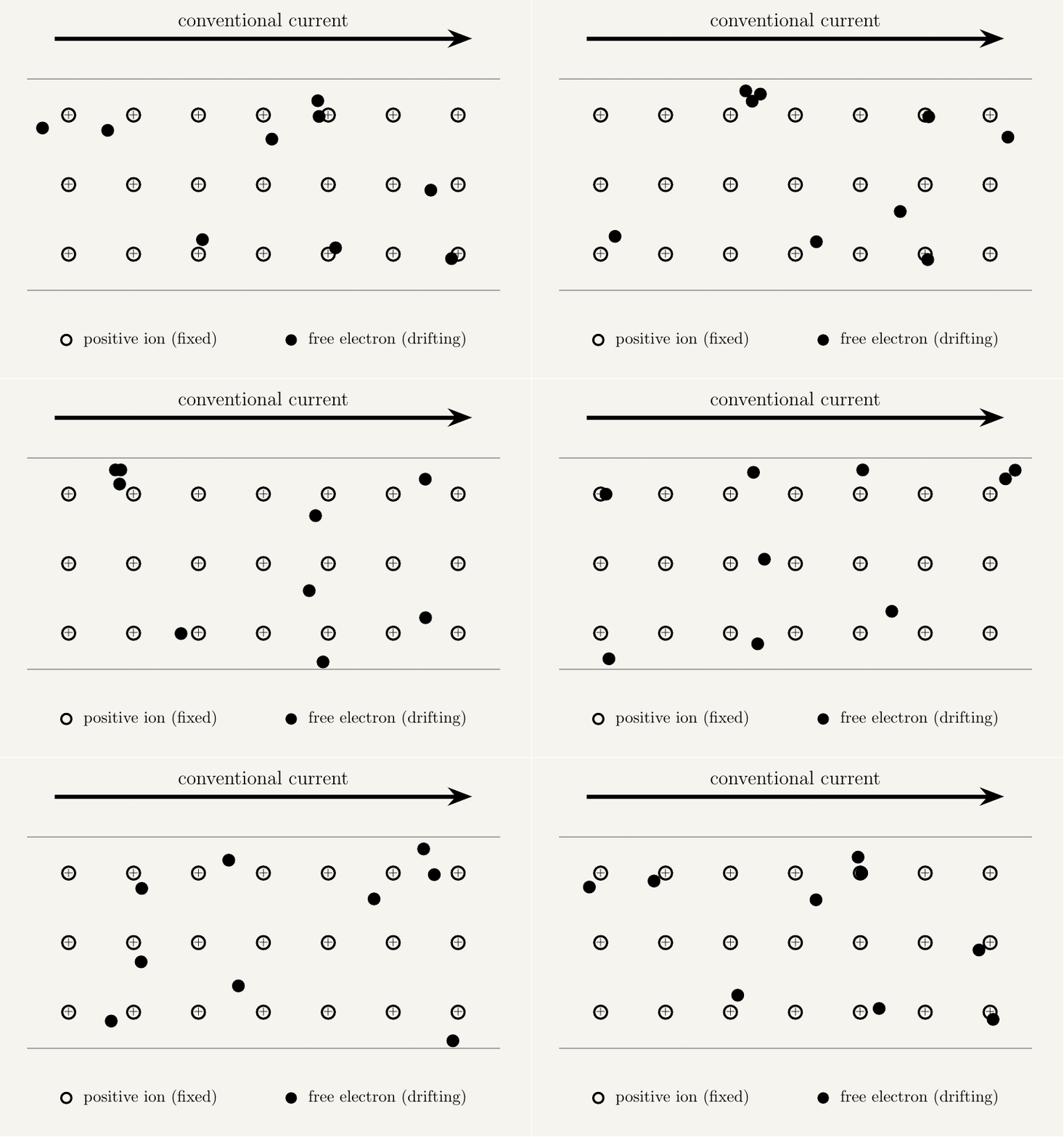
Picture a metal wire as a rigid, close-packed lattice of positive metal ions, fixed in place and vibrating gently. Threading through the gaps is a sea of electrons that don't belong to any particular ion — they're free, or delocalised, and can wander through the whole structure. This is what makes a metal a conductor: those free electrons are ready to move the instant an electric field is set up across the wire.
Without a battery connected, electrons still shoot around at huge speeds in random directions, colliding constantly with the vibrating ions, going nowhere overall. Connect a battery and an electric field appears inside the wire almost instantly, pushing on every free electron at once. Superimposed on the random thermal chaos is now a slow, steady overall drift — and that drift, multiplied over the trillions of electrons in the wire, is what we call an electric current.
Current as a rate of flow
Current isn't a measure of how much charge there is — it's a measure of how quickly charge passes a point. That's why it's defined as a rate:
where $\Delta Q$ is the charge that passes a given point during a time interval $\Delta t$. Current is measured in amperes (A): 1 A means 1 coulomb of charge passes a point every second. The coulomb, the SI unit of charge, is defined as the charge transferred by a current of one ampere flowing for one second. Rearranged, $\Delta Q = I\Delta t$ finds how much charge has flowed given a current and a time — handy whenever a question gives a steady current running for a known duration.
An individual electron's charge is tiny, about $1.6\times10^{-19}\,\text{C}$. A current of just 1 A means roughly six billion billion electrons drifting past a point every second.
An accident of history: conventional current
Something that trips students up: electrons drifting through a wire move from the negative terminal towards the positive terminal. But every circuit diagram shows current arrows pointing the opposite way — from positive to negative.
This is a genuine historical accident. Decades before the electron was discovered (1897), scientists like Benjamin Franklin had already picked a direction to call "positive" charge flow, based on nothing more than an educated guess — flowing from the positive terminal round the circuit to the negative terminal. That convention stuck. When the electron turned up with negative charge, physicists were left with a direction convention pointing exactly backwards compared to what's physically drifting through the metal.
Rather than rewrite over a century of diagrams and conventions, physics kept both ideas under separate names. Conventional current is the direction from positive to negative — the direction used in every circuit diagram, formula and current arrow you'll draw. The actual drift of electrons runs the other way. For every calculation at this level, you use conventional current and rarely need to think about electron drift direction at all — but it's worth understanding why the two point in opposite directions rather than just memorising it.
Potential difference: energy per unit charge
Current tells you how much charge is moving. It says nothing about how much energy that charge carries, or how much gets transferred as it moves through a component. That's the job of potential difference.
When charge moves between two points in a circuit — say, across a resistor — energy is transferred: electrical energy converts into heat, light, or whatever else that component does. Potential difference is the work done, or energy transferred, per unit charge that passes between those two points:
where $W$ is the work done (energy transferred) and $Q$ is the charge that moved. A potential difference of 1 volt across a component means 1 joule of energy is transferred for every coulomb of charge that flows through it. The bigger the potential difference, the more energy each coulomb gives up crossing it.
It's this equation — not some abstract idea of "electrical pressure" — that defines what a volt means.
Resistance: linking current and potential difference
Push more potential difference across a component and — for most things — more current flows. The quantity that captures this relationship is resistance:
Resistance measures how much a component opposes the flow of charge: for a given potential difference, a higher-resistance component lets less current flow. This equation is completely general — it works for any conductor, whether a wire, resistor, or filament lamp — because it's a definition, not a claim about how $V$ and $I$ relate. The next lesson looks at what happens — the special behaviour called "Ohm's law" — when a conductor's resistance stays constant as $V$ and $I$ change.
It helps to keep a clear mental separation between these three quantities. Current is about how much charge flows, and how fast. Potential difference is about how much energy each unit of that charge is carrying, or gives up. Resistance is simply the ratio between the two for a particular component — how hard that component makes it for current to flow, for a given push.
Key takeaways
- Electric current in a metal is the drift of free, delocalised electrons through a fixed lattice of positive ions, defined as $I = \Delta Q/\Delta t$, the rate of flow of charge.
- Conventional current flows from positive to negative — the opposite direction to actual electron drift — purely because the convention was fixed before the electron was discovered.
- Potential difference is the work done, or energy transferred, per unit charge moving between two points: $V = W/Q$.
- The volt is derived directly from this definition: $1\,\text{V} = 1\,\text{J}\,\text{C}^{-1}$.
- Resistance is defined as $R = V/I$ — a general ratio that applies to any conductor, ohmic or not.
- A current of even 1 A involves an enormous number of electrons drifting past a point every second, despite each carrying a vanishingly small charge.