Momentum & Conservation
Two snooker balls collide, a firework explodes, a rocket engine fires — wildly different events, but every one of them obeys the same quiet bookkeeping rule. Total momentum in, total momentum out. This lesson is about where that rule comes from and what it lets you calculate.
What momentum is
Momentum is defined as mass multiplied by velocity: $p = mv$, measured in kilogram metres per second (kg m s⁻¹). Because velocity is a vector, so is momentum, with a direction as well as a size — a 2 kg trolley rolling right at 3 m s⁻¹ and an identical trolley rolling left at 3 m s⁻¹ have the same magnitude but opposite signs, and handling that sign is where most momentum calculations succeed or fail.
Intuitively, momentum measures how hard something would be to stop: mass and velocity both contribute, which is why a lorry's enormous mass wins out over a fast tennis ball even at low speed.
Conservation of linear momentum
The principle of conservation of linear momentum: the total momentum of a system stays the same unless an external force acts on it. "System" means whatever objects you're tracking together — two colliding balls, a bullet and a block, an exploding firework's fragments. Individual objects within the system can gain or lose momentum, as long as those changes cancel out overall.
This lets you solve collision and explosion problems without knowing the details of the messy, complicated instant of contact — only the state before and after.
Why momentum is conserved — a derivation from Newton's laws
This isn't an extra rule bolted onto Newton's laws — it falls straight out of them.
Conservation of momentum is Newton's third law (equal and opposite forces, same duration) combined with Newton's second law (force as rate of change of momentum) — nothing more exotic than that.
Force, impulse, and the area under a graph
Rearranging the rate-of-change-of-momentum form of the second law gives another useful quantity. For a constant force $F$ acting over a time $\Delta t$:
The left-hand side, $F\Delta t$, is called the impulse of the force — impulse equals the change in momentum it produces. If the force isn't constant, as in most real collisions, this simple product doesn't apply directly, but on a force-time graph the area under the curve still represents the impulse and therefore the change in momentum, exactly as area under a velocity-time graph represents displacement.
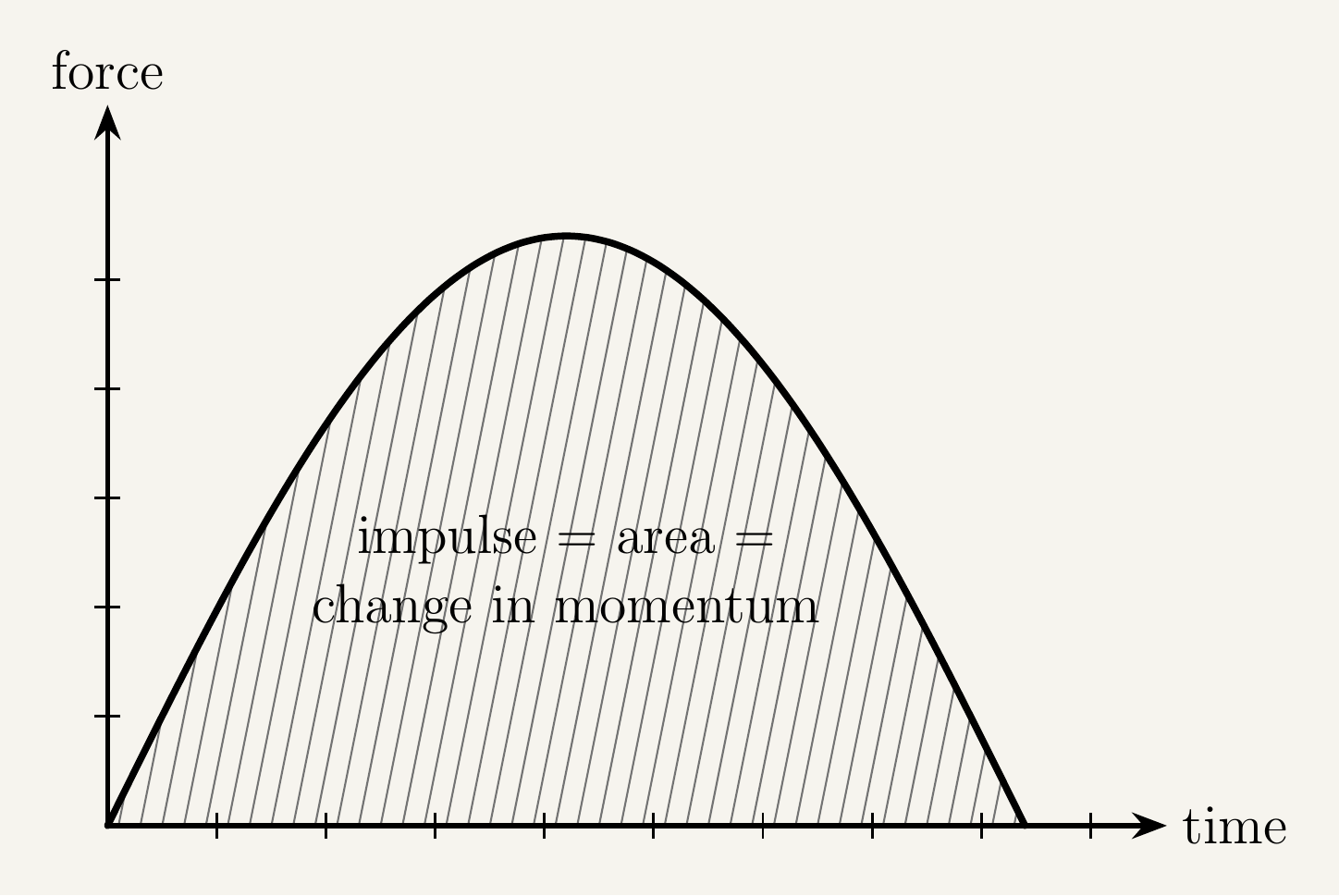
This explains a whole family of everyday safety engineering. A car's momentum change in a crash is fixed by its mass and speed, but a crumple zone extends the time over which that change happens. Since the same impulse ($F\Delta t$) is delivered either way, stretching $\Delta t$ reduces the peak force $F$ — the same trick behind crumple zones, airbags, and padded packaging: same momentum change, more time, smaller peak force.
Elastic and inelastic collisions
Momentum is conserved in every collision within an isolated system, no exceptions. Kinetic energy is only sometimes conserved, giving two named categories of collision.
An elastic collision conserves kinetic energy as well as momentum. These are an idealisation at the macroscopic scale (a genuinely perfect example is rare outside collisions between atoms or subatomic particles), though two hard steel balls bouncing off each other come close.
An inelastic collision still conserves momentum, but not kinetic energy — some is transformed to heat (deformation, friction) or sound. Most real-world collisions are inelastic to some degree. A perfectly inelastic collision is the special case where the objects stick together and move with a shared common velocity — the maximum kinetic energy loss consistent with momentum conservation.
Explosions: momentum conservation in reverse
An explosion — a firework bursting, a bullet firing from a gun, a nucleus undergoing radioactive decay — is a collision played backwards: one object (or system initially at rest) separates suddenly into two or more pieces, driven apart by internal forces. Momentum conservation still applies, and is often most useful here because the total momentum before the explosion is very often zero.
If total momentum starts at zero, it must still be zero afterwards. For a simple two-piece explosion, the fragments must fly apart with equal and opposite momenta: $m_1v_1 = -m_2v_2$. This is why a gun recoils when it fires a bullet: the bullet's forward momentum is matched by an equal, opposite momentum given to the gun, even though the bullet's small mass means it travels much faster than the gun's recoil.
Key takeaways
- Momentum is $p = mv$, a vector quantity — its direction matters as much as its size, and sign conventions must be handled carefully.
- Total momentum of an isolated system is conserved unless an external force acts on it, regardless of what happens between the objects during the interaction.
- Momentum conservation follows directly from Newton's third law (equal, opposite forces on the two interacting bodies, for the same time) combined with Newton's second law (force as rate of change of momentum).
- Impulse is $F\Delta t = \Delta(mv)$ for a constant force, and more generally is the area under a force-time graph, even when the force varies.
- Extending the time of an impact (crumple zones, airbags, padding) reduces the peak force needed to produce a given change in momentum.
- Elastic collisions conserve kinetic energy as well as momentum; inelastic collisions conserve only momentum, with some kinetic energy transformed to heat or sound.
- In an explosion starting from rest, the fragments must separate with equal and opposite momenta, since the total momentum must remain zero.