Newton's Laws of Motion
Three short statements, written down over three hundred years ago, and they still describe how everything from a dropped pen to a launched rocket behaves. The hard part isn't memorising them — it's noticing how often our gut instinct about forces and motion is quietly wrong, and letting these three laws correct it.
The first law: constant velocity needs no explanation
Newton's first law: a body stays at rest, or continues at constant velocity in a straight line, unless a resultant external force acts on it.
Push a book across a table and it slides, then stops. Everyday experience suggests moving objects naturally slow down — that keeping something moving requires a continuous push. Aristotle believed this for nearly two thousand years, since in ordinary life almost everything is fighting friction or air resistance. Newton's insight: the book stops because friction is decelerating it, not because motion "runs out." Take friction away — an object drifting through deep space — and it keeps going forever in a straight line at the same speed.
The useful content of the first law is this: a constant velocity is the natural, do-nothing state of an object, and only a change in velocity demands an explanation. A resultant force is needed to speed something up, slow it down, or change its direction — never just to keep it going at a steady pace in a straight line.
Everyday friction is so pervasive that we rarely observe the "natural" behaviour Newton describes. Space missions show the first law in its pure form: a probe coasting between planets needs no engine running to maintain its speed.
The second law: force and the rate of change of momentum
In its everyday form, for an object of constant mass, the second law is $F = ma$: the resultant force acting on an object equals its mass multiplied by its acceleration. Twice the resultant force gives twice the acceleration; twice the mass, for the same force, gives half the acceleration.
But $F=ma$ is a special case of something more fundamental. In its deeper form, the resultant force equals the rate of change of momentum:
This general version still works when mass isn't constant — a rocket burning through its fuel, for instance, where both mass and velocity change at once. $F=ma$ is just this general law applied to the everyday case where mass doesn't change.
The third law: forces come in pairs, on different objects
Newton's third law: whenever one object exerts a force on a second object, the second exerts an equal and opposite force back on the first, along the same line of action. Push on a wall, and the wall pushes back just as hard. Stand on the ground, and the ground pushes up on your feet exactly as hard as gravity pulls you down.
The common mistake: the two forces in a Newton's-third-law pair always act on two different objects — never the same object. They can never cancel each other out or produce equilibrium on their own, precisely because they're not both acting on the same thing.
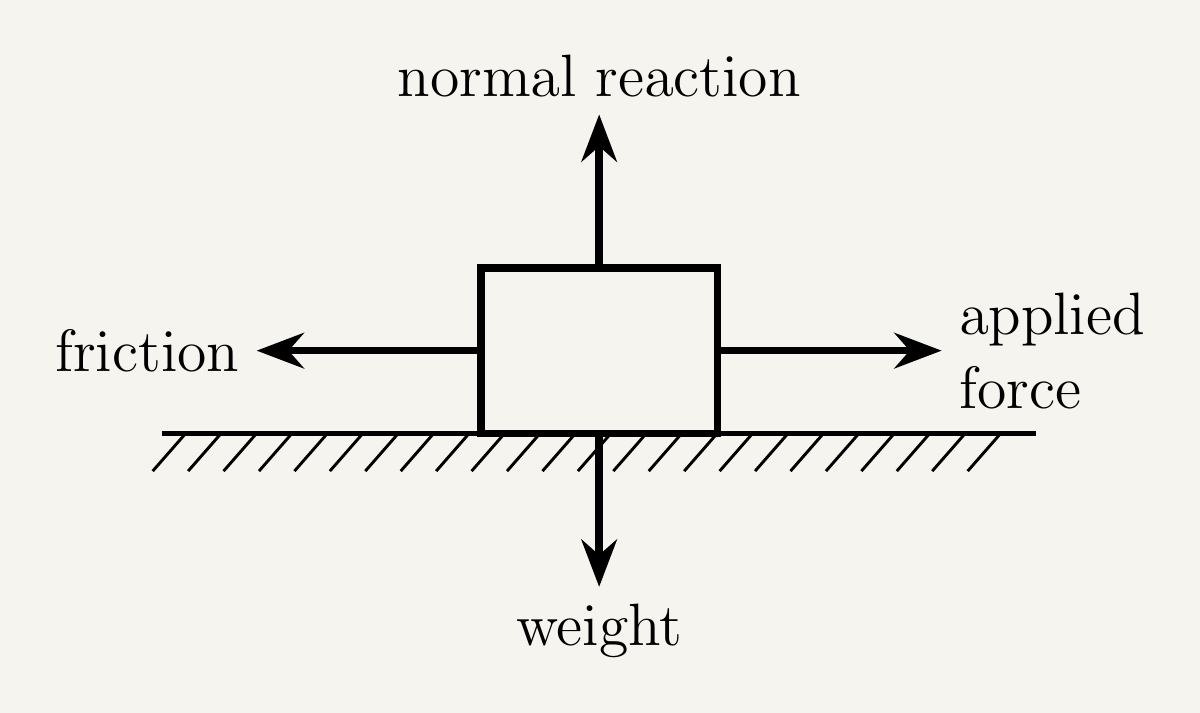
Take a book resting on a table. It's tempting to say the weight of the book and the normal reaction force from the table are a third-law pair, and that's why the book doesn't accelerate. That's wrong, even though the conclusion is right: weight and normal reaction both act on the book itself, and they're equal only because the book is in equilibrium (the first law, not the third). The genuine third-law partner of the table's push on the book is the book's push down on the table — a different force, on a different object, playing no role in whether the book accelerates.
To check whether two forces are a genuine third-law pair, ask: are they the same type of force, the same size, opposite in direction, and — the part everyone forgets — acting on two different objects? If both forces act on the same object, they cannot be a third-law pair, no matter how equal and opposite they look.
Free-body diagrams: the standard tool
Applying these three laws almost always starts with a free-body diagram. Pick a single object of interest. Draw every external force acting on that object as an arrow from its centre, roughly in proportion to size, and label each one. Just as important: draw nothing else — no forces the object exerts on other things, nothing internal.
Once drawn, the second law tells you what to do with it: add the forces as vectors to find the resultant, and that resultant divided by mass is the acceleration. If the arrows balance, the resultant is zero and, by the first law, the object's velocity isn't changing.
Key takeaways
- Newton's first law: an object stays at rest or at constant velocity unless a resultant force acts on it — only a change in velocity needs a force to explain it, not motion itself.
- Everyday friction hides the first law from casual observation, which is why "things naturally slow down" feels true even though it isn't.
- Newton's second law, in its fundamental form, is $F = \dfrac{\Delta(mv)}{\Delta t}$ — force equals the rate of change of momentum.
- $F = ma$ is the special case of the second law that applies when mass is constant, derived by pulling the fixed mass outside the change in momentum.
- Newton's third law: every force has an equal and opposite reaction force, but the two forces of a pair always act on two different objects.
- Because third-law pairs act on different objects, they can never cancel each other out or create equilibrium by themselves — equilibrium comes from balanced forces on a single object, governed by the first law.
- A free-body diagram isolates one object and shows only the external forces acting on it, as the standard starting point for applying all three laws.