Terminal Velocity
Drop a coin and a feather in a vacuum and they land together. Drop them in air, and the feather drifts down long after the coin has hit the floor. The difference is a resistive force that grows the faster you move through a fluid — and it's the reason nothing that falls through air keeps on accelerating forever.
Friction: resisting relative motion
Whenever two surfaces are in contact and one tries to slide over the other, a force appears that opposes that sliding — friction. The rougher the surfaces, the larger the frictional force, and friction always acts to oppose the relative motion (or attempted motion) between the two surfaces, never to assist it.
For this course: friction is a contact force between touching surfaces, it opposes sliding, and its size depends on the nature of the surfaces and how hard they're pressed together. A cousin of friction appears the moment an object moves through a fluid rather than across a solid surface.
Stopping a vehicle: thinking distance and braking distance
Friction between tyres and road is what a vehicle's brakes rely on. The total distance a car needs to stop, the stopping distance, splits into two stages:
The thinking distance is how far the car travels during the driver's reaction time, before the brake is pressed. No braking force is applied, so the car carries on at constant velocity, and thinking distance is simply speed multiplied by reaction time — doubling speed doubles it.
The braking distance is how far the car travels once the brakes are applied, decelerating until it stops — a direct SUVAT problem. Using $v^2=u^2+2as$ with $v=0$ gives $s = \dfrac{u^2}{2a}$: braking distance is proportional to the square of the initial speed, so doubling speed quadruples braking distance.
Both distances are also affected by factors beyond speed: tiredness, alcohol, or distraction increase thinking distance; a wet or icy road, worn tyres or brakes, or a heavier load increase braking distance.
Drag and lift: forces from moving through a fluid
Air is a fluid. So is water. When an object moves through either, it shoves the fluid out of its way, and the fluid pushes back. That reaction splits into two components: drag, acting opposite to the object's velocity and resisting its motion, and lift, acting perpendicular to the velocity. For a falling object with no aerodynamic shaping, lift is usually negligible and drag is the force that matters.
The key fact about drag: drag increases as speed increases. Stick your hand out of a car window at 10 mph and you barely notice the air; at 70 mph your arm gets thrown backwards. Same hand, same air, wildly different force, because the force depends on how fast you're pushing through the fluid.
The physical story of a falling object
Picture something released from rest — a skydiver, or a ball dropped from a height. Follow the forces acting on it from the instant of release.
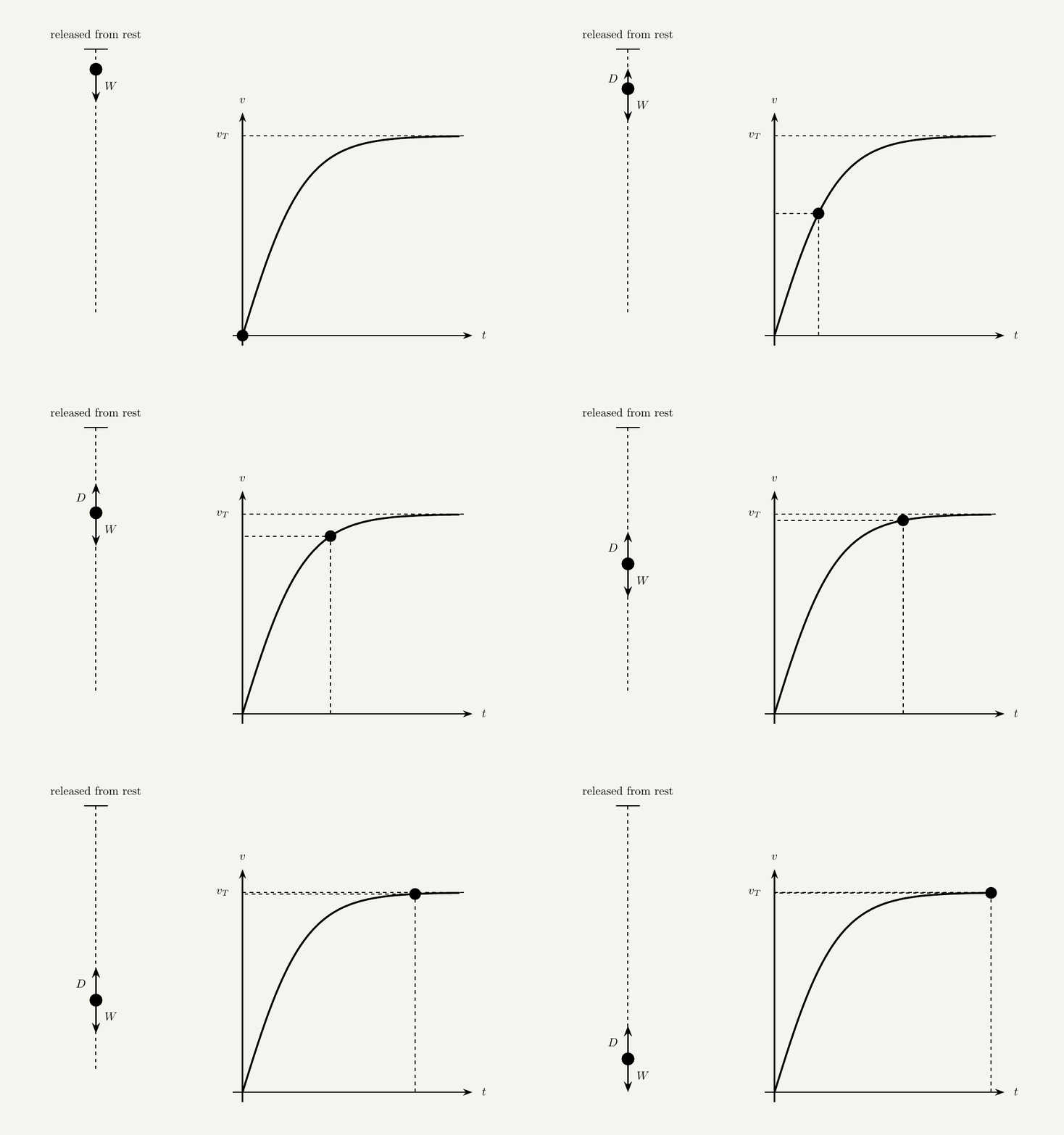
The instant of release. Speed is zero, so drag is zero too — the only force acting is weight. With one unbalanced force, the object accelerates downward, and Newton's second law says that acceleration at this instant is at its largest possible value, roughly $g$.
Speeding up. Once the object has downward speed, drag switches on, acting upward. At low speed drag is small compared to weight, so the resultant force is still downward but slightly smaller — the object keeps accelerating, just a little less quickly than before. As speed builds, drag grows with it, and acceleration keeps shrinking.
Terminal velocity. Eventually drag grows large enough to exactly equal weight. The resultant force is zero, so acceleration is zero too, and the object falls at a constant speed, the terminal velocity. It's not that the object refuses to go faster — there's simply no resultant force left to make it.
Terminal velocity isn't a special maximum speed built into an object — it's simply the speed at which the resistive force has grown to exactly balance the driving force. Change the driving force (a heavier skydiver) or the resistive force (a smaller parachute, denser air) and you change the terminal velocity, but the underlying condition — resultant force equals zero — stays exactly the same.
Plotted as a velocity-time graph, this story becomes a single curve: steep to begin with, gradually flattening as acceleration shrinks, and levelling off into a horizontal line once terminal velocity is reached — approached smoothly from below, never overshooting. The animation below shows both sides of the story together: the falling object with its weight and drag arrows on the left, and the velocity-time graph building up in step on the right.
Why the gradient of that graph matters
The gradient of a velocity-time graph is acceleration, so the shape of that curve is a direct visual record of the reasoning above. A steep gradient near the origin means a large initial acceleration; the gradient shrinking as the curve bends over means acceleration shrinking as drag builds; a gradient of exactly zero on the flat final section means zero acceleration, constant velocity.
How this reshapes a projectile's path
The previous lesson on projectile motion assumed no air resistance, giving a clean, symmetric parabola. Real air resistance breaks that symmetry: drag acts opposite to the object's velocity at every instant, so for a projectile it has a horizontal component slowing forward progress and a vertical component either boosting or fighting gravity.
The result: a real trajectory falls short of the parabola's range, since horizontal velocity is constantly eroded rather than staying constant. The descent also tends to be steeper than the ascent, since drag has bled off kinetic energy throughout the flight. A cannonball's real trajectory is a lopsided, slightly deflated version of the ideal parabola.
Why cars (and planes, and cyclists) have a top speed
The same balance-of-forces idea explains a car's maximum speed, even flat out. An engine can only deliver a limited driving force. Air resistance grows as speed increases, exactly as for the falling object: at low speed, driving force comfortably exceeds drag and the car accelerates; as speed rises, drag claws back more of the resultant force, until it matches the maximum driving force the engine can supply. At that point acceleration stops — the car's own version of terminal velocity, with an engine playing the role weight played for the falling object.
Key takeaways
- Friction opposes relative sliding motion between two surfaces in contact; its size depends on the surfaces involved and how hard they're pressed together.
- Stopping distance = thinking distance + braking distance. Thinking distance is proportional to speed (constant velocity during reaction time); braking distance is proportional to speed squared (from $v^2=u^2+2as$ with $v=0$), so doubling speed quadruples braking distance.
- Drag and lift are the components of the force a fluid exerts on an object moving through it — drag opposes the motion, lift acts perpendicular to it.
- Drag increases as speed increases: the faster an object moves through a fluid, the larger the resistive force it experiences.
- A falling object accelerates fastest at release (drag is zero), then accelerates progressively more slowly as drag grows, until drag equals weight and acceleration becomes zero.
- Terminal velocity is the constant speed reached once the resistive force exactly balances the driving force — not a hard ceiling, but the point where the resultant force vanishes.
- Air resistance shortens a projectile's range and steepens its descent compared with the ideal, symmetric parabola of resistance-free motion.
- A vehicle's top speed is reached when drag has grown to match the maximum driving force its engine can supply — the same balance-of-forces logic as a falling object reaching terminal velocity.