Throw a ball sideways and drop an identical ball at exactly the same instant, from the same height, and they hit the ground at the same time — every time. That slightly surprising fact is the key to this whole lesson: sideways motion and falling motion happen completely independently of one another.
8 min read
The independence of horizontal and vertical motion
A projectile is any object launched into the air and left to move freely under gravity alone — a thrown ball, a launched shell, a long jumper mid-flight. The key idea: as long as air resistance is negligible, the horizontal and vertical parts of the motion don't interact at all, and can be analysed as two independent problems sharing the same clock.
Gravity pulls straight down and has no horizontal component, so horizontal velocity stays constant throughout the flight — exactly as Newton's first law predicts for zero net force in that direction. The vertical motion is a plain case of uniform acceleration under gravity, unaffected by sideways speed. A shot put and a lightly tossed marble, launched horizontally from the same height at the same instant, land at the same time.
This means the SUVAT equations apply twice over for a single projectile problem: once horizontally ($a=0$), once vertically ($a=g$, downward), linked only by the shared quantity time.
Resolving the initial velocity
Most projectile problems launch an object at some angle $\theta$ above the horizontal. The first step is to resolve the initial velocity $u$ into components using $u_x = u\cos\theta$ and $u_y = u\sin\theta$. From there, $u_x$ feeds into the horizontal analysis and $u_y$ into the vertical one, recombined only for a final answer like landing speed or direction.
Time of flight, maximum height, and range
Three questions come up in almost every projectile problem: how long is it in the air, how high does it get, and how far does it travel before landing? All three follow from the vertical and horizontal SUVAT equations.
DerivationTime of flight, maximum height, and range
1
Consider a projectile launched from ground level with vertical component $u_y$ and horizontal component $u_x$, landing back at the same height it launched from.
Launch height equals landing height, so the total vertical displacement over the whole flight is zero — that's the key simplification for time of flight.
2
Apply $s = u_y t + \frac{1}{2}(-g)t^2$ vertically, with $s=0$ over the full flight time $t_{\text{flight}}$: $0 = u_y t_{\text{flight}} - \frac{1}{2}g t_{\text{flight}}^2$.
3
Factorise: $t_{\text{flight}}\left(u_y - \frac{1}{2}g t_{\text{flight}}\right) = 0$. The root $t_{\text{flight}}=0$ is just the launch instant, so the physically meaningful root comes from $u_y - \frac{1}{2}g t_{\text{flight}} = 0$.
4
Rearranging gives the time of flight: $t_{\text{flight}} = \dfrac{2u_y}{g}$.
Notice this is exactly double the time to reach the peak — the rise and the fall are symmetric in time when launch and landing heights match.
5
For maximum height, use $v^2 = u_y^2 + 2(-g)s$ vertically. At the very top of the trajectory the projectile is momentarily moving neither up nor down, so $v=0$ there.
This is the standard trick for "greatest height" problems in any SUVAT context — the peak is defined by zero vertical velocity, not zero vertical acceleration (gravity is still acting throughout).
6
Substituting $v=0$: $0 = u_y^2 - 2g h_{\max}$, which rearranges to the maximum height: $h_{\max} = \dfrac{u_y^2}{2g}$.
7
For the range, use the horizontal equation $x = u_x t$ (constant velocity, so no acceleration term), evaluated over the full time of flight: $R = u_x \, t_{\text{flight}} = u_x\left(\dfrac{2u_y}{g}\right)$.
The horizontal motion doesn't know or care about the vertical journey — it just keeps going at $u_x$ for as long as the vertical motion keeps the projectile airborne.
▪ derived
These formulae assume launch and landing heights are equal
$t_{\text{flight}}=\dfrac{2u_y}{g}$ and the range formula above only apply when the projectile lands at the same height it was launched from. If it's launched from a cliff edge, or lands on a raised platform, go back to the full equation $s=u_yt-\frac12gt^2$ with the actual (non-zero) vertical displacement, rather than reaching for the shortcut.
Worked exampleTime of flight, maximum height, and range
1
A ball is launched from level ground at $20\,\text{m}\,\text{s}^{-1}$ at $30°$ above the horizontal. Find the time of flight, maximum height, and range. Take $g=9.81\,\text{m}\,\text{s}^{-2}$.
2
Resolve the launch velocity: $u_x = 20\cos30° = 17.3\,\text{m}\,\text{s}^{-1}$, and $u_y = 20\sin30° = 10.0\,\text{m}\,\text{s}^{-1}$.
3
Time of flight: $t_{\text{flight}} = \dfrac{2u_y}{g} = \dfrac{2(10.0)}{9.81} = 2.04$ s.
4
Maximum height: $h_{\max} = \dfrac{u_y^2}{2g} = \dfrac{10.0^2}{2(9.81)} = \dfrac{100}{19.62} = 5.10$ m.
So the ball is airborne for $2.04$ s, rises to a maximum height of $5.10$ m, and lands $35.3$ m from where it was launched.
▪ answer
The shape of the trajectory
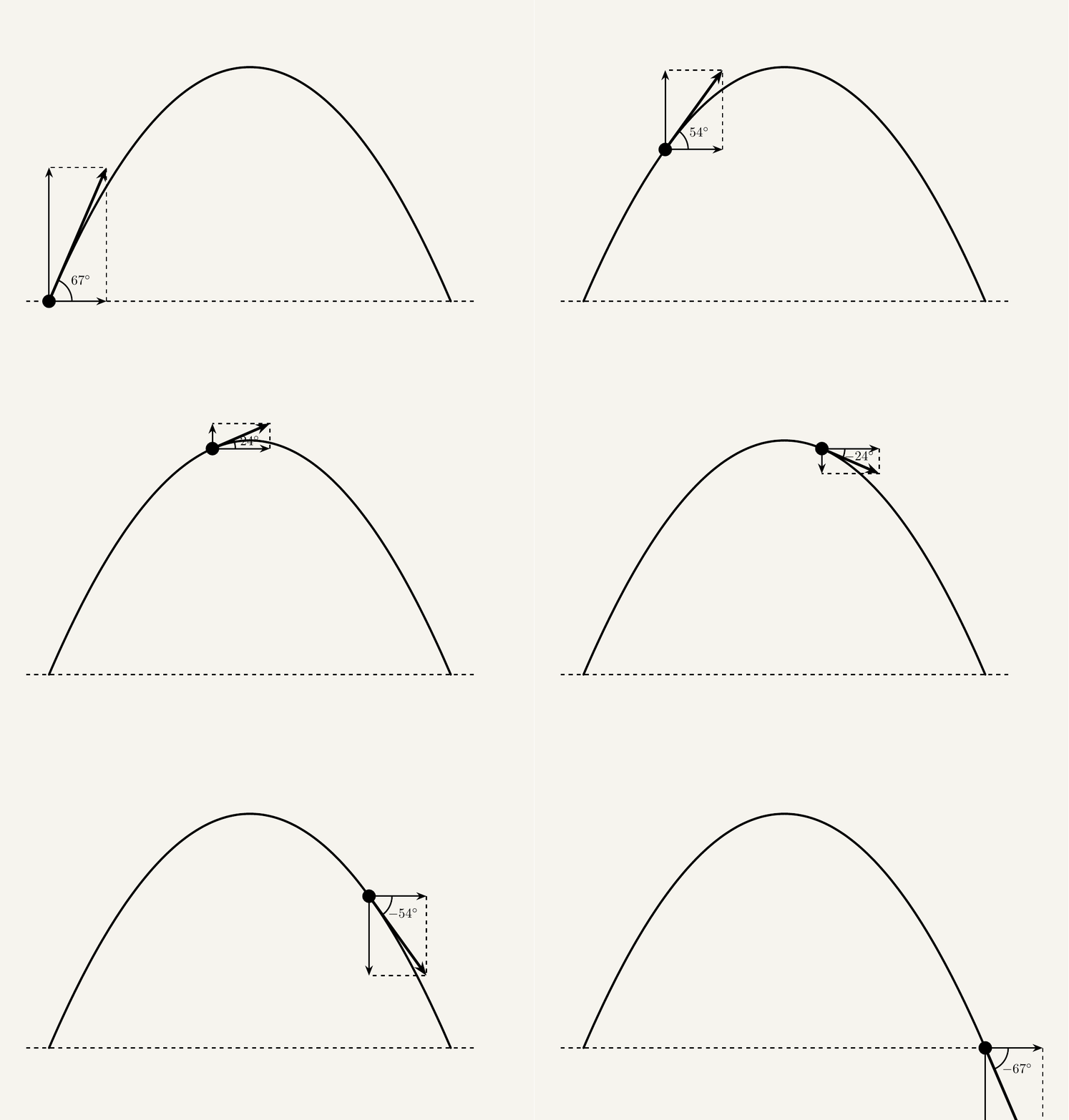
Put the two independent motions back together: what shape does the path trace out?
DerivationThe projectile's path is a parabola
1
Take a projectile launched with horizontal component $u_x$ and vertical component $u_y$, and set up coordinates with $x$ measured horizontally and $y$ measured vertically from the launch point.
2
Horizontally, velocity is constant, so displacement is simply $x = u_x t$.
This is the constant-velocity case of $s=ut+\frac12at^2$ with $a=0$.
3
Vertically, the motion is uniformly accelerated by $g$ downward, so $y = u_y t - \dfrac{1}{2}gt^2$.
The minus sign appears because $g$ acts downward while $y$ is measured as positive upward — this is exactly $s=ut+\frac12at^2$ with $a=-g$.
4
Both equations share the same $t$, so time can be eliminated between them. From the horizontal equation, $t = \dfrac{x}{u_x}$.
This is the step that ties the two independent motions back together into a single relationship between $x$ and $y$.
5
Substitute this into the vertical equation: $y = u_y\left(\dfrac{x}{u_x}\right) - \dfrac{1}{2}g\left(\dfrac{x}{u_x}\right)^2$.
The two bracketed quantities are just fixed numbers once the launch speed and angle are known — everything else is $x$ or $x^2$.
7
This has the form $y = (\text{constant})\,x - (\text{constant})\,x^2$ — a quadratic in $x$, which is exactly the equation of a parabola.
The $x^2$ term, with its negative coefficient, is what curves the path over and brings it back down — without gravity that term would vanish and the path would be a straight line.
▪ derived
The arc of every thrown object, from a basketball to a cannonball, is a parabola for the same reason: constant horizontal velocity combined with a vertical position that depends on $t^2$.
The parabolic path of a projectile: the horizontal velocity component stays constant throughout, while the vertical component shrinks to zero at the peak and reverses on the way down. The angle between the velocity and the horizontal shrinks to 0° at the peak and grows again, with equal and opposite magnitude, as the projectile descends.
Where the real world departs from the model
Everything above assumes air resistance is negligible — a good approximation for a dense, compact object like a shot put, but a poor one for something light and spread out, like a shuttlecock. With air resistance, drag acts opposite to the direction of travel, with both horizontal and vertical components that change as the projectile's direction changes. Real trajectories fall short of the ideal parabola, landing closer to the launch point, and lose their left-right symmetry — the messier picture the next lesson, on terminal velocity, picks up.
Key takeaways
Horizontal and vertical motion of a projectile are independent: horizontal velocity is constant (no horizontal force), vertical motion is uniformly accelerated by $g$.
Each direction can be analysed separately with the SUVAT equations, linked only by the shared variable $t$.
Always start by resolving the initial velocity into components: $u_x = u\cos\theta$ and $u_y = u\sin\theta$.
For launch and landing at the same height: time of flight $t_{\text{flight}}=\dfrac{2u_y}{g}$, maximum height $h_{\max}=\dfrac{u_y^2}{2g}$, and range $R=u_x\,t_{\text{flight}}$.
Eliminating $t$ between $x=u_xt$ and $y=u_yt-\frac12gt^2$ gives $y$ as a quadratic function of $x$ — the trajectory is a parabola.
The parabola's curvature comes entirely from the $x^2$ term, which in turn comes from gravity's constant vertical acceleration.
Air resistance, ignored in this idealised model, breaks the horizontal-vertical independence in reality, shortening the range and distorting the shape compared with a true parabola.