Scalars & Vectors
Two cars can have exactly the same speed and still be doing completely different things — one heading for the motorway, the other for a hedge. Physics needs a way to talk about "how much" and "which way" separately, and that distinction turns out to run through almost everything in mechanics.
Two kinds of quantity
A scalar quantity is completely described by its magnitude alone — a size, with a unit attached. Mass is a scalar: a bag of sugar is 1 kg, no direction needed. Speed, distance, energy, temperature, and time all behave the same way, and can be added just by adding the numbers.
A vector quantity needs both a magnitude and a direction. Force is the classic example — pushing a stalled car with 200 N tells you nothing useful until you also say which way. Velocity, displacement, acceleration, and momentum are all vectors too. Each vector quantity has a scalar twin that strips the direction away — velocity's magnitude is speed, displacement's magnitude is distance.
| Scalars | Vectors |
|---|---|
| mass | force (including weight) |
| distance | displacement |
| speed | velocity |
| energy | acceleration |
| time, temperature | momentum |
This isn't just bookkeeping: treat a vector as a scalar — adding forces or velocities regardless of direction — and you get answers that are simply wrong. Two 5 N forces pulling in opposite directions produce zero net force, not 10 N.
Adding vectors by scale drawing
Suppose you know two forces acting on an object and want their combined effect — the single equivalent force, called the resultant. A scale drawing finds it visually: represent each vector as an arrow, length proportional to magnitude, pointing the right way, then join them tip to tail. The resultant is the arrow that closes the gap, from the start of the first arrow to the tip of the last.
With two vectors this is a triangle of vectors. Drawing both original vectors from a common starting point instead gives a parallelogram of vectors, where the resultant is the diagonal — both methods give identical answers.
Scale drawing works for any angle between the two vectors. Measure the resultant arrow's length against your scale for magnitude, and its angle with a protractor for direction.
Subtraction is addition in disguise. To find $\mathbf{A} - \mathbf{B}$, reverse the direction of $\mathbf{B}$ to get $-\mathbf{B}$, then add tip-to-tail: $\mathbf{A} - \mathbf{B} = \mathbf{A} + (-\mathbf{B})$. This is how you'll find a change in velocity, $\Delta v = v - u$, later in the course.
Adding vectors by calculation
When the two vectors are at right angles, the triangle they form is right-angled, giving Pythagoras' theorem and basic trigonometry for free.
This method only works because the two vectors are perpendicular. Vectors at some odd angle like 50° don't form a right-angled triangle, so Pythagoras doesn't apply — you'd need scale drawing, or trigonometry beyond this course.
Resolving a vector into components
Run the idea in reverse: instead of combining two perpendicular vectors into one resultant, start with a single vector and split it into two perpendicular pieces — its components. This is called resolving, and it's one of the most useful tricks in mechanics, since forces or velocities in awkward directions are much easier to handle once broken into a horizontal and vertical piece (or any convenient perpendicular pair).
$F_x = F\cos\theta$ and $F_y = F\sin\theta$ are worth knowing cold — they show up throughout the course: resolving a velocity at launch, a tension in a cable, weight on a slope. The letters change; the triangle never does.
Inclined planes: resolving weight along and perpendicular to a slope
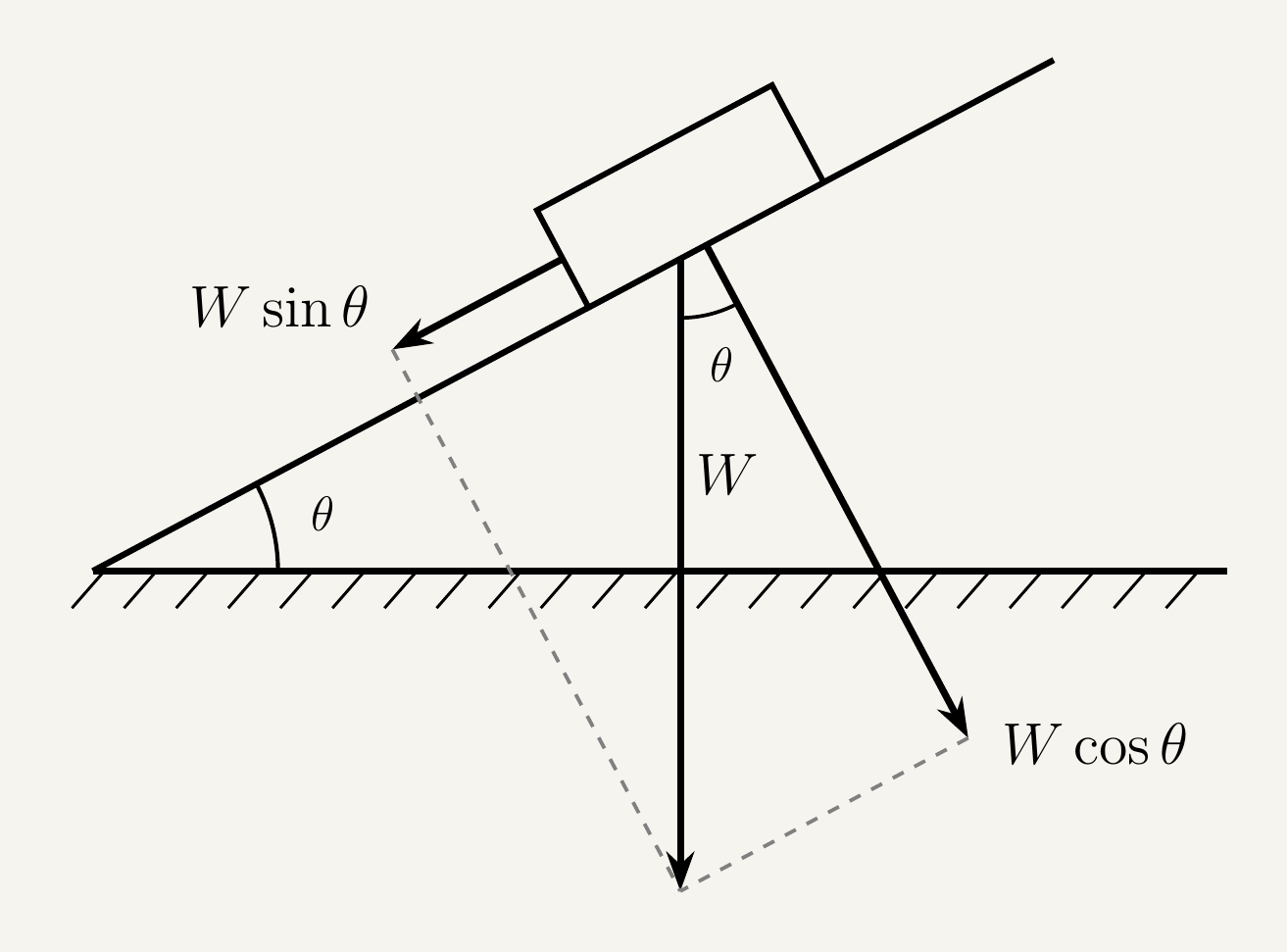
A common application is a block on a ramp tilted at angle $\theta$ to the horizontal. The block's weight, $mg$, still points straight down. Since "straight down" isn't convenient when the block is constrained to slide along the slope, it's standard to resolve weight into two components relative to the slope: one parallel to the surface (tending to slide the block down), one perpendicular into the surface (balanced by the normal contact force).
Because the angle between the vertical weight vector and the slope's normal direction is also $\theta$, the components come out as $mg\sin\theta$ parallel to the slope and $mg\cos\theta$ perpendicular to it — sine and cosine swap roles compared with a component measured from the horizontal, since the reference direction has rotated by $\theta$.
Equilibrium of coplanar forces
When several vectors combine and the resultant is exactly zero, that's equilibrium: a set of coplanar forces acting at a single point is in equilibrium precisely when their vector sum is zero.
There are two equivalent ways to check this. The first is geometric: forces in equilibrium, drawn tip to tail, form a closed shape — a closed triangle for two forces, extending to more vectors for more forces.
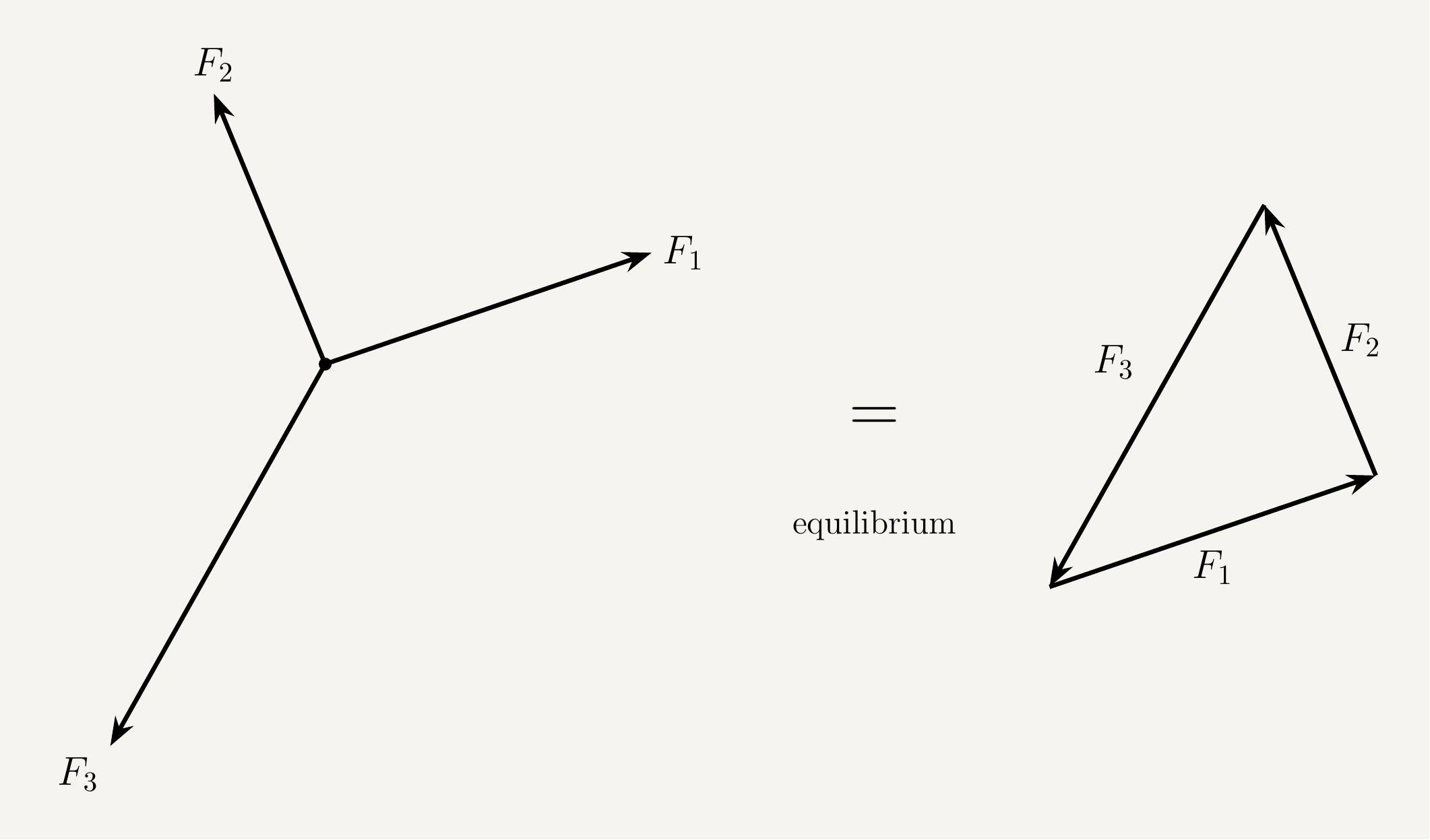
The second way is algebraic, and it's the one you'll use for calculation: resolve every force into components along two perpendicular directions (horizontal and vertical is the usual default), and equilibrium then requires the components in each direction to separately sum to zero — the closed-triangle condition translated into numbers.
Physically, equilibrium means the object sits completely still, or carries on moving in a straight line at constant velocity — both correspond to zero acceleration. That link is the content of Newton's first law: "equilibrium" doesn't mean "not moving," it means "not accelerating."
Equilibrium of three forces at a point doesn't require any two of them to be perpendicular, or any special symmetry — only that the vector sum of all three is zero.
Key takeaways
- Scalars have magnitude only (mass, speed, distance, energy); vectors have magnitude and direction (force, velocity, displacement, acceleration) — mixing them up in a calculation gives wrong answers, not just imprecise ones.
- Two vectors add tip to tail; the resultant closes the triangle (or diagonal of the parallelogram) from start to finish. This scale-drawing method works for any angle between the vectors.
- For two perpendicular vectors specifically, the resultant's magnitude comes from Pythagoras, $R=\sqrt{X^2+Y^2}$, and its direction from $\theta=\tan^{-1}(Y/X)$.
- Resolving reverses this: a vector $F$ at angle $\theta$ splits into components $F_x = F\cos\theta$ and $F_y = F\sin\theta$ along two perpendicular directions.
- On an inclined plane, weight resolves into $mg\sin\theta$ down the slope and $mg\cos\theta$ into the slope — the standard application of resolving in mechanics.
- Coplanar forces at a point are in equilibrium when their vector sum is zero — equivalently, a closed triangle (or polygon) of vectors, or components summing to zero in any two perpendicular directions.
- Equilibrium means zero acceleration — the object is either at rest or moving at constant velocity, the physical content behind Newton's first law.