Physics/Lessons/Mechanics/Moments, Couples & Centre of Mass
Physics · Mechanics · AS Level

Moments, Couples & Centre of Mass

A tiny push on the end of a long spanner can shift a bolt that laughs at a much bigger push applied close to it. Turning effects don't just depend on how hard you push — they depend on where and how you push, and that's the whole subject of this lesson.

9 min read

The moment of a force

When a force doesn't act through a pivot, it tends to turn whatever it's acting on around that pivot. The measure of that turning effect is called the moment of the force, and it's defined as:

$\text{moment} = \text{force} \times \text{perpendicular distance from the pivot to the line of action of the force}$

Moments are measured in newton-metres (N m) — a different unit from the joule, even though both come from multiplying newtons by metres: a joule is force times distance moved in the direction of the force, while a moment is force times a distance perpendicular to the force.

The key word is perpendicular. Push at right angles to a spanner and the perpendicular distance is just the length along it to the pivot. Push at some other angle, and the perpendicular distance from the pivot to the force's line of action — the infinite straight line the force vector sits on — is shorter than the physical distance along the spanner to your hand.
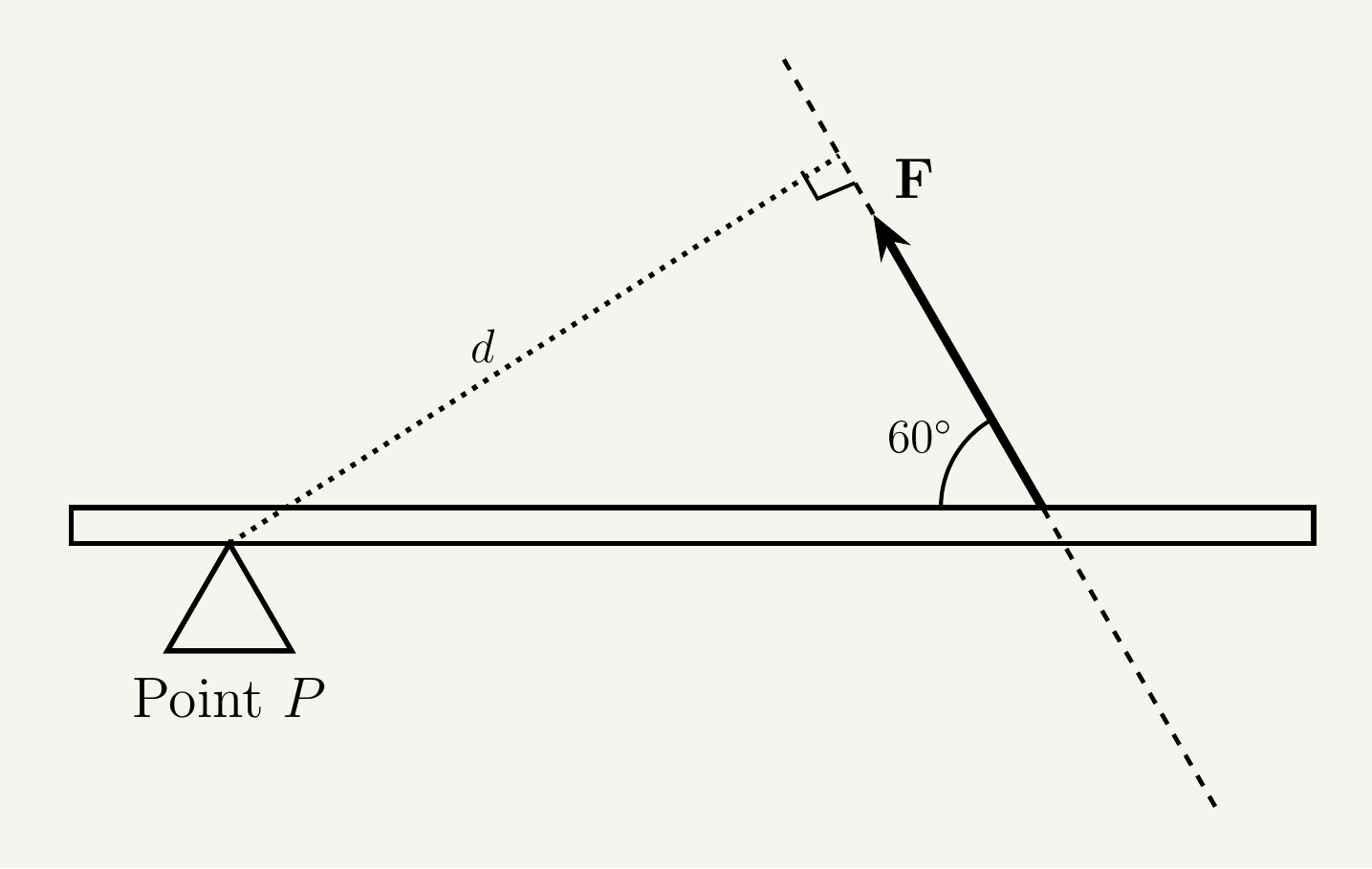
A horizontal lever or rod pivoted at a fixed point marked with a triangle support near its left end. A force arrow labelled F is applied near the right end of the rod, drawn pointing up and to the left at an angle to the rod rather than straight up, so it is not perpendicular to the rod. A dashed straight line extends from F's line of action, continuing infinitely in both directions through the arrow. A second dashed line is drawn from the pivot point straight across to meet this line of action at a right angle, with a small square symbol marking the right angle where the two dashed lines meet. The length of this second dashed line, from the pivot to the point where it meets the force's line of action, is labelled d, representing the perpendicular distance used in the moment calculation — clearly shorter than the distance measured along the rod itself to where F is applied.
The moment of a force equals force times the perpendicular distance d from the pivot to the force's line of action — not the distance along the rod.

A common mark loss is using the distance along the rod to the point of application, rather than the true perpendicular distance to the line of action. If a force is applied at an angle, resolve it first and use the component perpendicular to the rod, or find the perpendicular distance to the line of action directly using trigonometry.

Both of those routes are worth seeing side by side, since they always agree:

DerivationMoment of a force applied at an angle to the rod
1
Let a force $F$ act at point $A$, a distance $L$ along the rod from the pivot $P$, at angle $\theta$ to the rod — exactly the setup in the diagram above.
$L$ is the distance measured along the rod, not the perpendicular distance — that's the whole point of the calculation.
2
By definition, the moment about $P$ is $F$ times the perpendicular distance $d$ from $P$ to the line of action of $F$. In the right-angled triangle formed by $P$, $A$, and the foot of that perpendicular, $d$ is opposite the angle $\theta$ in a triangle with hypotenuse $L$, so $d = L\sin\theta$.
$PA$ has length $L$ and meets the line of action at angle $\theta$; resolving that length perpendicular to the line of action is exactly a sine ratio.
3
So the moment is $\text{moment} = Fd = FL\sin\theta$.
4
Equivalently, resolve $F$ itself into a component perpendicular to the rod, $F\sin\theta$, and a component along the rod, $F\cos\theta$.
Only the perpendicular component has any turning effect about $P$ — the component along the rod points straight through the pivot's line and contributes nothing to the moment.
5
That perpendicular component acts at distance $L$ from $P$ along the rod, giving $\text{moment} = (F\sin\theta)\times L = FL\sin\theta$ — the same result as method one.
The two methods are just two ways of packaging the same trigonometry, so they always agree; use whichever is more convenient for the geometry in front of you.
▪ derived

Couples

Push the top of a steering wheel one way while pulling the bottom the opposite way — that's a couple: a pair of forces equal in magnitude, opposite in direction, and coplanar, but not sharing the same line of action. Being equal and opposite, a couple produces zero net force, but the offset lines of action give it a pure turning effect.
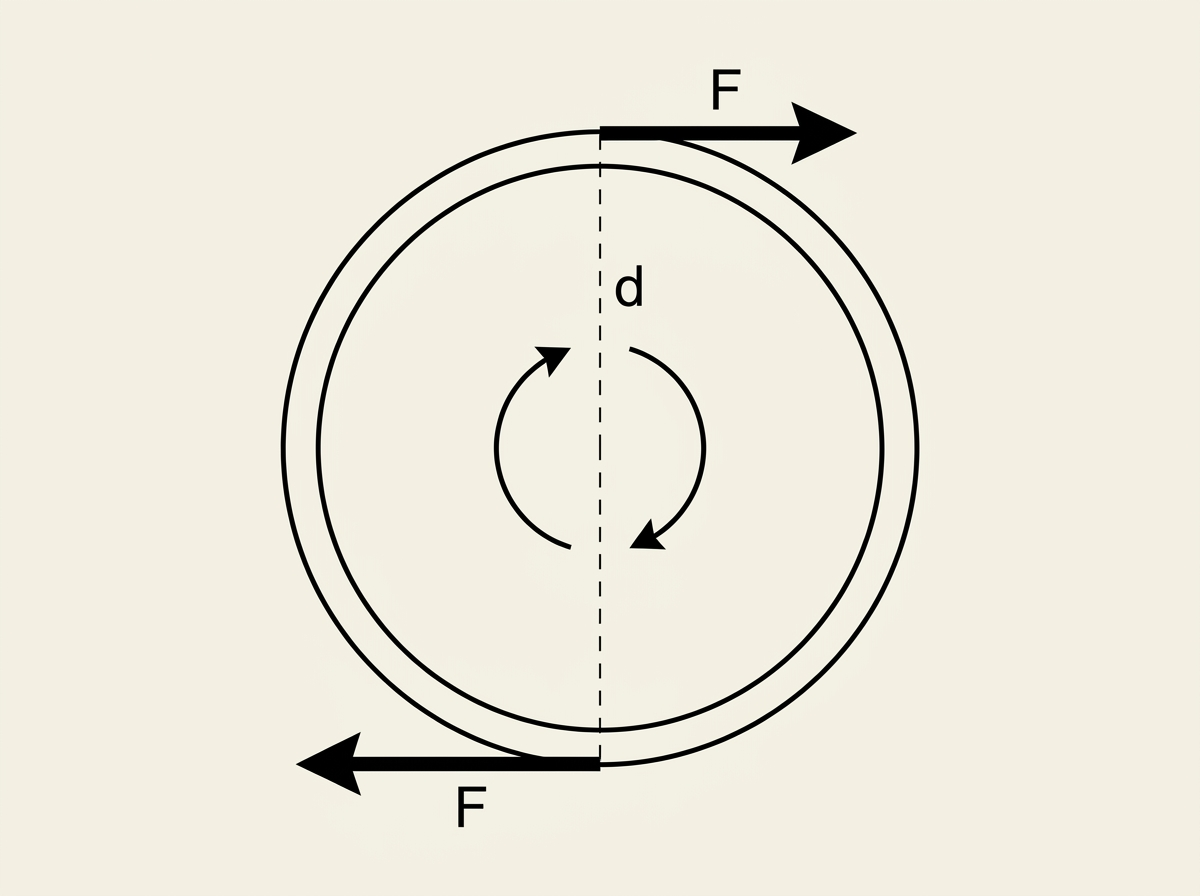
A diagram of a steering wheel viewed face-on as a circle. At the top of the wheel rim, a force arrow points to the right, labelled F. At the bottom of the wheel rim, a second force arrow of the same length points to the left, also labelled F, so the two arrows are parallel, equal in length, and point in opposite directions. A vertical dashed line connects the two arrows showing the perpendicular distance d between their two lines of action, measured through the centre of the wheel. Small curved arrows around the centre of the wheel indicate the resulting rotational turning effect produced by the pair of forces.
A couple: two equal, opposite, parallel forces separated by a perpendicular distance d, producing pure rotation with no net force.

The moment of a couple is defined the same way as for a single force, but using the perpendicular distance between the two lines of action:

$\text{moment of a couple} = \text{force} \times \text{perpendicular distance between the two lines of action}$

What makes a couple special is that this total turning effect is the same no matter which point you take moments about — not just the midpoint between the two forces.

DerivationThe moment of a couple is independent of the pivot chosen
1
Take a couple made of two forces, each of magnitude $F$, with their lines of action separated by a fixed perpendicular distance $d$. Choose any point $P$ in the plane, not necessarily between the two forces.
The whole point is to show the choice of $P$ doesn't matter, so we mustn't assume anything convenient about where it sits.
2
Let $d_1$ be the perpendicular distance from $P$ to the line of action of the first force, and $d_2$ the perpendicular distance from $P$ to the line of action of the second force. Because the two lines of action are themselves a fixed distance $d$ apart, these two distances are related by $d_1 - d_2 = d$ (if $P$ lies outside the pair) or $d_1 + d_2 = d$ (if $P$ lies between them) — either way, one combination of $d_1$ and $d_2$ is fixed and equal to $d$.
This is just the geometry of three parallel lines a fixed distance apart, with $P$ placed anywhere among them.
3
The two forces turn the plane in the same rotational sense about $P$ (that's the defining feature of a couple), so their individual moments about $P$ add rather than cancel: total moment $= Fd_1 + Fd_2$ if $P$ lies between the lines, or $Fd_1 - Fd_2$ if $P$ lies outside them.
4
Substituting the relationship from step 2 into either case: $Fd_1+Fd_2 = F(d_1+d_2) = Fd$, or equally $Fd_1-Fd_2=F(d_1-d_2)=Fd$.
Either geometric case collapses to the same expression.
5
So the total moment about $P$ is $Fd$ regardless of where $P$ was chosen — the position of $P$ has completely cancelled out of the final result.
This is why a couple is described as producing a "pure" turning effect: it turns everything in the plane by the same amount, whichever point you judge the rotation from.
▪ derived

The principle of moments

A rigid body acted on by several forces is said to be in rotational equilibrium when it has no tendency to start spinning. The condition for this is the principle of moments:

Principle of moments

For a body in rotational equilibrium, the sum of the clockwise moments about any point equals the sum of the anticlockwise moments about that same point.

"About any point" means you're free to choose whichever point makes the algebra easiest — often a point where an unknown force acts, since that force then has zero moment (no perpendicular distance from itself) and drops out of the equation.

A classic setting is a beam or see-saw balanced on a pivot with several weights at different distances: sum the clockwise moments, sum the anticlockwise moments, set them equal. The same logic applies to a cable tension holding up a shop sign or the reaction force at a bridge support.

Worked exampleBalancing a see-saw
1
A uniform see-saw is pivoted at its centre. A child of weight $300$ N sits $1.8$ m from the pivot. A second child sits on the opposite side, $1.2$ m from the pivot. What weight must the second child have for the see-saw to balance?
The see-saw itself is uniform, so its own weight acts through the pivot and contributes no moment about that point — only the two children matter.
2
Take moments about the pivot. Clockwise moment (first child): $300 \times 1.8 = 540$ N m.
3
Anticlockwise moment (second child): $W \times 1.2$, where $W$ is the unknown weight.
4
By the principle of moments, these are equal: $W \times 1.2 = 540$.
5
$W = \dfrac{540}{1.2} = 450$ N.
▪ answer

Centre of mass

Every extended object is a huge collection of tiny masses, each contributing its own tiny weight and moment. Instead of tracking each one, physics defines a single point — the centre of mass — where the object's entire weight can be treated as acting for moments and equilibrium. Every calculation then becomes as simple as a single-particle problem.

For a uniform object (same density throughout, with some symmetry of shape), the centre of mass sits at the geometric centre: a sphere's at its centre, a cube's at its centre, a rod's at its midpoint.

Non-uniform or irregular objects — a cricket bat heavier at one end, an L-shaped bracket — don't have their centre of mass at an obvious point; it's often found by treating the object as several simple regular pieces and combining them, but it's still the single point where the whole object's weight acts.

Locating the centre of mass of a system of point masses

The cleanest version of this problem is a set of point masses joined by a light (massless) rod or frame — several weights strung along a metre rule. The centre of mass is the single position where hanging one total mass would produce the same turning effect as the real, spread-out arrangement — an application of the principle of moments.

DerivationCentre of mass of point masses on a line
1
Take masses $m_1, m_2, m_3, \dots$ fixed at positions $x_1, x_2, x_3, \dots$ measured from some chosen origin along a line, joined by a light rod. Let $\bar{x}$ be the position of the centre of mass, still to be found.
The origin can be anywhere convenient — one end of the rod is the usual choice.
2
By definition, $\bar{x}$ is the point where a single total mass $M = m_1+m_2+m_3+\dots$ would produce the same moment about the origin as all the individual masses do together.
This is exactly the "replace the whole messy distribution with one force" idea from earlier in this lesson, applied to moments rather than just weight.
3
The moment of the single replacement mass about the origin is $Mg\bar{x}$. The total moment of the individual masses about the same origin is $m_1gx_1 + m_2gx_2 + m_3gx_3+\dots$
Every term here is (weight) × (perpendicular distance from the origin), exactly the moment definition from earlier.
4
Setting these equal and cancelling $g$ from every term: $M\bar{x} = m_1x_1+m_2x_2+m_3x_3+\dots$
5
Rearranging gives the position of the centre of mass: $\bar{x} = \dfrac{m_1x_1+m_2x_2+m_3x_3+\dots}{m_1+m_2+m_3+\dots}$.
This is a weighted average of the positions, with each position weighted by its own mass — heavier masses pull $\bar{x}$ towards themselves, exactly as you'd expect.
▪ derived

The same idea extends directly to masses spread across a flat plane rather than along a single line — you just apply the formula separately to find an $\bar{x}$ coordinate and a $\bar{y}$ coordinate, using the horizontal and vertical distances of each mass from a chosen origin in turn.

Why this matters for equilibrium

An object is in complete equilibrium (translational and rotational) only when both conditions hold: the vector sum of all forces is zero, and the principle of moments is satisfied. A see-saw can have balanced moments while still accelerating sideways under an unbalanced horizontal force, or zero net force while still spinning if the forces don't share a common line of action.

Key takeaways

  • Moment of a force $= F \times d$, where $d$ must be the perpendicular distance from the pivot to the force's line of action — not the distance along the object to the point of application.
  • A couple is a pair of equal, opposite, coplanar forces with different lines of action; its moment is $F \times d$, using the perpendicular distance between the two lines of action.
  • The moment of a couple is the same about any point in the plane — the position of the chosen point always cancels out of the calculation.
  • The principle of moments: for a body in rotational equilibrium, the sum of clockwise moments about any point equals the sum of anticlockwise moments about that same point.
  • You can choose any point to take moments about — choosing a point where an unknown force acts is a common trick, since it removes that force from the equation.
  • Centre of mass is the single point where an object's entire weight can be considered to act, for the purposes of moments and equilibrium.
  • For a uniform regular solid (sphere, cube, uniform rod), the centre of mass is at its geometric centre.
  • For a system of point masses on a line, the centre of mass is the weighted average position $\bar{x} = \dfrac{\sum m_ix_i}{\sum m_i}$, found by equating the moment of the total mass to the sum of the individual moments.