Stress, Strain & Elastic Energy
Pull back a catapult and you're doing work against the elastic band — work that doesn't vanish but gets stored, ready to release the instant you let go. This lesson derives how much energy gets stored when a material stretches elastically, and follows where that energy goes next.
Elastic strain energy
Stretching a material within its elastic limit requires doing work against the resisting force, and that work doesn't disappear — it's stored as elastic strain energy (elastic potential energy). Release the material and, provided it stayed within its elastic limit, that stored energy is recovered in full as it returns to its original shape.
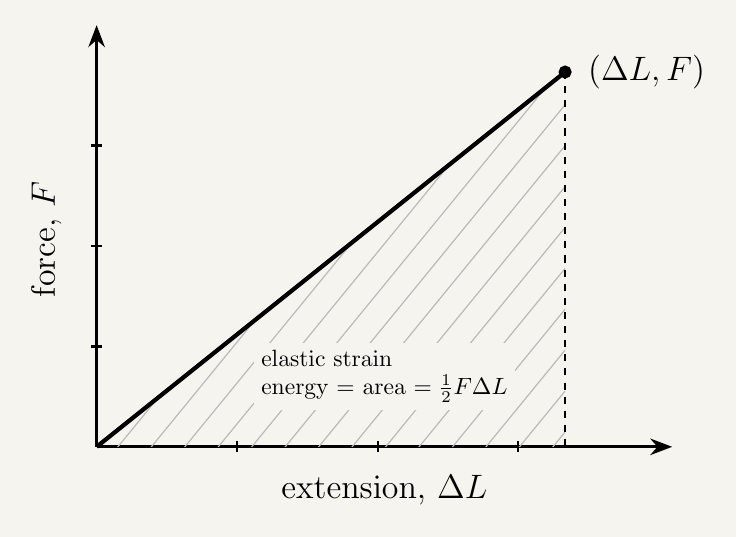
The energy stored can be found from a force-extension graph, using the same reasoning as work done under any varying force: it's the area under the graph.
Using $F=k\Delta L$, this can equally be written $E_{\text{el}} = \tfrac{1}{2}k(\Delta L)^2$ — the same formula as for a stretched or compressed spring. For a material stretched beyond its elastic limit, the loading and unloading curves no longer coincide, and the area between them represents energy spent permanently rearranging the material's internal structure rather than recovered.
Hysteresis in rubber-like materials
Diverging loading and unloading curves aren't only a sign of permanent, plastic damage. Rubber and similar polymers show a related but distinct effect called elastic hysteresis: stretch a rubber band and let go, and it returns to very close to its original length — still behaving elastically, with no permanent set — yet the unloading curve sits below the loading curve, enclosing a loop rather than retracing the same line.
That loop area still represents energy. The area under the loading curve is the work done stretching the rubber; the smaller area under the unloading curve is the energy actually recovered. The difference — the loop area — went in but didn't come back out as useful work: it's dissipated as heat, generated by internal friction between tangled polymer chains sliding past one another during stretching and relaxing.
This is why a rubber ball never bounces back to its drop height. Each bounce is one loading-unloading cycle, and the hysteresis loop means some kinetic energy is lost as heat rather than returned on rebound — no permanent deformation is needed for this to happen.
Beyond the elastic limit, a loading/unloading mismatch signals permanent damage: the material doesn't return to its original length. Rubber hysteresis is different — it happens well within the elastic limit, the material does return to (approximately) its original length, and the lost energy is simply dissipated as heat each cycle, not spent on lasting damage.
Ultimate tensile stress and breaking stress
Push a material further, well beyond its elastic limit, and two more landmark points appear. The ultimate tensile stress (UTS) is the maximum stress the material reaches — the peak of the curve. For a ductile material (deforms substantially before failing, like copper), the UTS is where the sample starts to neck: it develops a localised narrowing, and since stress is force over cross-sectional area, that thinner region sees rapidly rising stress even as applied force stays the same or falls. As a result, plotted stress can appear to fall past the UTS even though the material hasn't failed yet.
The point where the sample actually separates is the breaking stress (fracture stress) — for a ductile material, a separate point from the UTS, usually lower because of necking. For a brittle material (little to no plastic deformation, like glass or cast iron), there's no necking: the sample fractures right at its peak stress, so UTS and breaking stress coincide.
Both are genuine material properties, just like the Young modulus, since stress already accounts for cross-sectional area — a thick rod and a thin wire of the same material reach the same UTS and breaking stress, even though the rod withstands much larger forces.
Where elastic strain energy goes
Elastic strain energy rarely stays put once released — it typically converts into other forms in line with conservation of energy. A stretched catapult releases stored strain energy as kinetic energy in its projectile. A bungee cord converts a falling jumper's gravitational potential energy into elastic strain energy on the way down, then hands much of it back as kinetic and gravitational potential energy on the rebound. A pole vaulter bends a flexible pole on the run-up, storing strain energy that's released to help convert horizontal kinetic energy into the gravitational potential energy of clearing the bar.
In each case total energy is conserved — the useful outcome comes from tracking how energy moves between elastic strain, kinetic and gravitational potential stores.
Key takeaways
- Elastic strain energy is the energy stored in a material stretched within its elastic limit, fully recoverable when the force is removed.
- Elastic strain energy equals the area under a force-extension graph; for a material obeying Hooke's law this is a triangle, giving $E_{\text{el}} = \tfrac{1}{2}F\Delta L = \tfrac{1}{2}k(\Delta L)^2$.
- Rubber-like materials show elastic hysteresis: loading and unloading curves form a loop even though the material stays elastic and returns to its original length — the loop area is energy dissipated as heat each cycle, which is why a rubber ball loses height on every bounce.
- Ultimate tensile stress (UTS) is the peak stress on the graph; for ductile materials this is where necking begins, and the sample fractures separately at a (usually lower) breaking stress. For brittle materials, UTS and breaking stress coincide.
- Beyond the elastic limit, loading and unloading curves diverge because of permanent deformation, and the area between them represents energy spent on lasting damage rather than heat.
- In practical situations, elastic strain energy typically converts into kinetic and/or gravitational potential energy, consistent with overall conservation of energy.