Density & Upthrust
A steel ship floats; a steel ball bearing sinks. Both are steel, both denser than water, and both experience an upward force from the water they displace — so floating vs sinking isn't about the material alone. This lesson builds density and upthrust from scratch, and derives where that upward force comes from.
Density
Density describes how much mass is packed into a given volume of a substance. For a uniform material it's defined as:
where $\rho$ is density, $m$ is mass, and $V$ is volume. The SI unit is kilograms per cubic metre (kg m−3), though data tables often use g cm−3: 1 g cm−3 = 1000 kg m−3.
Density is a property of the material, not of any particular sample. A pebble and a boulder of the same rock have wildly different masses and volumes but identical density, since mass and volume scale together. That's what makes density useful for identifying materials — and why it matters for whether something floats.
| Substance | Typical density |
|---|---|
| Air | ≈ 1.2 kg m−3 |
| Water | ≈ 1000 kg m−3 |
| Ice | ≈ 920 kg m−3 |
| Steel | ≈ 7800 kg m−3 |
| Gold | ≈ 19300 kg m−3 |
Pressure
Pressure is force acting per unit area, applied perpendicular to a surface:
where $F$ is the perpendicular force and $A$ is the area it acts over. The SI unit is the pascal (Pa), where $1\ \text{Pa} = 1\ \text{N m}^{-2}$. Spreading the same force over a larger area reduces the pressure — the idea behind snowshoes and drawing pins.
Pressure in a fluid increases with depth
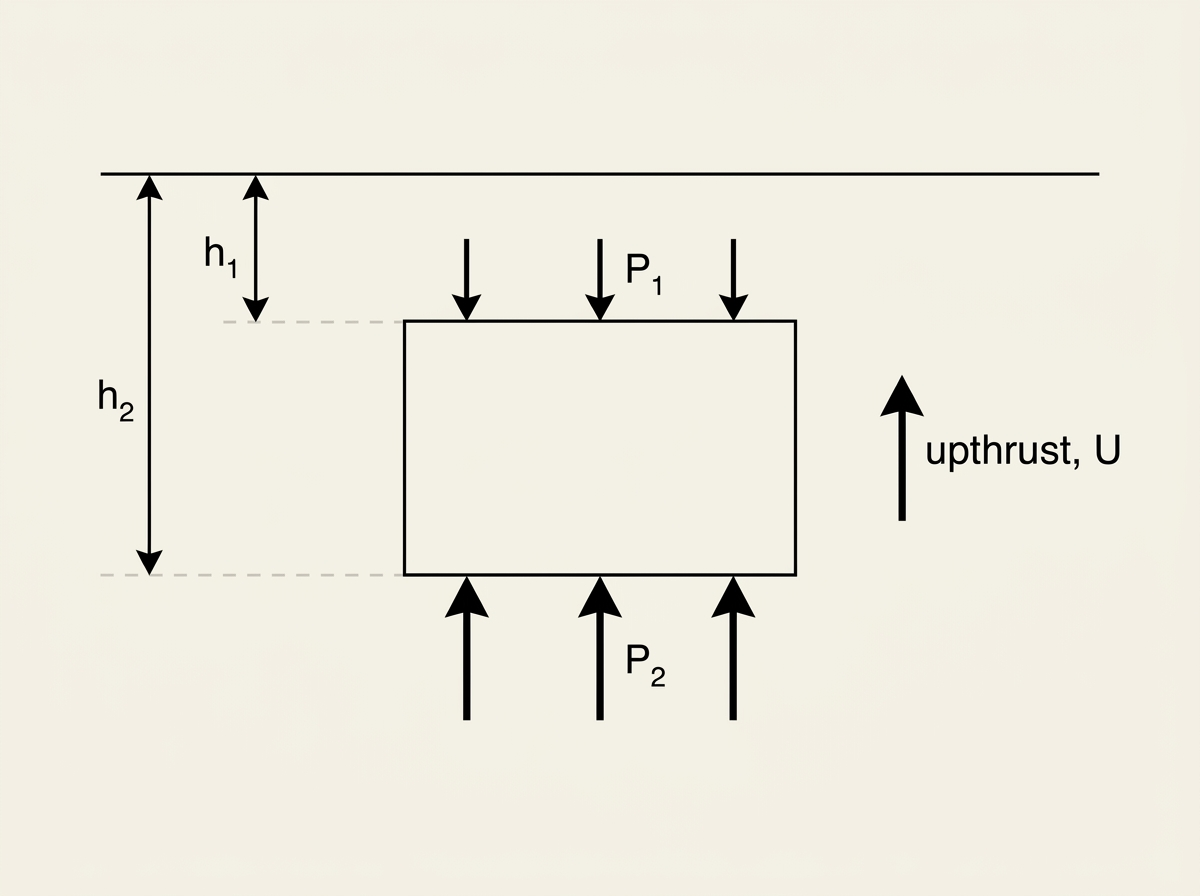
To understand upthrust, you first need one fact: pressure increases with depth. A column of fluid above a point has weight, which the fluid below must support — so fluid at greater depth is under more pressure than fluid near the surface.
Applied to a submerged object, this single fact explains upthrust.
The pressure at depth $h$ below the surface of a fluid of density $\rho$ is $P = \rho g h$, measured in pascals (Pa) with $\rho$ in kg m−3, $g$ in m s−2 and $h$ in m. This is on top of whatever pressure already acts at the surface (atmospheric pressure, if the fluid is open to the air) — it's the extra pressure due to the weight of fluid above that depth.
Upthrust and Archimedes' principle
Any object submerged, partly or fully, in a fluid experiences an upward force from that fluid, called upthrust. It's why objects feel lighter underwater, why a helium balloon rises, and why a steel ship floats despite steel being denser than water. Upthrust arises directly from the pressure difference between the bottom and top of the submerged object.
So Archimedes' principle: the upthrust on a fully or partially submerged object equals the weight of the fluid it displaces. It applies equally to liquids and gases — the same effect keeps a hot air balloon aloft and a swimmer buoyant.
Floating and sinking
Whether an object floats or sinks comes down to comparing the upthrust it would experience if fully submerged with its actual weight.
- If full-submersion upthrust is less than weight, the object sinks — the fluid can never push hard enough to support it.
- If full-submersion upthrust would exceed weight, the object rises and floats with only part of its volume submerged, sinking in just enough for the upthrust on that fraction to balance its weight.
- If the two are exactly equal at full submersion, the object is in equilibrium fully submerged — as with a submarine holding constant depth.
This is why a solid steel ball sinks but a steel ship floats: the ball's full-submersion upthrust (set by steel's volume and water's density) can never match its weight. The ship's hull encloses a huge volume of air, so it displaces far more water for the same mass of steel — enough that upthrust exceeds weight well before full submersion.
For an object floating in equilibrium, the upthrust exactly equals its weight: $\rho_{\text{fluid}}\,g\,V_{\text{submerged}} = mg$, where $V_{\text{submerged}}$ is only the volume of the object actually below the surface, not its total volume.
Key takeaways
- Density is $\rho = m/V$, measured in kg m−3 — a property of the material, independent of the size of the sample.
- Pressure is $P = F/A$, measured in pascals (Pa), where $1\ \text{Pa} = 1\ \text{N m}^{-2}$.
- Pressure in a fluid increases with depth according to $P = \rho g h$, because a deeper point has more fluid weight stacked above it.
- This depth-pressure difference means the upward force on the bottom of a submerged object exceeds the downward force on its top — the source of upthrust.
- Archimedes' principle: upthrust equals the weight of fluid displaced, $U = \rho_{\text{fluid}}\,g\,V_{\text{displaced}}$, derived directly from the pressure difference between top and bottom faces.
- An object sinks if the upthrust at full submersion is less than its weight, and floats (partially submerged) if that upthrust would exceed its weight.
- A floating object settles at the depth where upthrust on its submerged volume exactly equals its total weight.