Alternating Currents
An alternator's output constantly changes direction and magnitude, so "the current" or "the voltage" of an AC supply isn't a single fixed number the way it is for a battery. This lesson defines the peak and root-mean-square (rms) values that let us describe an AC supply meaningfully, and uses them to work out the power it delivers.
Peak and instantaneous values
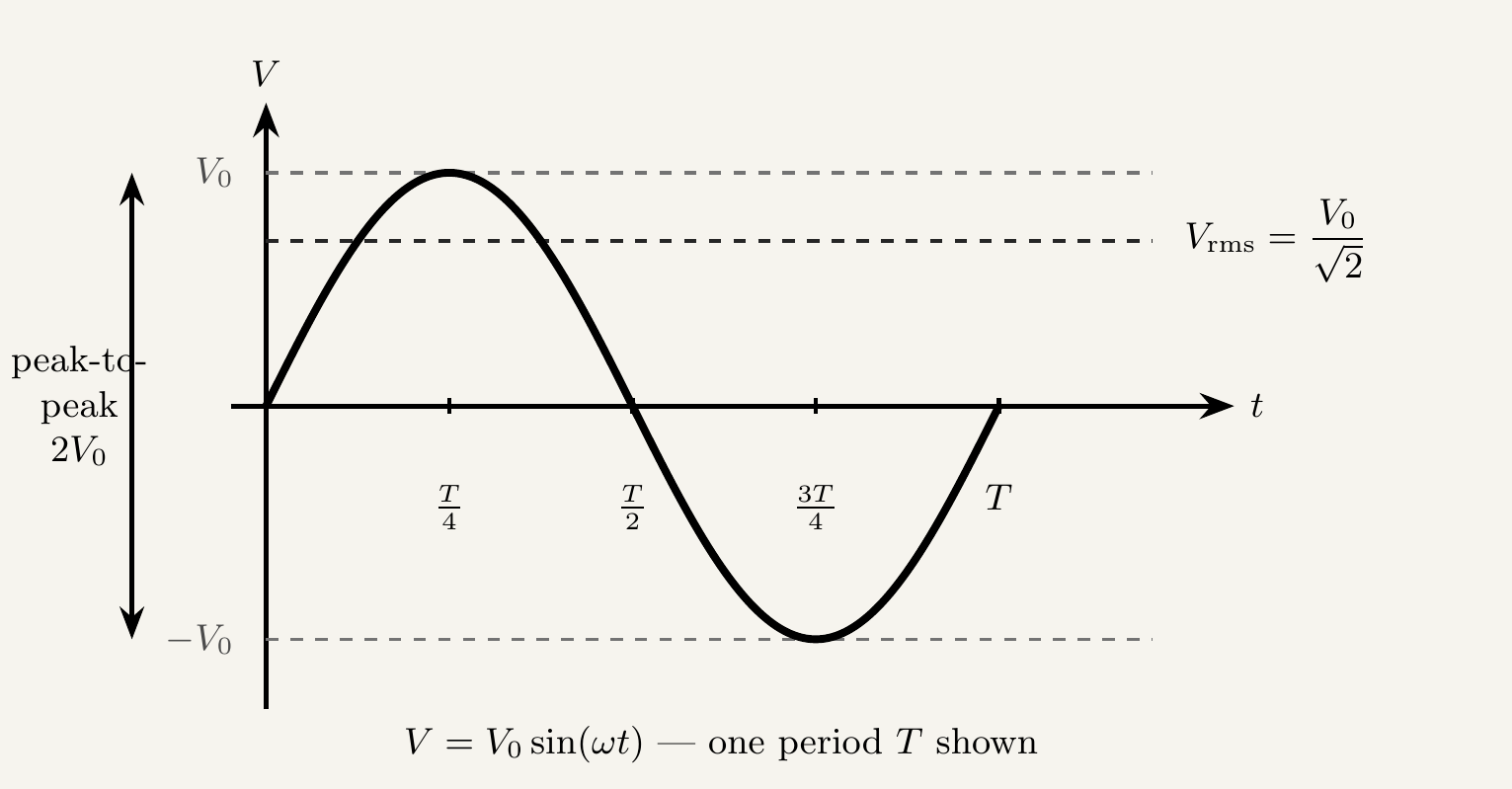
An alternating voltage varies sinusoidally with time, $V=V_0\sin(\omega t)$, where $V_0$ is the peak voltage — the maximum value reached each cycle — and $V$ is the instantaneous voltage at time $t$. If the supply drives current through a fixed resistance $R$, the current follows the same sinusoidal shape and is in phase with the voltage: $I=I_0\sin(\omega t)$, with peak current $I_0=V_0/R$.
Why we need an rms value
The average of a symmetric sine wave over a full cycle is zero — it spends as much time negative as positive, so a simple mean tells you nothing useful about how much power it delivers. Power dissipated in a resistor depends on $I^2R$, though, and $I^2$ is always positive whichever way the current is flowing. So instead of averaging $I$ directly, we average $I^2$, then take a square root to get back to a current-like quantity — the root-mean-square, or rms, value.
The same argument applies equally to voltage, giving $V_{\text{rms}}=\dfrac{V_0}{\sqrt2}$. These are the values you'd actually measure with a standard AC voltmeter or ammeter, and the values quoted for mains supplies.
UK mains electricity is quoted as 230 V — this is $V_{\text{rms}}$, not the peak voltage. The actual peak voltage is $V_0=V_{\text{rms}}\times\sqrt2\approx325\text{ V}$, and the supply alternates at a frequency of 50 Hz.
Power in AC circuits
Because $I_{\text{rms}}$ and $V_{\text{rms}}$ are defined precisely so that they reproduce the same average power as an equivalent DC supply, the familiar DC power equations carry straight over, provided rms values are used throughout:
Using peak values instead would overstate the power by a factor of 2 — a common error to watch for. Always check whether a quoted current or voltage is a peak or an rms value before substituting into a power equation.
Key takeaways
- An alternating supply is described by $V=V_0\sin(\omega t)$ and $I=I_0\sin(\omega t)$, with $V_0$ and $I_0$ the peak values.
- Because a sine wave averages to zero over a cycle, power delivery is instead described using root-mean-square values: $I_{\text{rms}}=\dfrac{I_0}{\sqrt2}$ and $V_{\text{rms}}=\dfrac{V_0}{\sqrt2}$.
- rms values are defined as the equivalent steady (DC) values that would deliver the same average power — and are what AC meters actually read.
- Average power: $\overline{P}=I_{\text{rms}}V_{\text{rms}}=I_{\text{rms}}^2R=V_{\text{rms}}^2/R$ — using peak values here overstates the power by a factor of 2.
- UK mains is 230 V rms at 50 Hz, corresponding to a peak voltage of about 325 V.