Circular Motion & Angular Velocity
A point on a spinning CD, a satellite in orbit, and the tip of a clock's second hand are all doing the same kind of motion — moving at constant speed around a circle. That word "constant" hides something strange: even though speed never changes, velocity changes every instant. Untangling that apparent contradiction is where circular motion starts.
Measuring angles in radians
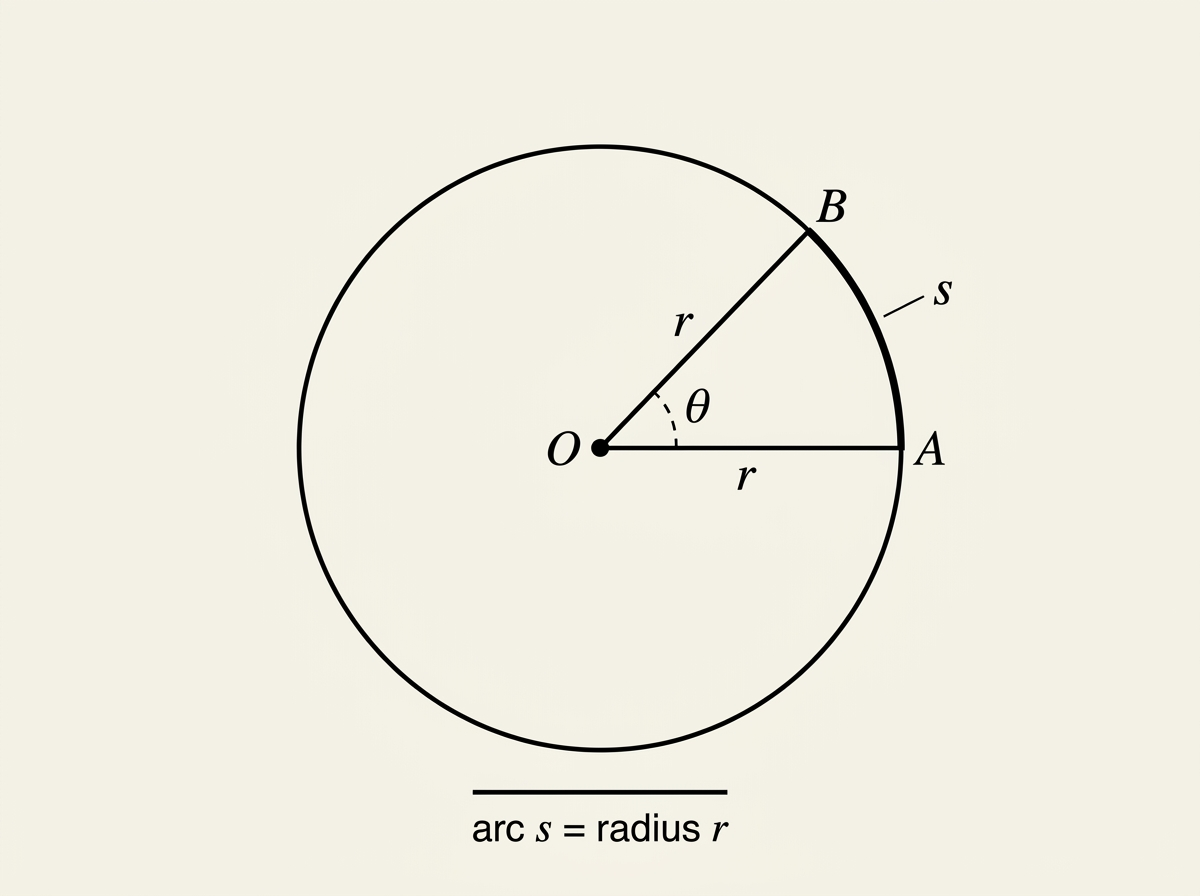
Degrees are a somewhat arbitrary unit — 360 of them in a circle, for historical reasons connected to Babylonian astronomy. Circular motion is described more naturally using the radian, defined so that an angle of $1$ radian is subtended at the centre of a circle by an arc equal in length to the radius.
Since the full circumference is $2\pi r$, a complete revolution corresponds to $\dfrac{2\pi r}{r}=2\pi$ radians — so $2\pi\,\text{rad}=360°$, and $1\,\text{rad}\approx57.3°$. The advantage of radians isn't just tidiness: equations linking angular and linear quantities (like $v=\omega r$, coming up shortly) only take their simple form in radians — degrees would require an awkward conversion factor every time.
Angular velocity
Just as velocity describes how fast a linear position changes, angular velocity $\omega$ describes how fast an angle is swept out:
with units of radians per second (rad s⁻¹). For an object moving at constant speed around a circle, one full revolution ($2\pi$ radians) takes one period $T$, so:
where $f=1/T$ is the frequency of revolution in hertz. This pair of relationships — $\omega=2\pi/T=2\pi f$ — is used constantly throughout circular motion and reappears in oscillations, so it's worth being fluent switching between $\omega$, $T$ and $f$.
Linking angular and linear speed
An object moving around a circle of radius $r$ still has an ordinary speed $v$ — metres travelled per second along the path. That linear speed and the angular velocity are directly related.
Why constant speed still means changing velocity
Velocity is a vector — it has both magnitude (speed) and direction. For an object travelling around a circle at constant speed, the magnitude never changes, but its direction changes constantly: velocity in circular motion is always tangential — along the tangent to the circle at the object's current position, perpendicular to the radius.
As the object moves around the circle, that tangent direction sweeps around too. A change in direction, even with fixed magnitude, is still a change in the velocity vector — and a changing velocity means a non-zero acceleration. This is the key idea the next lesson builds on: an object in uniform circular motion is constantly accelerating, even at constant speed, because its direction isn't constant.
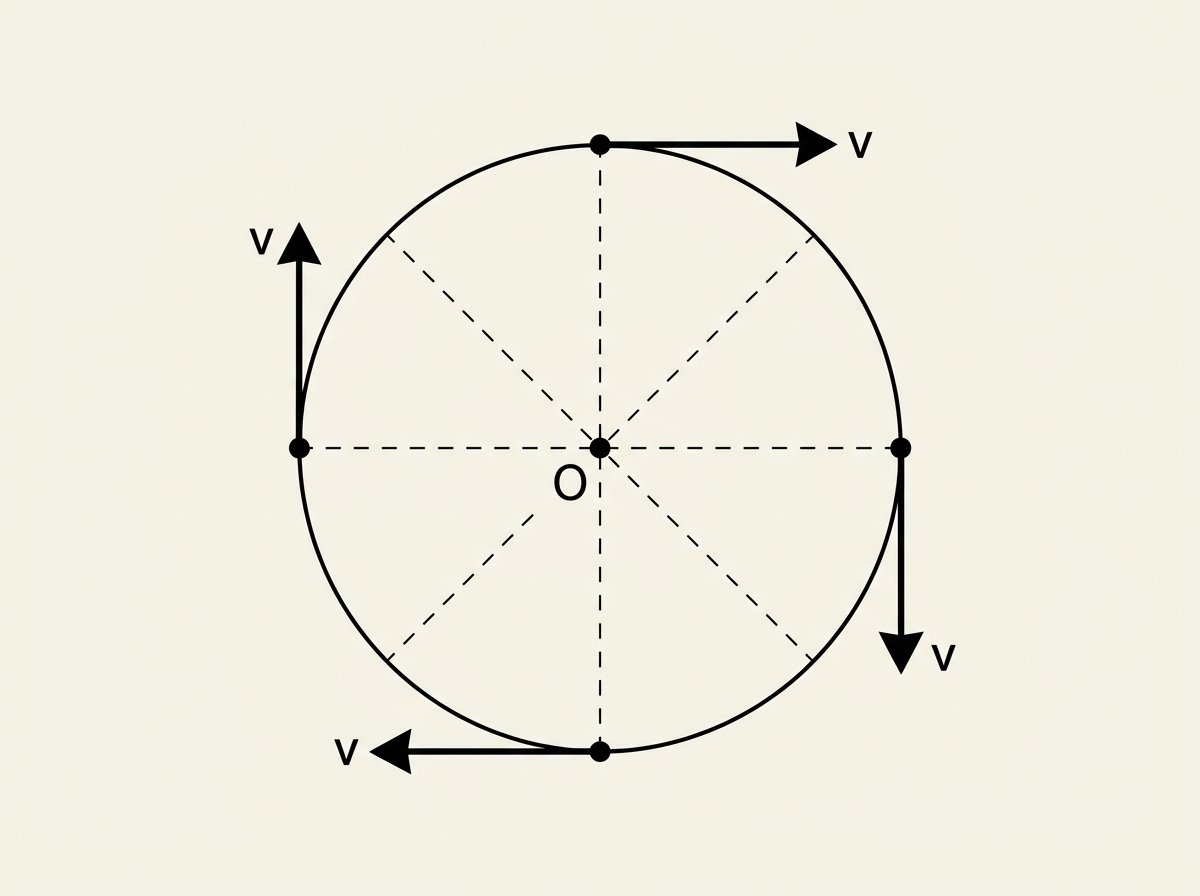
Uniform circular motion means constant speed, not constant velocity. Examiners exploit this: an object going around a circle at unchanging speed is still accelerating, because acceleration is the rate of change of velocity (a vector), and the direction component is changing throughout, even while the magnitude isn't.
Key takeaways
- The radian is defined by $\theta = s/r$; a full revolution is $2\pi$ radians ($360°$).
- Angular velocity $\omega = \dfrac{\Delta\theta}{\Delta t} = \dfrac{2\pi}{T} = 2\pi f$, measured in rad s⁻¹.
- Linear speed and angular velocity are linked by $v=\omega r$.
- Velocity in circular motion is always tangential — perpendicular to the radius at that point.
- Uniform circular motion has constant speed but continuously changing direction, so the velocity vector is always changing — meaning the object is always accelerating, even though its speed never does.