Every object moving in a circle accelerates toward the centre — not away from it, whatever your instinct in a spinning car tells you. There's no "centrifugal force" flinging things outward; there's only ever a real, ordinary force pulling inward. This lesson finds it, sizes it, and applies it to everything from conical pendulums to loop-the-loop tracks.
11 min read
The direction of the acceleration
The previous lesson established that an object moving at constant speed around a circle is still accelerating, because its velocity direction constantly changes. Which way does that acceleration point? A vector argument — subtracting the velocity vector at one instant from the velocity vector a moment later, for two nearby points on the circle — shows the change-in-velocity vector always points radially inward, toward the centre. This is why the acceleration in uniform circular motion is called centripetal acceleration ("centre-seeking"): at every instant it's directed from the object's position straight to the centre of its path.
There is no centrifugal force
The outward sensation you feel in a fast-cornering car isn't a real force pushing you outward — it's your own inertia. Your body's natural tendency (Newton's first law) is to travel in a straight line; the seat or door pushes you inward to keep you on the circular path, and what you feel is your body pressing back against that inward push. In an inertial frame, the only real force involved is centripetal — directed inward. "Centrifugal force" is fictitious, appearing only if you analyse motion from inside the rotating frame, and isn't needed in A-level mechanics.
Deriving the magnitude of centripetal acceleration
A common, mathematically direct approach for A-level uses the geometry of similar triangles formed by the position and velocity vectors at two close-together instants.
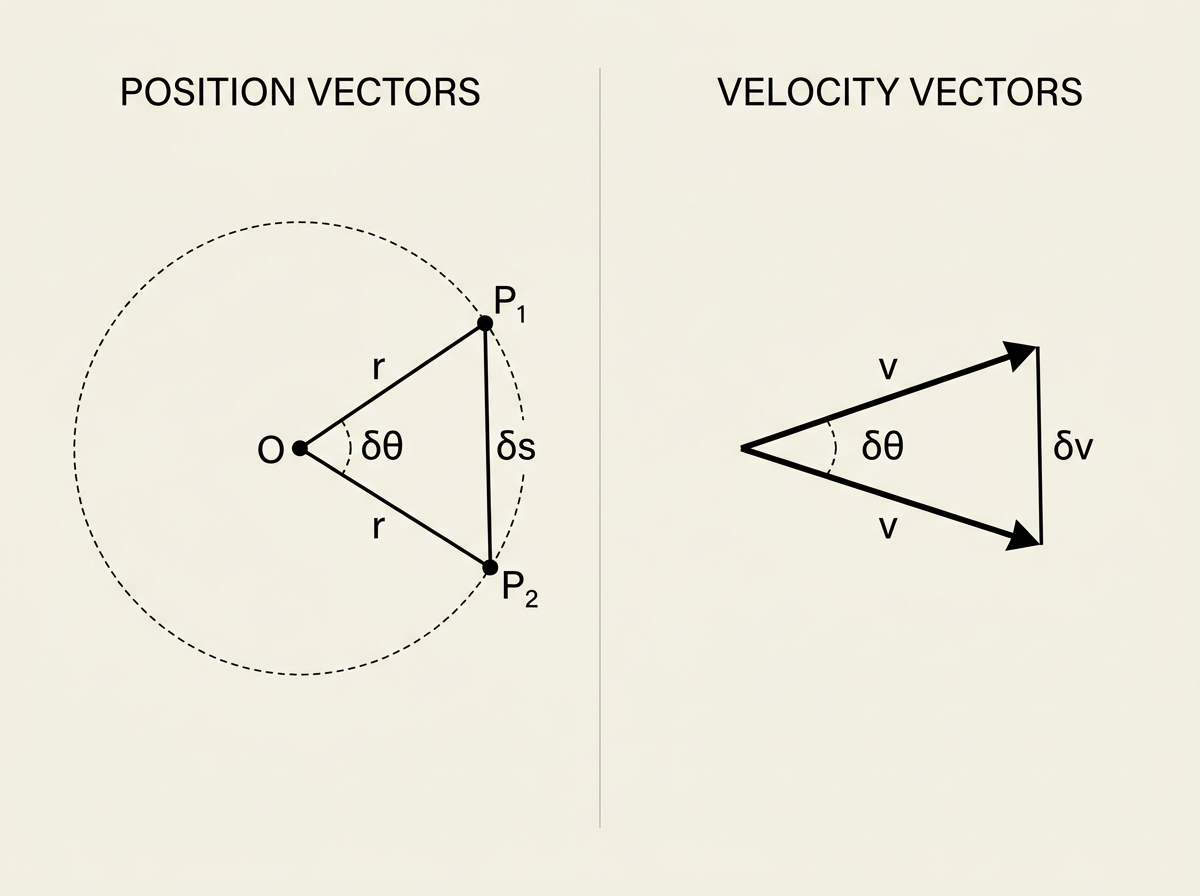
The position-vector triangle (left) and the velocity-vector triangle (right) are similar — same apex angle δθ, same isosceles shape — which is exactly what makes δv/v = δs/r true.
Derivationa = v²/r, via similar triangles
1
Consider an object moving at constant speed $v$ around a circle of radius $r$, at two positions separated by a small angle $\delta\theta$ and a short time $\delta t$.
2
The two position vectors (from the centre) both have length $r$ and are separated by angle $\delta\theta$; the two velocity vectors both have length $v$ and, because velocity is always perpendicular to the radius, are also separated by the same angle $\delta\theta$.
Rotating the position vector by $\delta\theta$ rotates the (perpendicular) velocity vector by the same $\delta\theta$.
3
This makes the "triangle" formed by the two position vectors and the small displacement between them similar to the "triangle" formed by the two velocity vectors and the small change in velocity, $\delta v$, between them — both are narrow isosceles triangles with the same small angle $\delta\theta$ at their apex.
4
Similar triangles give equal ratios of corresponding sides: $\dfrac{\delta v}{v} = \dfrac{\delta s}{r}$, where $\delta s = v\,\delta t$ is the small arc length travelled.
Dividing both sides by $\delta t$ gives the magnitude of the acceleration: $a = \dfrac{\delta v}{\delta t} = \dfrac{v^2}{r}$.
In the limit of a very small $\delta\theta$, the direction of $\delta v$ (and hence of $a$) points exactly toward the centre — confirming the earlier claim.
▪ derived
Using $v=\omega r$ from the previous lesson, this can be rewritten entirely in terms of angular velocity:
$a = \dfrac{v^2}{r} = \omega^2 r$
Both forms are equally valid and equally examinable — use whichever the question's given data makes more convenient.
Centripetal force
Applying Newton's second law, $F=ma$, gives the resultant force needed to keep an object on a circular path:
$F = \dfrac{mv^2}{r} = m\omega^2 r$
Centripetal force is not a new type of force
"Centripetal force" isn't a new fundamental force alongside gravity, tension, friction and the normal force — it's the name for whichever resultant of the real forces present is directed toward the centre and causes the circular motion. It might be supplied by tension, gravity, friction, the normal contact force, or a combination. Never draw a separate "centripetal force" arrow on a free-body diagram — identify which real force (or combination) is providing it.
Worked applications
The conical pendulum
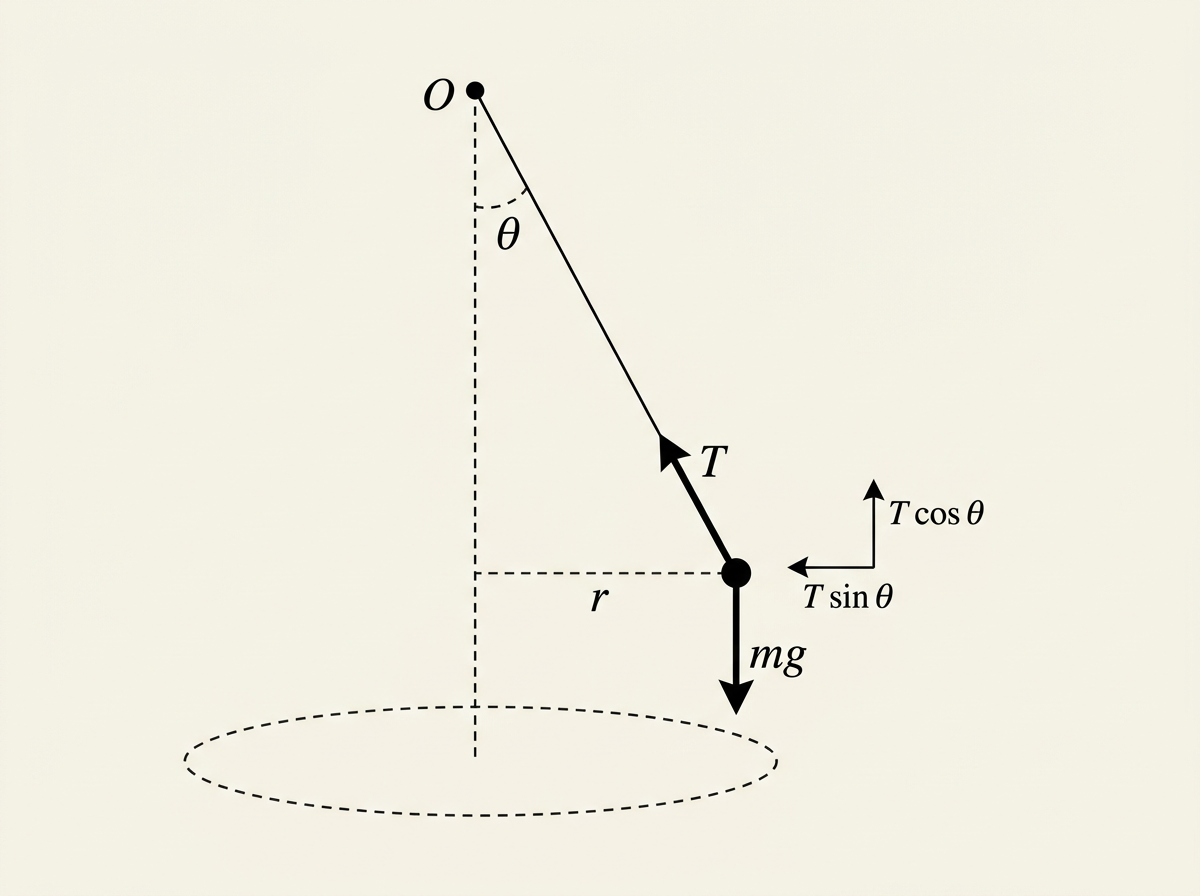
A mass on a string traces a horizontal circle while the string sweeps out a cone at a constant angle $\theta$ to the vertical. Only two forces act on the mass: tension $T$ in the string and its weight $mg$.
The tension T is the only force with a horizontal component, so resolving it into Tcos θ (vertical) and Tsin θ (horizontal) is the whole derivation in one picture.
DerivationResolving the tension in a conical pendulum
1
The mass moves in a horizontal circle at constant height, so it has no vertical acceleration — the vertical forces on it must balance exactly.
2
Resolve the tension $T$ into a vertical component $T\cos\theta$ and a horizontal component $T\sin\theta$, where $\theta$ is the angle the string makes with the vertical.
3
Vertical equilibrium: the vertical component of tension balances the weight, $T\cos\theta = mg$.
4
Horizontal: the only horizontal force is $T\sin\theta$, and it points toward the centre of the circle, so it is entirely responsible for the centripetal force needed for the circular motion: $T\sin\theta = \dfrac{mv^2}{r}$.
This uses $F=mv^2/r$ from earlier in this lesson — here the "F" is supplied by the horizontal component of the tension.
5
Dividing the horizontal equation by the vertical one cancels $T$ and $m$ completely: $\tan\theta = \dfrac{v^2}{rg}$.
A compact result linking the pendulum's angle directly to its speed, with no need to know the tension or the mass at all.
▪ derived
A car on a flat, unbanked curve
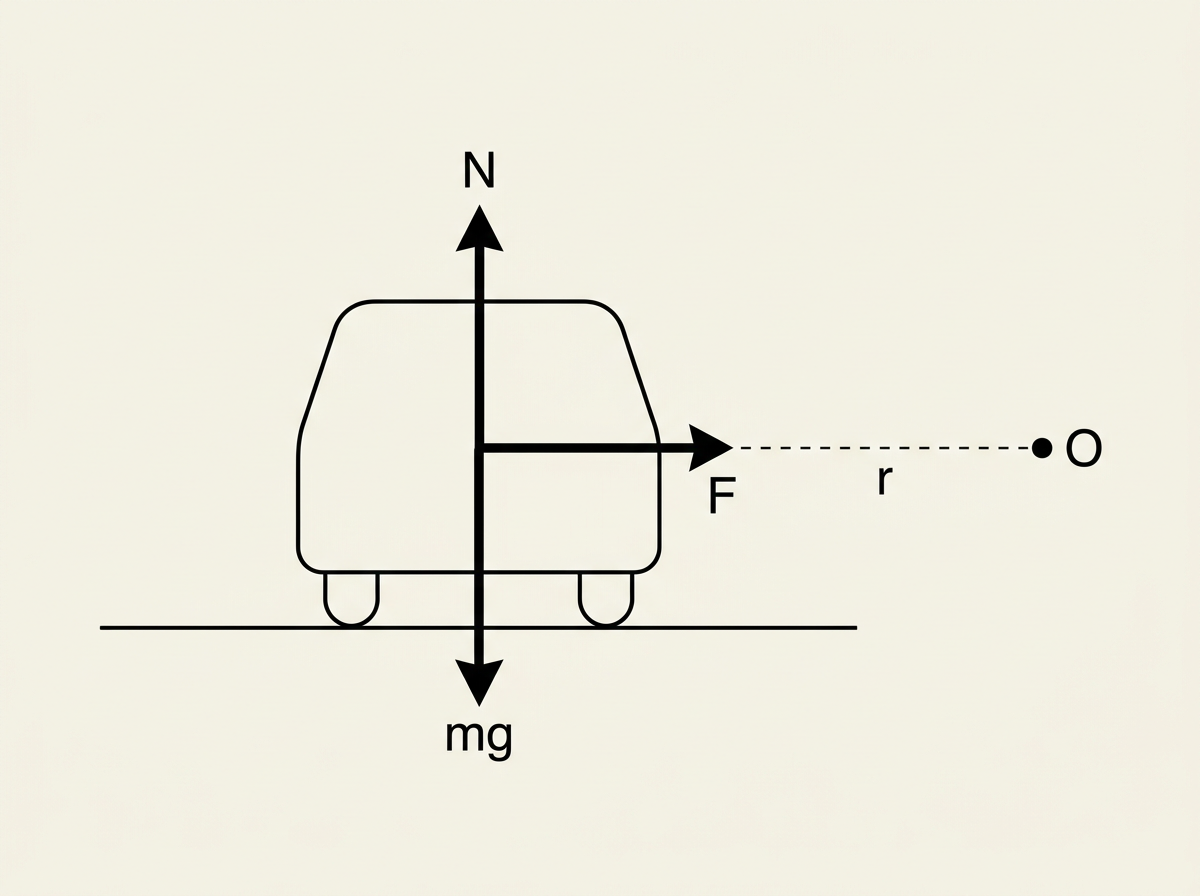
On a flat road, the only horizontal force available to keep a car on a curved path is friction between tyres and road.
Three forces, but only friction has a horizontal component — everything about the maximum cornering speed follows from how much friction can supply.
DerivationFriction as the centripetal force, and the maximum cornering speed
1
Three forces act on the car: weight $mg$ (down), normal contact force $N$ (up), and friction $F_{friction}$ (horizontal, toward the centre of the curve).
2
Vertical equilibrium (the car doesn't accelerate vertically): $N=mg$.
3
Horizontal: friction is the only horizontal force present, so it alone must provide the centripetal force: $F_{friction}=\dfrac{mv^2}{r}$.
4
The maximum friction force available before the tyres skid is $F_{max}=\mu N = \mu mg$, where $\mu$ is the coefficient of friction between tyre and road.
5
Setting the required centripetal force equal to this maximum gives the fastest speed the bend can be taken without skidding: $\dfrac{mv_{max}^2}{r}=\mu mg \implies v_{max}=\sqrt{\mu rg}$.
Exceeding $v_{max}$ means the required centripetal force outstrips what friction can supply, and the car slides outward off its intended path — not because of any outward force, but because the inward force was no longer sufficient.
▪ derived
A car on a banked curve
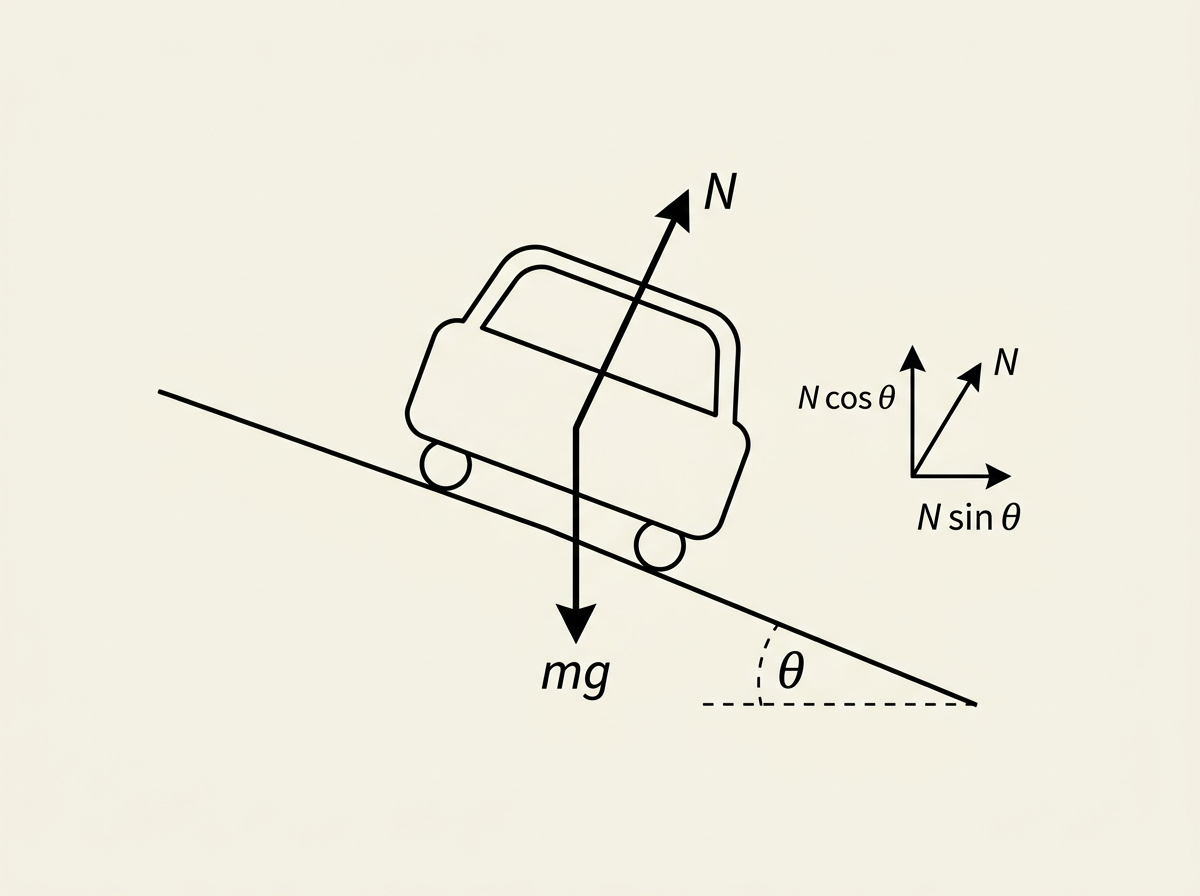
Banking the road tilts the normal contact force inward, so it can supply some — or, at exactly the right speed, all — of the centripetal force, reducing or eliminating reliance on friction.
Tilting the road tilts N with it — the same resolving-forces method as the conical pendulum, just with N playing the role T played there.
DerivationThe "design speed" of a banked curve
1
At the design speed, the car needs no friction at all: only two forces act — weight $mg$ (down) and normal force $N$ (perpendicular to the banked road surface, tilted at angle $\theta$ to the vertical).
2
Resolve $N$ into a vertical component $N\cos\theta$ and a horizontal component $N\sin\theta$ — exactly the same resolving step as the conical pendulum's tension.
3
Vertical equilibrium: $N\cos\theta = mg$.
4
Horizontal: the horizontal component alone provides the centripetal force, since no friction is needed: $N\sin\theta = \dfrac{mv^2}{r}$.
5
Dividing the two equations cancels $N$ and $m$: $\tan\theta=\dfrac{v^2}{rg} \implies v=\sqrt{rg\tan\theta}$.
This is the one specific speed — the "design speed" — at which a car on this bank angle needs zero friction to corner safely. Racetrack and motorway curves are banked so that typical traffic speeds sit close to this value.
▪ derived
Vertical circular motion
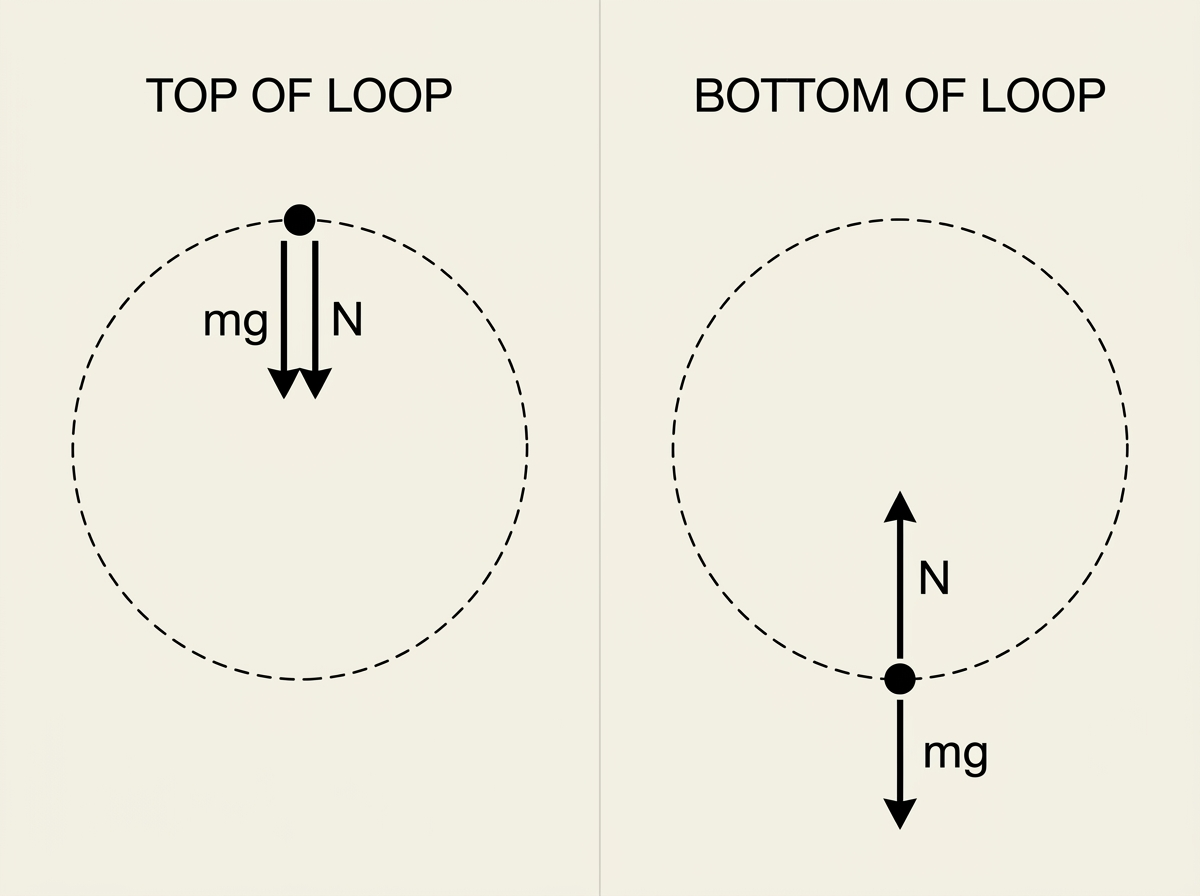
For an object on the inside of a vertical circular track (like a rollercoaster loop), the direction "toward the centre" changes constantly relative to gravity — so gravity and the normal force combine differently depending on the object's position on the loop.
At the top and bottom, gravity has a full component toward or away from the centre. At the side, gravity is entirely tangential — it doesn't affect the centripetal force at that instant at all.
DerivationApplying F = ma at the top, bottom and sides of the loop
1
At the top of the loop, both weight $mg$ and normal force $N$ point downward — toward the centre. Newton's second law along the direction to the centre gives their sum equal to the required centripetal force: $mg+N=\dfrac{mv^2}{r} \implies N=\dfrac{mv^2}{r}-mg$.
2
At the bottom of the loop, $N$ points upward (toward the centre) while $mg$ points downward (away from the centre), so Newton's second law gives their difference equal to the centripetal force: $N-mg=\dfrac{mv^2}{r} \implies N=\dfrac{mv^2}{r}+mg$.
This is why the normal force — and the sensation of your own weight — is greatest at the bottom of a loop and smallest at the top.
3
At the sides of the loop (the 3 o'clock and 9 o'clock positions), the direction toward the centre is horizontal, while $mg$ still acts straight down — entirely tangential to the circle at this point, with no component toward or away from the centre at all. So the normal force alone supplies the centripetal force here: $N=\dfrac{mv^2}{r}$.
Gravity hasn't switched off — it's still acting on the object — but at this instant it only affects the object's speed (decelerating it as it climbs from the side toward the top, accelerating it as it falls back from the side toward the bottom), not the size of the centripetal force needed at that instant.
4
The track can only push on the object, never pull, so $N$ can't be negative. Setting $N=0$ in the top equation gives the minimum speed needed to maintain contact at the top: $mg=\dfrac{mv_{min}^2}{r} \implies v_{min}=\sqrt{gr}$.
Below this speed, gravity alone is already more than enough to supply the centripetal force, so the object falls away from the track before reaching the top.
▪ derived
Key takeaways
Centripetal acceleration points radially inward, toward the centre of the circular path, with magnitude $a=\dfrac{v^2}{r}=\omega^2r$.
Centripetal force $F=\dfrac{mv^2}{r}=m\omega^2r$ is the resultant of whatever real forces (tension, gravity, friction, normal force) are directed toward the centre — it is not a separate force in its own right.
There is no real "centrifugal force" in an inertial frame; the outward sensation felt in circular motion is inertia resisting the inward force.
Worked applications: conical pendulum ($T\sin\theta=mv^2/r$), car cornering (friction or banking supplies the centripetal force), and vertical circular motion, where gravity and the normal force add at the top of a loop and oppose at the bottom.