Elastic & Inelastic Collisions
Momentum is conserved in every collision, no exceptions. Kinetic energy is different — sometimes it survives intact, sometimes almost all of it vanishes into heat, sound and deformation. This lesson is about telling these cases apart and calculating what happens in each.
Two conservation laws, not one
Every collision in an isolated system conserves momentum — this follows directly from Newton's third law, and holds regardless of what the objects are made of or how they deform. What is not automatically conserved is kinetic energy. Whether it's conserved defines the type of collision:
- A perfectly elastic collision conserves both momentum and total kinetic energy.
- An inelastic collision conserves momentum but not kinetic energy — some is transferred to other forms (heat, sound, permanent deformation).
- A perfectly inelastic collision is the extreme case of inelastic: the colliding objects stick together and move off with a common final velocity, losing the maximum kinetic energy possible while still conserving momentum.
In physics, elastic has a precise meaning: total kinetic energy before equals total kinetic energy after. Truly elastic collisions are rare at everyday scales — a "superball" bounce or snooker-ball collision are close approximations, never perfect, since some sound and heat is always generated. They're essentially exact, however, for collisions between individual atoms, ions or subatomic particles, which have no internal structure to absorb energy as deformation or heat.
Perfectly inelastic collisions
When two objects collide and stick together, conservation of momentum alone is enough to find the common final velocity — no information about kinetic energy needed.
Notice the pattern: whenever objects coalesce, some kinetic energy is always lost. That loss isn't a mistake — it's a genuine physical requirement. A perfectly inelastic collision can never conserve kinetic energy unless the two objects already shared the same velocity before colliding (in which case there's no real "collision").
Elastic collisions
An elastic collision must satisfy both conservation equations simultaneously — momentum and kinetic energy — giving two independent equations, enough in principle to solve for two unknown final velocities.
Solving the two equations simultaneously for general masses is algebraically heavy, but at A-level it's rarely necessary to derive the general result — most questions either give enough information to use momentum conservation directly (e.g. one object initially at rest) or expect you to combine both conservation equations for the specific numbers given. A useful special case: when a moving object collides elastically with a stationary object of equal mass, the incoming object stops dead and the target moves off with the incoming object's original velocity — a full transfer, only possible because the collision is elastic.
The coefficient of restitution Not included at A-level
Real collisions usually fall somewhere between the two extremes — inelastic, but not perfectly so. A single number, the coefficient of restitution $e$, quantifies where on that spectrum a collision sits: the ratio of relative separation speed to relative approach speed.
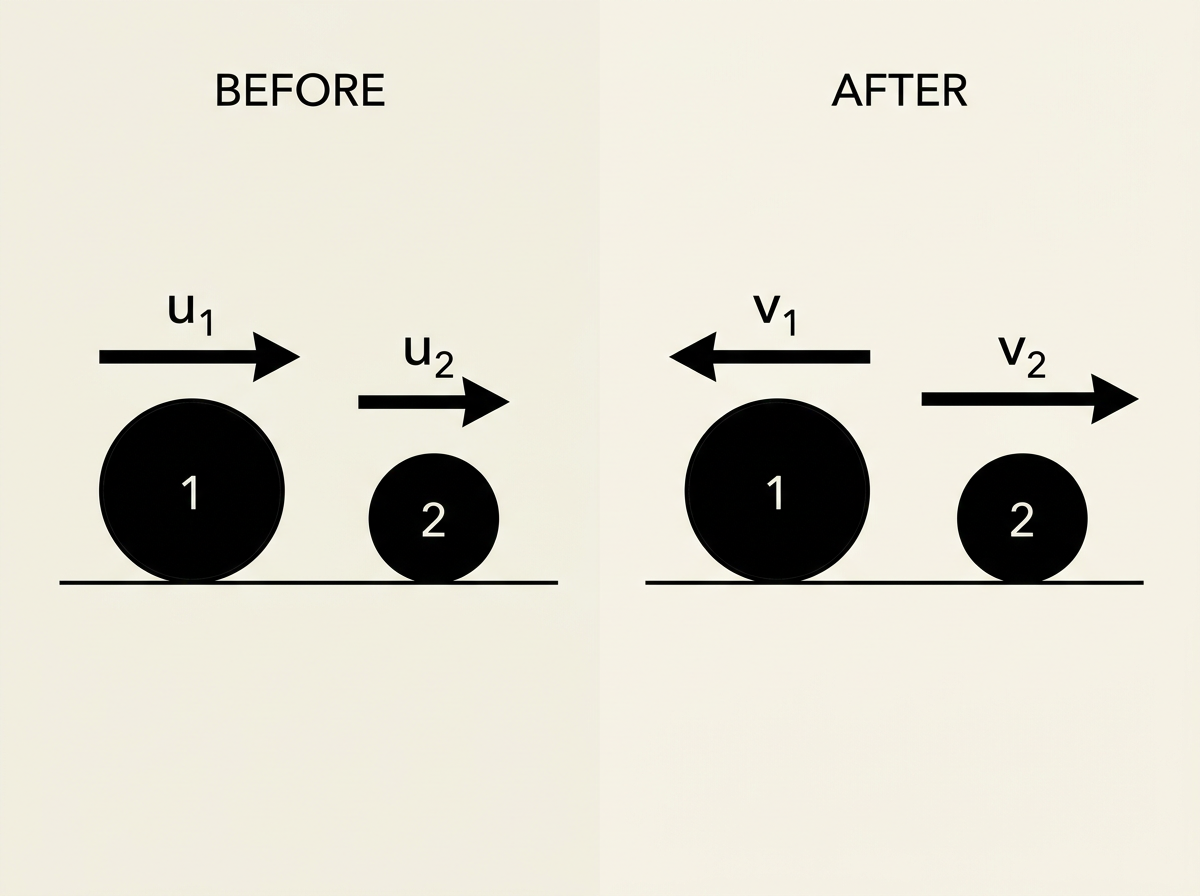
A perfectly elastic collision has $e=1$ (objects separate exactly as fast as they approached); a perfectly inelastic collision has $e=0$ (no separation — they move off together). Every real collision has $0 \le e < 1$. It isn't part of the core A-level specification, but is a useful extension if you encounter it.
Key takeaways
- Momentum is conserved in every collision. Kinetic energy is only conserved in a perfectly elastic collision.
- An inelastic collision loses some kinetic energy to heat, sound or deformation; a perfectly inelastic collision is the extreme case where the objects stick together and lose the maximum possible kinetic energy.
- For a perfectly inelastic collision, momentum conservation alone gives the common final velocity: $m_1u_1+m_2u_2=(m_1+m_2)v$.
- For an elastic collision, both momentum and kinetic energy conservation equations must hold simultaneously — two equations for two unknown final velocities.
- A moving object colliding elastically with an equal stationary mass transfers all its velocity to the target and itself stops.
- The coefficient of restitution $e=\dfrac{v_2-v_1}{u_1-u_2}$ measures how elastic a real collision is, from $e=0$ (perfectly inelastic) to $e=1$ (perfectly elastic).