Position Vectors
Fix a point by its vector from the origin, and geometry becomes algebra: AB = b − a, distance is a magnitude, and a midpoint is just an average.
Pinning vectors to points
So far vectors have floated free — position didn't matter. A position vector fixes a vector to a specific point by measuring it from the origin. The position vector of a point $A$ is $\overrightarrow{OA}$, written $\mathbf{a}$: it's the vector from the origin $O$ straight to $A$. Its components are simply the coordinates of $A$ — the point $A(3, 5)$ has position vector $\mathbf{a} = \begin{pmatrix} 3 \\ 5 \end{pmatrix}$.
Position vectors are the bridge between vectors and coordinate geometry: they let you describe points, lines and shapes using vector algebra.
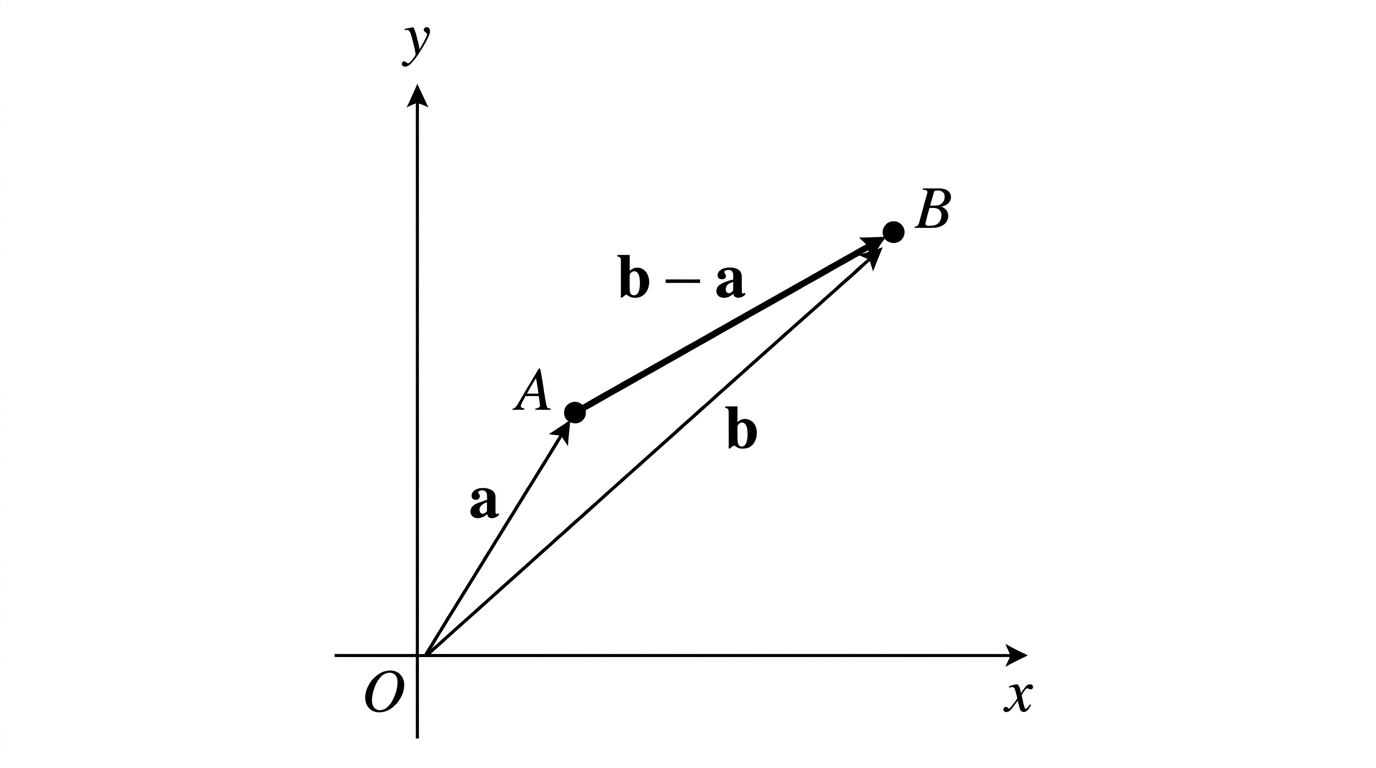
To travel from $A$ to $B$, you can go backwards from $A$ to the origin ($-\mathbf{a}$), then forwards from the origin to $B$ ($+\mathbf{b}$). So $\overrightarrow{AB} = \mathbf{b} - \mathbf{a}$ — the position vector of the destination minus the position vector of the start. This one rule unlocks almost every vector-geometry problem. Watch the order: $\overrightarrow{AB} = \mathbf{b} - \mathbf{a}$, but $\overrightarrow{BA} = \mathbf{a} - \mathbf{b}$ — the reverse, pointing the other way.
Distance between two points
The distance between points $A$ and $B$ is the magnitude of the vector joining them:
Find $\overrightarrow{AB} = \mathbf{b} - \mathbf{a}$ first, then take its magnitude with Pythagoras. This is exactly the coordinate-geometry distance formula in vector clothing.
Midpoints
The midpoint $M$ of $AB$ has position vector the average of the endpoints' position vectors:
For vector-geometry problems: write every point as a position vector, then translate the geometry into vector statements. "The vector from $A$ to $B$" is $\mathbf{b} - \mathbf{a}$; "the distance $AB$" is $|\mathbf{b} - \mathbf{a}|$; "$M$ is the midpoint" is $\overrightarrow{OM} = \tfrac12(\mathbf{a}+\mathbf{b})$; "$P$ divides $AB$ so that..." uses $\overrightarrow{AP} = k\,\overrightarrow{AB}$. Once written in vectors, it's just algebra on components.
Worked example 1
Get the subtraction order right: $\overrightarrow{AB} = \mathbf{b} - \mathbf{a}$, not $\mathbf{a} - \mathbf{b}$ — the arrow points to $B$, so $B$'s vector comes first. Then simplify surds: $\sqrt{40} = \sqrt{4 \times 10} = 2\sqrt{10}$. Leaving it as $\sqrt{40}$ usually loses the final accuracy mark.
Worked example 2
The midpoint formula is just the average of the endpoints — the same "$\tfrac{x_1+x_2}{2}, \tfrac{y_1+y_2}{2}$" you met in coordinate geometry, now written as one vector equation $\tfrac12(\mathbf{p}+\mathbf{q})$. Because a position vector's components are the coordinates, the vector method and the coordinate method give identical answers — they're the same idea in different notation.
Worked example 3
In a parallelogram $ABCD$, the sides $\overrightarrow{AB}$ and $\overrightarrow{DC}$ are equal (parallel and the same length). Use this to pin down $D$.
The labelling $ABCD$ goes around the parallelogram, so the sides in order are $AB$, $BC$, $CD$, $DA$ — which makes $\overrightarrow{AB}$ and $\overrightarrow{DC}$ the opposite pair (equal). Getting the vertex order right is essential: if you paired the wrong sides you'd find a different point. A quick sketch of $A$, $B$, $C$ in order shows where $D$ must go to close the shape. You can check: $\overrightarrow{AD}$ should equal $\overrightarrow{BC}$ too.
The commonest error is the subtraction order in $\overrightarrow{AB} = \mathbf{b} - \mathbf{a}$ — reversing it gives $\overrightarrow{BA}$, pointing the wrong way. Remember: the arrow's head letter comes first in the subtraction. Also, don't confuse a point's position vector (from the origin) with a displacement vector between two points — $\mathbf{a}$ is where $A$ is; $\overrightarrow{AB}$ is how to get from $A$ to $B$.
Check yourself
Points $A$ and $B$ have position vectors $\mathbf{a} = \begin{pmatrix} 2 \\ -1 \end{pmatrix}$ and $\mathbf{b} = \begin{pmatrix} 8 \\ 7 \end{pmatrix}$. Find $\overrightarrow{AB}$, the distance $AB$, and the midpoint of $AB$.
(Hint: AB = b − a; distance is its magnitude; midpoint is ½(a + b).)
Note the double negative in $7 - (-1) = 8$. The distance came out to a clean $10$ (a $6$–$8$–$10$ triangle), and the midpoint is the average of the endpoints.