Magnitude & Direction
A vector's length is Pythagoras on its components; its direction is an angle from tan⁻¹. Divide by the length to get a unit vector — pure direction, length one.
The magnitude of a vector
The magnitude of a vector is its length — written $|\mathbf{a}|$ (or $|\overrightarrow{AB}|$ for a vector between points). Since the components of a 2D vector form the two legs of a right-angled triangle, the length is just the hypotenuse, found by Pythagoras:
For example, $\left|\begin{pmatrix} 3 \\ 4 \end{pmatrix}\right| = \sqrt{3^2 + 4^2} = \sqrt{25} = 5$. The magnitude is always positive (or zero for the zero vector) — it's a length, so it can't be negative.
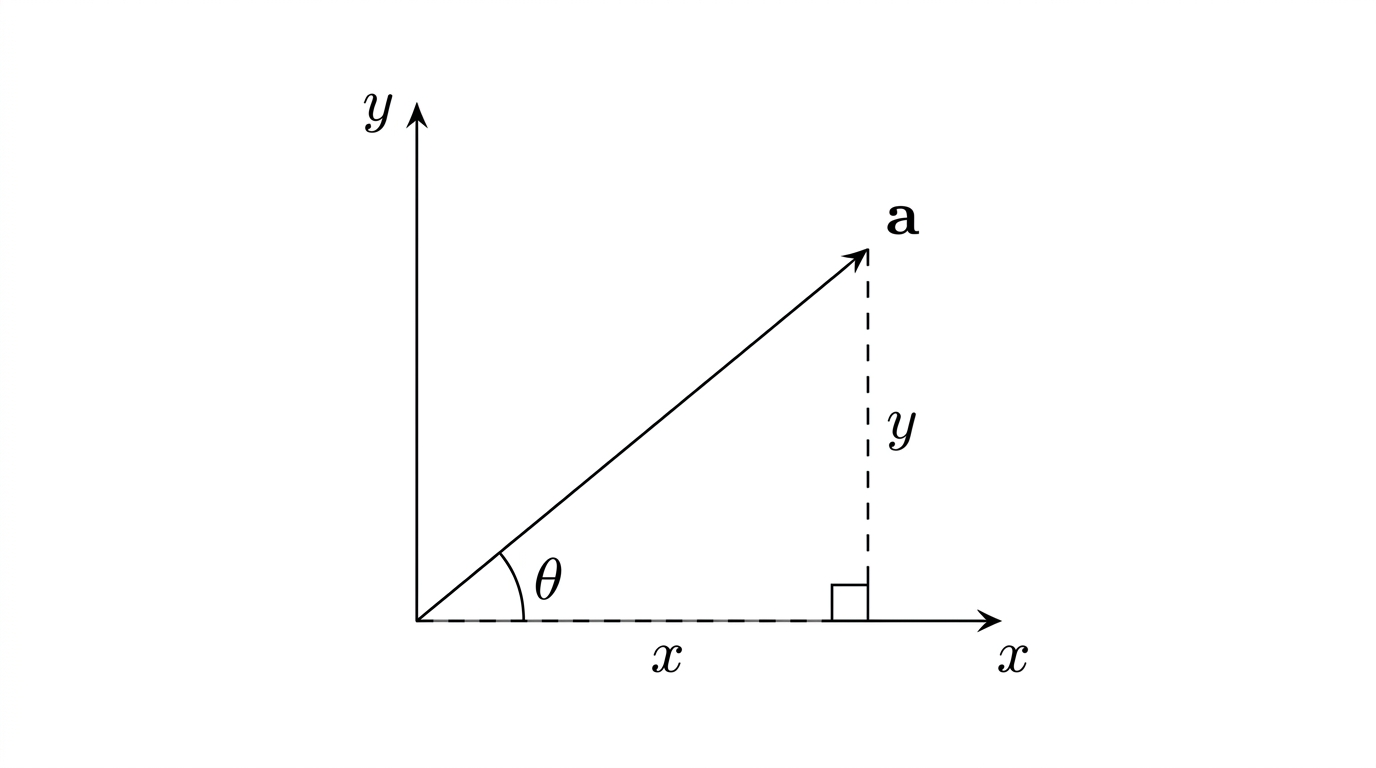
A vector $\begin{pmatrix} x \\ y \end{pmatrix}$ is "$x$ across and $y$ up". Draw that as a right-angled triangle: the horizontal leg is $x$, the vertical leg is $y$, and the vector itself is the hypotenuse connecting start to end. Pythagoras gives its length directly as $\sqrt{x^2+y^2}$. This is the same right-triangle idea behind the distance formula in coordinate geometry — vectors and coordinates are two views of the same picture.
Unit vectors
A unit vector is a vector of magnitude exactly $1$. It captures pure direction with a standard length. To find the unit vector in the direction of $\mathbf{a}$, divide $\mathbf{a}$ by its own magnitude:
The "hat" symbol $\hat{\mathbf{a}}$ denotes a unit vector. Dividing by the length rescales the vector to length $1$ without changing its direction — because dividing by a positive scalar keeps the line of direction.
Finding the direction angle
The direction of a 2D vector is the angle it makes with a reference direction (usually the positive $x$-axis, or measured as a bearing). From the right-angled triangle, the angle $\theta$ from the horizontal satisfies
Always sketch the vector first to see which quadrant it's in — the calculator's $\tan^{-1}$ only returns angles between $-90°$ and $90°$, so you often need to adjust for vectors pointing left or down.
For "find the magnitude and direction" questions: (1) magnitude is $\sqrt{x^2+y^2}$, done straight from components. (2) For direction, sketch the vector to fix the quadrant, compute the acute angle from $\tan^{-1}\!\left|\tfrac{y}{x}\right|$, then adjust to the correct angle or bearing based on the sketch. The sketch is what stops quadrant errors.
Worked example 1
The sign of a component vanishes when you square it — $(-12)^2 = 144$, positive — which is why magnitude is always positive. Leave surds exact unless told otherwise: $\sqrt{169}$ happens to be the whole number $13$, but many magnitudes stay as e.g. $\sqrt{20} = 2\sqrt5$.
Worked example 2
A unit vector always has magnitude $1$ — so verifying $\sqrt{0.6^2 + 0.8^2} = 1$ is a built-in check on your answer. Dividing by $|\mathbf{b}|$ scales the length down to exactly $1$ while every component keeps its proportion, preserving the direction. Unit vectors are how you strip a vector down to pure direction.
Worked example 3
Here both components were positive, so $\tan^{-1}(0.75) \approx 36.9°$ is the answer directly. But if $\mathbf{v}$ had been $\begin{pmatrix} -4 \\ 3 \end{pmatrix}$ (second quadrant), the calculator would still give $-36.9°$ — and you'd need to add $180°$ to land in the correct quadrant, giving $143.1°$. Always sketch: $\tan^{-1}$ can't tell which of two opposite directions you meant, but a quick diagram can.
Magnitude is never negative — if you get a negative answer you've slipped a sign, probably forgetting that squaring removes it. And don't trust $\tan^{-1}$ blindly for direction: it only returns angles in $(-90°, 90°)$, so vectors pointing left or straight down need adjusting by $\pm180°$ after a sketch. Compute magnitude from components, but always draw to get direction right.
Check yourself
Find the magnitude of $\mathbf{c} = \begin{pmatrix} -7 \\ 24 \end{pmatrix}$, and hence the unit vector in the direction of $\mathbf{c}$.
(Hint: find $|\mathbf{c}|$ first, then divide each component by it.)
The magnitude $25$ came from recognising the $7$–$24$–$25$ Pythagorean triple. Dividing by it gives a unit vector, and the length check confirms it.