Introduction to Vectors
A vector carries both size and direction. Add them component by component, scale them by a number, and spot when two are parallel — the foundations everything else builds on.
What a vector is
A vector has two properties: magnitude (size) and direction. This makes it fundamentally different from a scalar, which is just a number — a size with no direction. Speed is a scalar; velocity (speed in a direction) is a vector. A displacement of "3 km north-east" is a vector; a distance of "3 km" is a scalar.
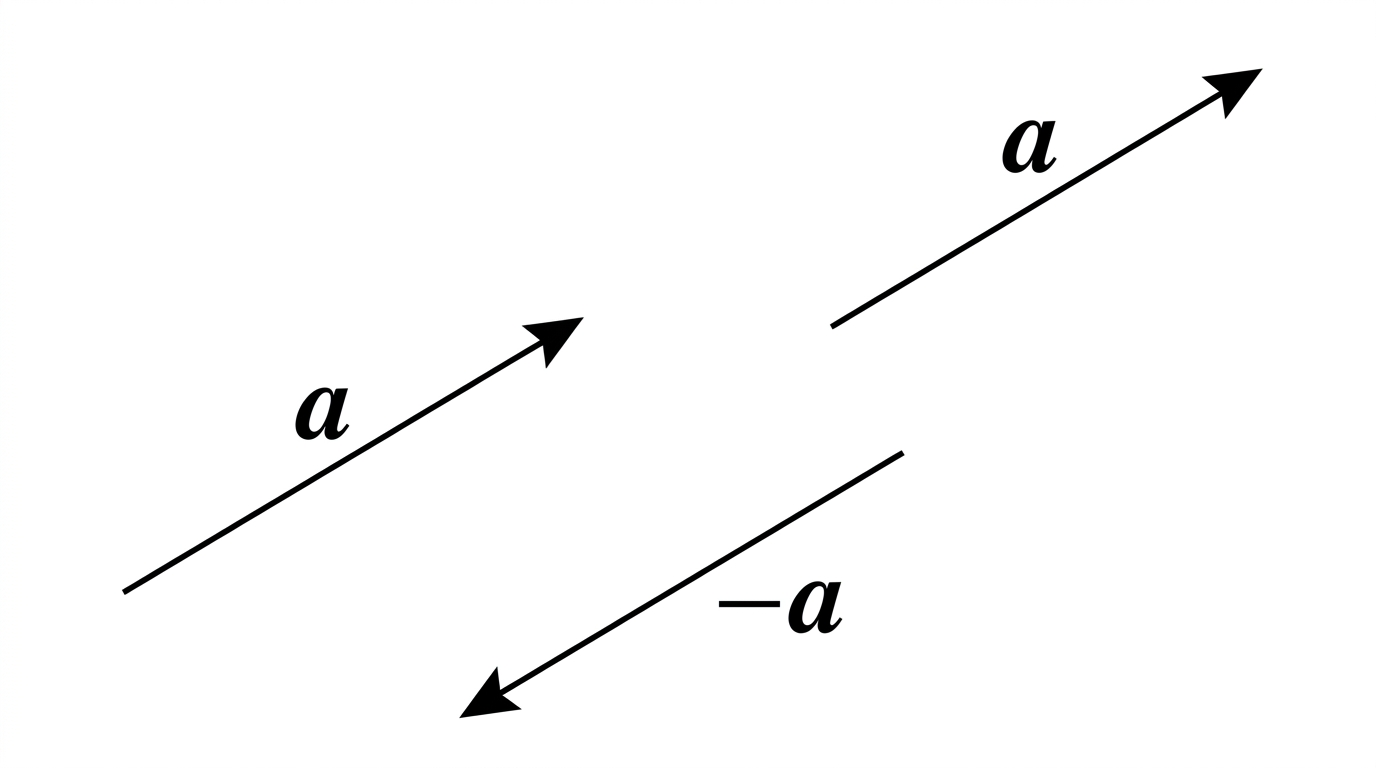
Because a vector is defined by magnitude and direction alone — not by where it starts — two arrows that are the same length and point the same way represent the same vector, even if they're drawn in different places.
You'll meet vectors written in two equivalent notations. Column form stacks the horizontal and vertical components: $\begin{pmatrix} 3 \\ 2 \end{pmatrix}$ means "3 right, 2 up". i–j form uses the unit vectors $\mathbf{i}$ (one unit right) and $\mathbf{j}$ (one unit up): the same vector is $3\mathbf{i} + 2\mathbf{j}$. They carry identical information — $\begin{pmatrix} 3 \\ 2 \end{pmatrix} = 3\mathbf{i} + 2\mathbf{j}$ — so switch between them freely. In print, vectors are bold ($\mathbf{a}$); handwritten, they're underlined ($\underline{a}$).
Adding and subtracting vectors
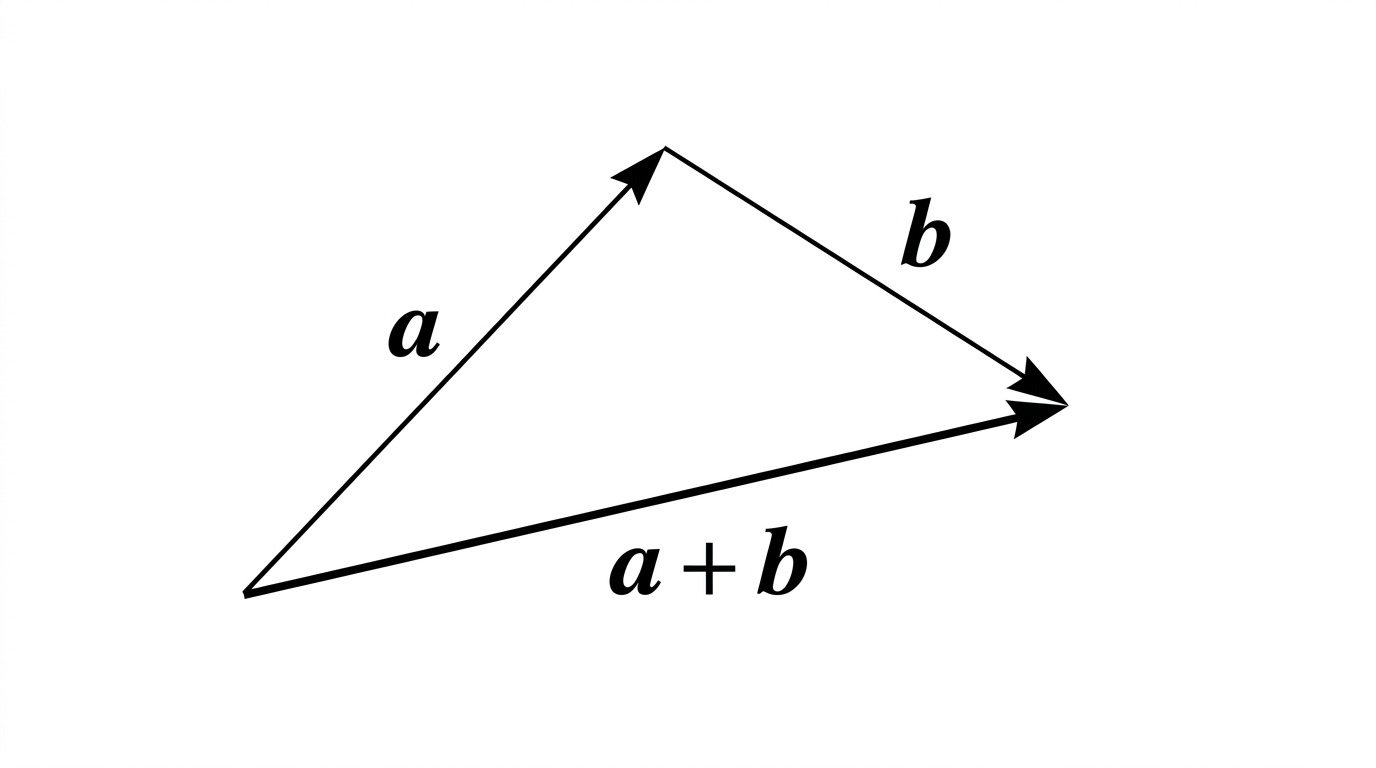
To add vectors, add their components. Geometrically, $\mathbf{a} + \mathbf{b}$ means "follow $\mathbf{a}$, then follow $\mathbf{b}$" — placing them nose-to-tail, the sum is the single vector from the very start to the very end (the triangle law).
Multiplying by a scalar
Multiplying a vector by a scalar (an ordinary number) scales its length but keeps its line of direction. So $2\mathbf{a}$ is twice as long as $\mathbf{a}$, same direction; $-\mathbf{a}$ is the same length, opposite direction; $\tfrac12\mathbf{a}$ is half as long. In components, multiply each one: $k\begin{pmatrix} a_1 \\ a_2 \end{pmatrix} = \begin{pmatrix} ka_1 \\ ka_2 \end{pmatrix}$.
Two non-zero vectors are parallel if and only if one is a scalar multiple of the other: $\mathbf{a}$ and $\mathbf{b}$ are parallel exactly when $\mathbf{b} = k\mathbf{a}$ for some scalar $k$. This is one of the most-used facts in the whole topic. For example $\begin{pmatrix} 2 \\ 3 \end{pmatrix}$ and $\begin{pmatrix} 6 \\ 9 \end{pmatrix}$ are parallel because $\begin{pmatrix} 6 \\ 9 \end{pmatrix} = 3\begin{pmatrix} 2 \\ 3 \end{pmatrix}$. If $k > 0$ they point the same way; if $k < 0$, opposite ways.
Worked example 1
The one place marks slip is the double negative in subtraction: $4 - (-2) = 6$, not $2$. Treat each component as its own little sum and take the signs slowly. Component arithmetic is the entire mechanic here — get comfortable with it and the rest of the topic follows.
Worked example 2
The $\mathbf{i}$ and $\mathbf{j}$ parts never mix — they behave like two separate tracks, exactly like the top and bottom of a column vector. Working in i–j form is really just column arithmetic written on one line. If you prefer, rewrite as columns, compute, and convert back; the answer is identical.
Worked example 3
Finding a $k$ that works for the first component isn't enough — it must give the same $k$ for the second too. If the two components demanded different values of $k$, the vectors would not be parallel. Here both give $k = -3$, so the test passes. The sign of $k$ then tells you the relative direction: negative means antiparallel (opposite ways).
Don't confuse a vector with a scalar: adding vectors means adding components separately, never adding them into one number. And keep the $\mathbf{i}$ and $\mathbf{j}$ parts apart — $9\mathbf{i} - 8\mathbf{j}$ cannot be simplified to $1\mathbf{j}$ or any single term; the two directions are independent. Finally, for the parallel test, a scalar multiple must work for all components at once.
Check yourself
Given $\mathbf{a} = \begin{pmatrix} 2 \\ -3 \end{pmatrix}$ and $\mathbf{b} = \begin{pmatrix} 1 \\ 4 \end{pmatrix}$, find $\mathbf{a} + 2\mathbf{b}$. Then determine whether $\begin{pmatrix} 4 \\ -6 \end{pmatrix}$ is parallel to $\mathbf{a}$.
(Hint: scale b first; for the parallel test, look for a single scalar k.)
The scalar $k = 2$ worked for both components, confirming the vectors are parallel — and being positive, they point the same way.