Mathematics/Lessons/Integration/Area Between Curves and Lines
Pure · Integration · Year 1

Area Between Curves and Lines

Two graphs enclose a region between the points where they cross. Subtract the lower one from the upper one before integrating, and if they swap places partway through, split at the crossing point.

10 min read 3 worked examples

The area trapped between two graphs

The last lesson found the area between a curve and the $x$-axis — really just a special case, since the $x$-axis is the line $y = 0$. The same idea works for any pair of graphs: two straight lines, a line and a curve, or two curves. Wherever they cross, they enclose a region, and its area comes from integrating the gap between them.

The general rule

If $y = f(x)$ lies above $y = g(x)$ for every $x$ between $a$ and $b$, the area enclosed between them is

$\displaystyle\text{Area} = \int_a^b \big[\,f(x) - g(x)\,\big]\,\mathrm{d}x.$

Subtracting the lower graph from the upper one first means each thin vertical strip already has the right height — the vertical gap between the two curves — so a single integral gives the enclosed area directly.

Two things have to happen before that formula can be used. First, the limits $a$ and $b$ are hardly ever given outright — they're the $x$-coordinates where the graphs intersect, found by setting the two expressions equal and solving. Second, you have to know which graph is on top, since integrating the wrong way round just flips the sign. A quick sketch usually settles it; failing that, substitute a value of $x$ strictly between the intersections into both expressions and compare.

Worked example 1
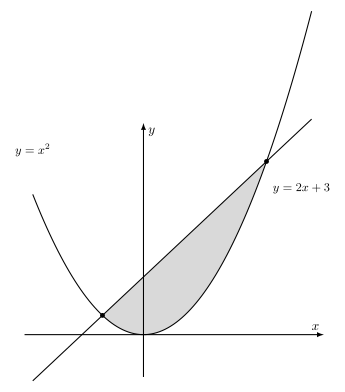
A straight line and a curve
Find the area of the region enclosed between the line $y = 2x + 3$ and the curve $y = x^2$.
The line y=2x+3 and the curve y=x squared, crossing at two points labelled (-1,1) and (3,9). The region enclosed between them, where the line runs above the curve, is shaded grey.
The line lies above the curve for the whole interval $-1 \le x \le 3$, so a single integral of (line − curve) gives the shaded area.
MethodFind the intersections, check which graph is on top, then integrate the difference
1
Set the expressions equal: $x^2 = 2x+3 \Rightarrow x^2-2x-3=0 \Rightarrow (x-3)(x+1)=0$.
Find where they cross.
2
So $x=-1$ or $x=3$ — the region runs from $x=-1$ to $x=3$.
These are the limits $a$ and $b$.
3
Test $x=1$: line gives $y=5$; curve gives $y=1$. The line is above the curve throughout the interval.
Confirms which to subtract.
4
Area $= \displaystyle\int_{-1}^{3} \big[(2x+3) - x^2\big]\,\mathrm{d}x = \Big[x^2+3x-\tfrac13x^3\Big]_{-1}^{3}$.
Line minus curve, then integrate.
5
Upper $x=3$: $9+9-9=9$. Lower $x=-1$: $1-3+\tfrac13=-\tfrac53$.
Substitute both limits.
6
Area $= 9-\left(-\tfrac53\right)=\dfrac{32}{3}$ square units.
About $10.67$.
▪ solved

Two curves at once

Nothing about the method changes when both boundaries are curves rather than one being a straight line — the formula $\int_a^b[f(x)-g(x)]\,\mathrm{d}x$ never cared which graph was "the line" and which was "the curve", only which one sits on top.

Worked example 2
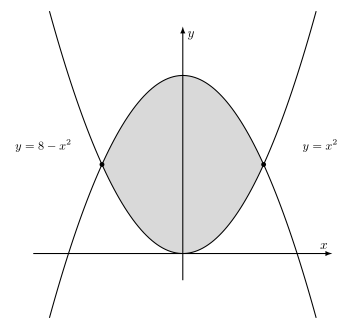
Curve and curve
Find the area of the region enclosed between the curves $y = x^2$ and $y = 8 - x^2$.
The curves y=x squared and y=8 minus x squared, crossing at two points labelled (-2,4) and (2,4). The lens-shaped region enclosed between them is shaded grey.
The two parabolas enclose a lens-shaped region between $x=-2$ and $x=2$, where $y=8-x^2$ stays above $y=x^2$.
MethodSame method — neither boundary has to be a straight line
1
Set the expressions equal: $x^2 = 8-x^2 \Rightarrow 2x^2=8 \Rightarrow x^2=4 \Rightarrow x=\pm2$.
Find where they cross.
2
Test $x=0$: $y=x^2$ gives $0$; $y=8-x^2$ gives $8$. So $y=8-x^2$ is on top throughout $-2<x<2$.
Confirms which to subtract.
3
Area $= \displaystyle\int_{-2}^{2}\big[(8-x^2)-x^2\big]\,\mathrm{d}x = \int_{-2}^{2}(8-2x^2)\,\mathrm{d}x = \Big[8x-\tfrac23x^3\Big]_{-2}^{2}$.
Top minus bottom, then integrate.
4
Upper $x=2$: $16-\tfrac{16}{3}=\tfrac{32}{3}$. Lower $x=-2$: $-16+\tfrac{16}{3}=-\tfrac{32}{3}$.
Substitute both limits.
5
Area $= \tfrac{32}{3}-\left(-\tfrac{32}{3}\right)=\dfrac{64}{3}$ square units.
About $21.33$.
▪ solved

When the graphs swap places

Both examples so far had exactly two intersection points, with one graph staying on top the whole way between them. If the graphs cross a third time inside the region you're interested in, they swap which one is "on top" at that crossing point. Integrating straight across it would let a positive and a negative contribution start cancelling, in exactly the same way a region below the $x$-axis could — so, just as before, the fix is to split the integral at every crossing point and treat each piece with the correct graph on top.

Splitting between curves works the same way as splitting at a root

Find every intersection, not just the outer two. Between each consecutive pair, test a value to see which graph is on top there, integrate $(\text{top}-\text{bottom})$ over just that piece, and add the pieces together. A sketch — even a rough one — is the fastest way to see how many pieces there are and where the split points fall.

Worked example 3
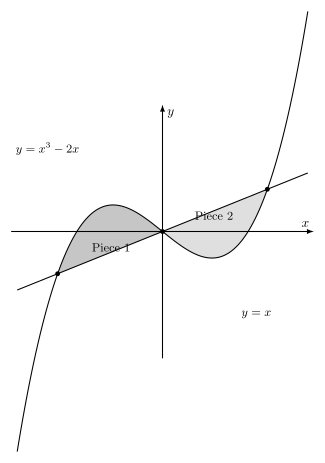
Three intersections — split the region
Find the total area enclosed between the line $y = x$ and the curve $y = x^3 - 2x$.
The line y=x and the curve y=x cubed minus 2x, crossing at three points labelled (-root3,-root3), (0,0) and (root3,root3). Two separate shaded regions appear either side of the origin, labelled Piece 1 and Piece 2, since the curve is above the line on the left and the line is above the curve on the right.
Three crossings make two enclosed regions. The curve is on top for Piece 1 (left of the origin); the line is on top for Piece 2 (right of the origin) — so each piece needs its own integral.

Setting the expressions equal gives $x^3-2x=x$, i.e. $x^3-3x=0$, i.e. $x(x^2-3)=0$ — three solutions: $x=-\sqrt3$, $x=0$, $x=\sqrt3$. With three crossings there are two enclosed regions, and testing a point in each shows they swap which graph is on top.

MethodSplit at x = 0, integrate each piece with the correct graph on top
1
Test $x=-1$ (in $-\sqrt3<x<0$): line gives $-1$; curve gives $(-1)^3-2(-1)=1$. The curve is above the line here.
Curve on top for this piece.
2
Piece 1: $\displaystyle\int_{-\sqrt3}^{0}\big[(x^3-2x)-x\big]\,\mathrm{d}x = \int_{-\sqrt3}^0(x^3-3x)\,\mathrm{d}x = \Big[\tfrac14x^4-\tfrac32x^2\Big]_{-\sqrt3}^{0} = 0-\left(\tfrac94-\tfrac92\right)=\tfrac94$.
Curve minus line, integrated.
3
Test $x=1$ (in $0<x<\sqrt3$): line gives $1$; curve gives $1-2=-1$. Now the line is above the curve.
Line on top for this piece — it has swapped.
4
Piece 2: $\displaystyle\int_{0}^{\sqrt3}\big[x-(x^3-2x)\big]\,\mathrm{d}x = \int_0^{\sqrt3}(3x-x^3)\,\mathrm{d}x = \Big[\tfrac32x^2-\tfrac14x^4\Big]_0^{\sqrt3} = \left(\tfrac92-\tfrac94\right)-0=\tfrac94$.
Line minus curve, integrated.
5
Total area $=\tfrac94+\tfrac94=\dfrac92$ square units.
Add the two pieces. $=4.5$.
▪ solved
Why not just integrate straight from $-\sqrt3$ to $\sqrt3$?

$\displaystyle\int_{-\sqrt3}^{\sqrt3}\big[(x^3-2x)-x\big]\,\mathrm{d}x=\int_{-\sqrt3}^{\sqrt3}(x^3-3x)\,\mathrm{d}x=0$, because $x^3-3x$ is an odd function and the interval is symmetric about $0$ — the two enclosed regions are equal in size but land with opposite sign, so a single integral makes them cancel exactly. The true total area is $\tfrac92$, not $0$; splitting at the middle crossing point is what recovers it.

Common mistake

Two errors show up again and again here. Subtracting the wrong way round (bottom minus top) flips the sign of the whole answer — always test a value strictly between the limits to confirm which graph is really on top, rather than assuming from the shapes of the equations. And missing an intersection point in the middle of the interval — as in Worked Example 3 — lets a positive piece and a negative piece cancel, giving an answer that's too small, or even zero. Find every solution to $f(x) = g(x)$ before deciding how many pieces to integrate.

Check yourself

Find the area of the region enclosed between the curve $y = 5x - x^2$ and the line $y = x + 3$.
(Hint: find the intersections first, then test a point between them to see which graph is on top.)

Method
1
Set equal: $5x-x^2=x+3 \Rightarrow -x^2+4x-3=0 \Rightarrow x^2-4x+3=0 \Rightarrow (x-1)(x-3)=0$.
Intersections at $x=1$ and $x=3$.
2
Test $x=2$: curve gives $10-4=6$; line gives $5$. The curve is above the line throughout.
Confirms which to subtract.
3
Area $= \displaystyle\int_1^3\big[(5x-x^2)-(x+3)\big]\,\mathrm{d}x = \int_1^3(4x-x^2-3)\,\mathrm{d}x = \Big[2x^2-\tfrac13x^3-3x\Big]_1^3$.
Curve minus line, integrated.
4
Upper $x=3$: $18-9-9=0$. Lower $x=1$: $2-\tfrac13-3=-\tfrac43$.
Substitute both limits.
5
Area $= 0-\left(-\tfrac43\right)=\dfrac43$ square units.
About $1.33$.
▪ solved