Area Under a Curve
A definite integral measures the area between a curve and the x-axis. Below the axis it comes out negative, so sketch first and split at the roots.
A definite integral measures area
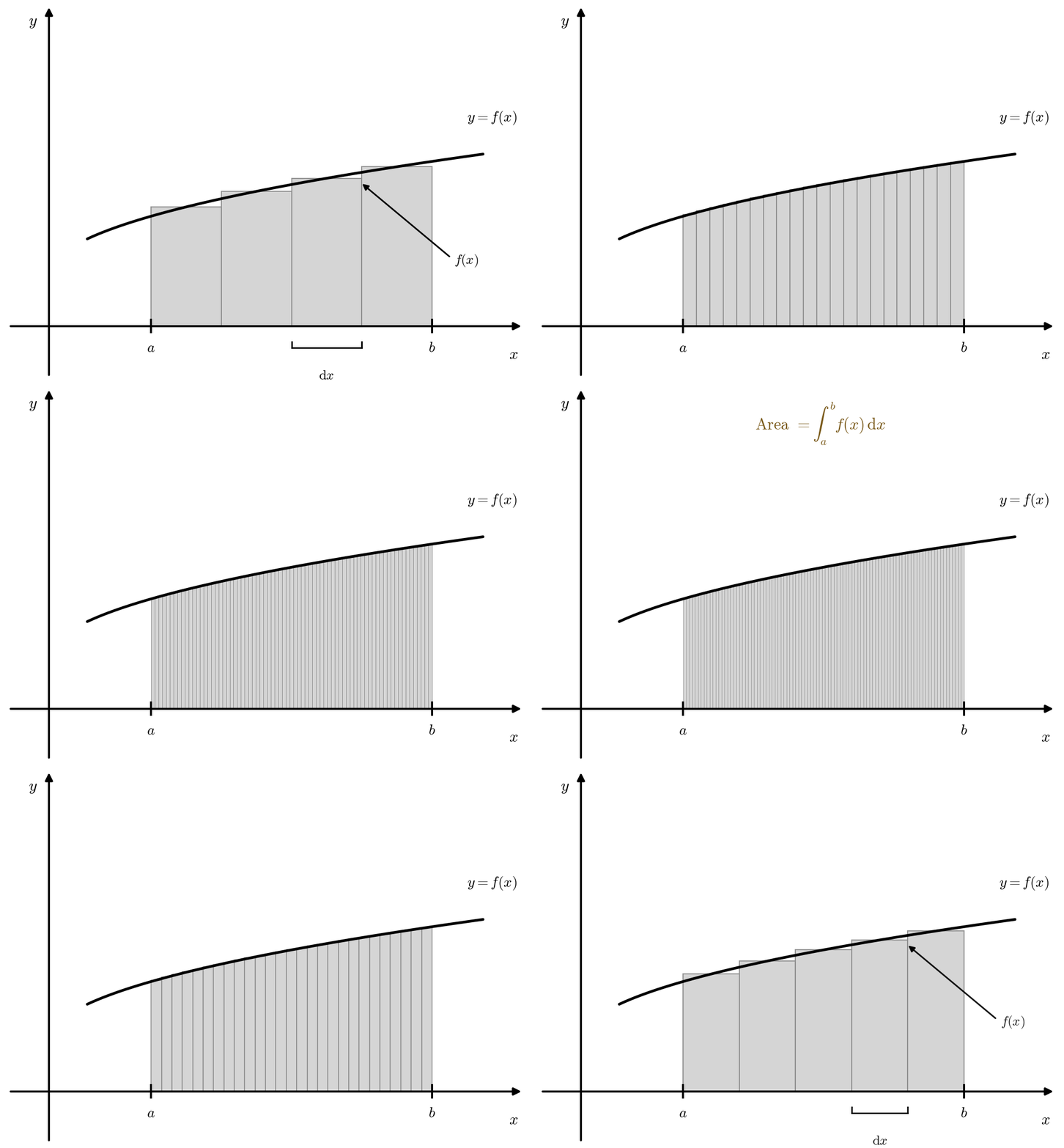
The definite integral has a geometric meaning: $\displaystyle\int_a^b f(x)\,\mathrm{d}x$ gives the area between the curve $y = f(x)$ and the $x$-axis, from $x = a$ to $x = b$. That is the region you saw shaded at the start of the last lesson. It is what the topic has been building towards, because it lets you find areas of shapes with curved edges, which no formula from earlier work can do.
Think of the region cut into very thin vertical strips. Each strip is nearly a rectangle: its height is $f(x)$ and its width is a tiny $\mathrm{d}x$, so its area is about $f(x)\,\mathrm{d}x$. Adding up infinitely many infinitely thin strips is what the integral sign does — it is a continuous sum. The limits $a$ and $b$ say where the strips start and stop.
Below the axis, the integral goes negative
There is one thing to watch. Where the curve dips below the $x$-axis, $f(x)$ is negative, so those strips contribute negative amounts and the integral comes out negative. A definite integral therefore gives a signed area: positive above the axis, negative below.
For a real geometric area you want the positive size of the region. So if part of the curve is below the axis, integrate that part separately and take the magnitude, then add the pieces. Integrating straight across a root lets the positive and negative parts cancel, which gives an answer that is too small, or sometimes zero.
Always sketch the curve over the interval before integrating. If it stays above the axis throughout, one integral gives the area. If it crosses, find the roots, integrate between consecutive roots separately, take the modulus of anything negative, and add. The sketch is the thing that tells you whether to split and where.
Worked example 1
Since $x^2 + 1$ never dips below the axis, no splitting was needed and the integral is the area directly. Keep the answer as the fraction $\tfrac{14}{3}$ unless a decimal is asked for, and say "square units" — it is an area, not a length.
Worked example 2
Start by finding where the curve meets the axis. Setting $x^2 - 4 = 0$ gives $x = \pm2$, and between those the parabola sits below the axis, so expect a negative integral.
The integral came out as $-\tfrac{32}{3}$ precisely because the whole region lies below the axis. That minus sign is the integral telling you where the curve is. The geometric area is its magnitude, $\tfrac{32}{3}$. Whenever an area integral turns out negative, the region was below the axis and you report the positive size.
Worked example 3
$y = x^3$ is below the axis for $-1 < x < 0$ and above it for $0 < x < 2$. Integrating straight across would let the two parts partly cancel, so split at the crossing point $x = 0$.
Integrating straight from $-1$ to $2$ would give $\big[\tfrac14x^4\big]_{-1}^{2} = 4 - \tfrac14 = \tfrac{15}{4}$, which is smaller than the true area of $\tfrac{17}{4}$. The below-axis part, $-\tfrac14$, cancelled some of the above-axis part instead of adding to it. Splitting at every root and taking magnitudes is the only way to get the real total, and the sketch is what tells you a root is there.
Area between a curve and a line
The same idea extends to the region trapped between a curve and a straight line, not just a curve and the $x$-axis. If the line sits above the curve throughout the interval, the area between them is
where $a$ and $b$ are the $x$-coordinates where the line and curve intersect. Subtracting the lower function from the upper one before integrating means each thin strip's height is already the gap between the two graphs — so a single integral gives the enclosed area directly, without needing to split or take magnitudes, provided one graph stays above the other across the whole interval.
The limits aren't given directly; they come from finding where the curve and line cross, by setting the two expressions for $y$ equal and solving. This turns "area between a curve and a line" into two separate skills chained together: solve a simultaneous equation to find the limits, then integrate the difference between them.
Worked example 4
Integrating $y_{\text{curve}} - y_{\text{line}}$ instead of $y_{\text{line}} - y_{\text{curve}}$ (or vice versa) flips the sign of the answer. Always test a value strictly between the two intersection points — as in step 3 — to check which graph is genuinely on top before setting up the subtraction, rather than guessing from the equations alone.
Integrating across a root without splitting is the error this topic is built around: the parts cancel and the answer comes out too small, or zero. Sketch, find the roots, handle each region separately, and take the modulus of any negative piece. The reverse also applies — if the curve stays on one side of the axis throughout, one integral is enough and there is no need to split.
Check yourself
Find the area of the region bounded by the curve $y = 4 - x^2$ and the $x$-axis.
(Hint: find the roots first, and check which side of the axis the curve is on between them.)
The curve stays above the axis on $-2 < x < 2$, so one integral gives the area with no splitting or magnitudes. Subtracting the negative lower value is what turns it into an addition.