Definite Integrals
Add two limits and an integral stops being a function and becomes a number: integrate, substitute top and bottom, subtract. The constant cancels itself out.
Integrals with limits
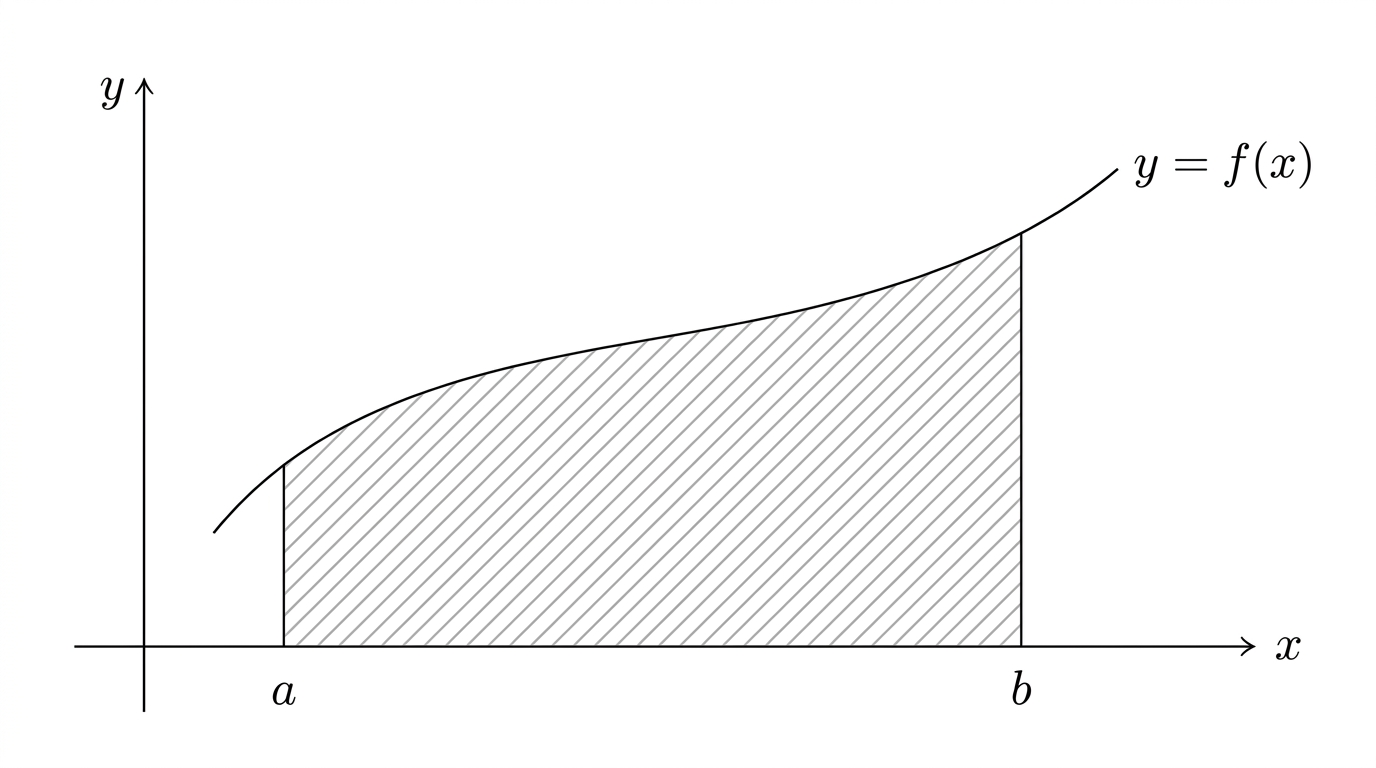
An indefinite integral gives you back a function, plus a $C$. A definite integral gives you a number. It carries two limits, a lower value $a$ and an upper value $b$:
To evaluate one, integrate as usual, then substitute the upper limit and the lower limit into the result and subtract. Writing $F(x)$ for the integral of $f(x)$:
The square brackets $\big[F(x)\big]_a^b$ are shorthand for "evaluate $F$ at $b$, evaluate it at $a$, and subtract".
Suppose you kept the $+C$. You would compute $\big(F(b)+C\big) - \big(F(a)+C\big)$, and the two constants cancel. So $C$ makes no difference to a definite integral and you can leave it out from the start. The ambiguity that forced the $+C$ on indefinite integrals is subtracted away, which is why a definite integral comes out as one specific number.
(1) Integrate $f(x)$, with no $+C$. (2) Write it in square brackets with the limits. (3) Substitute the upper limit, then the lower limit. (4) Subtract: upper minus lower. Keeping the two substitutions on separate lines is worth the extra second, because that is where sign errors happen.
Worked example 1
It would cancel anyway, so there is no reason to carry it. Set the two substitutions out clearly — $F(3) = 18$ and $F(1) = 0$ — before subtracting, rather than doing both in your head at once. The answer to a definite integral is always a plain number, never a function.
Worked example 2
Even powers come out positive and odd powers keep the sign: $(-1)^4 = +1$, but $(-1)^3 = -1$. Write each substitution out in full, brackets and all, before combining anything. And keep the order straight: it is upper minus lower, so if the lower value is negative you end up adding, which is easy to get the wrong way round.
Worked example 3
Integrating $6x^{-1/2}$ raised the power to $+\tfrac12$, well clear of the forbidden $n = -1$. The formula copes with $-\tfrac12$ without any trouble; it is only the exact power $x^{-1}$ that it cannot touch. Work the limits out exactly — most definite integrals are meant to give an exact value rather than a decimal.
Subtracting the wrong way round is the big one: it is always $F(b) - F(a)$, upper minus lower, and swapping them negates your answer. Watch the signs when a limit is negative, particularly with odd powers. And do not waste time on a $+C$ that cancels itself.
Check yourself
Evaluate $\displaystyle\int_0^2 \left(3x^2 + 4x\right)\,\mathrm{d}x$.
(Hint: integrate to $x^3 + 2x^2$, then take the value at 2 minus the value at 0.)
A lower limit of $0$ often makes $F(a) = 0$, but write it out rather than assuming — a constant term in $F(x)$ would make it something else.