Finding the Constant of Integration
Integrating a gradient function gives a family of curves, all the same shape at different heights. One known point picks out the one you want.
From a gradient function back to the curve
Every indefinite integral in the last lesson ended with an unknown $+C$. Usually a question gives you one extra piece of information — a point the curve passes through — and that is exactly enough to work out what $C$ is and recover the one curve you want.
The setup is standard: you are given $\dfrac{dy}{dx}$ and told the curve passes through some point. Integrating gives $y$ in terms of $x$ plus a $C$; substituting the point then lets you solve for it.
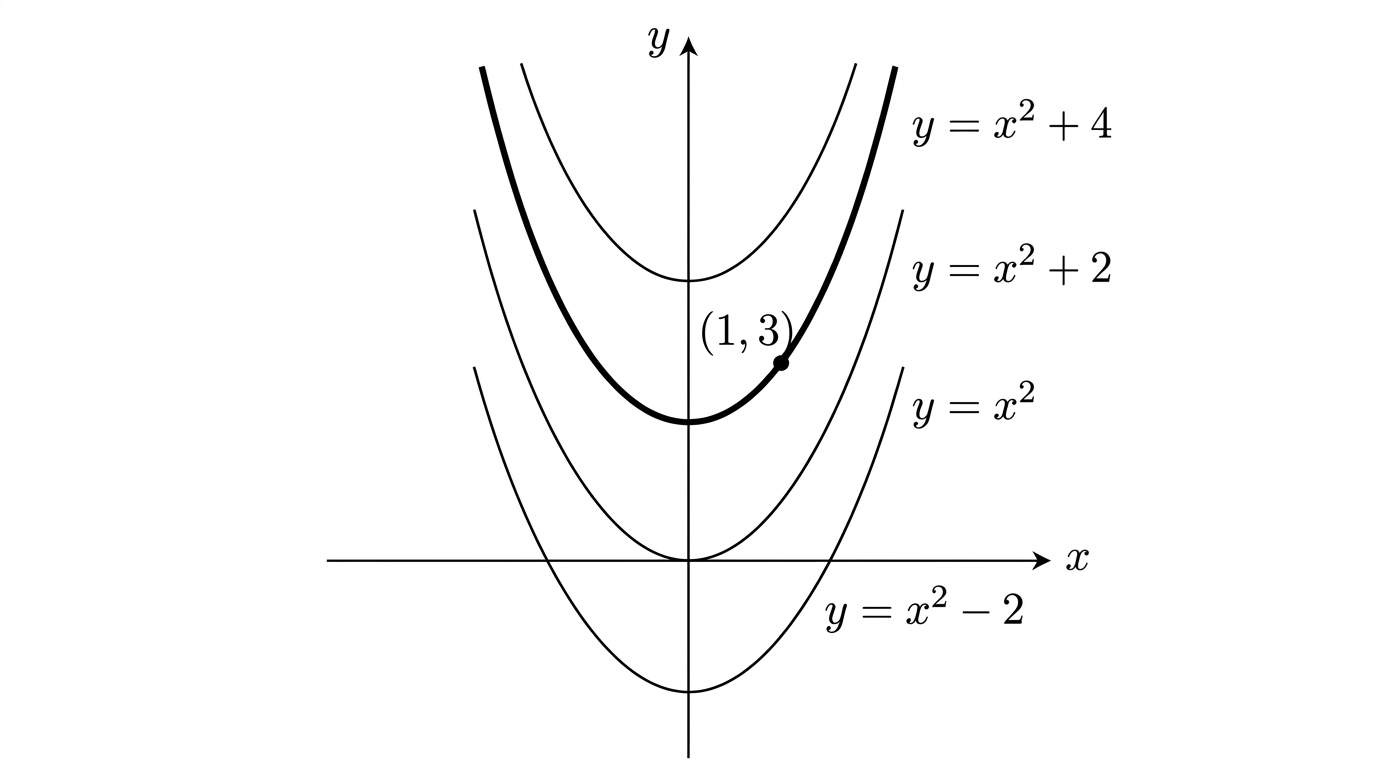
Each value of $C$ gives a different curve, but they all have the same shape and differ only in height. Picture a stack of identical curves at every level. Telling you one point the curve passes through fixes the height, and only one member of the stack goes through it. Substituting the coordinates into $y = f(x) + C$ turns it into an equation you can solve for $C$.
(1) Integrate $\dfrac{dy}{dx}$ to get $y = f(x) + C$, keeping the $C$. (2) Substitute the coordinates of the given point for $x$ and $y$. (3) Solve for $C$ and write out the full equation. The point is used after integrating, never before.
Worked example 1
If you drop the constant while integrating, there is nothing left for the point to determine and the method falls apart. Note also that the point is substituted into the curve $y = f(x) + C$, not into the gradient function: the coordinates satisfy the equation of the curve, not the equation of its gradient.
Worked example 2
The step people stumble on is $4^{3/2}$. Read the denominator as the root and the numerator as the power: take $\sqrt4 = 2$, then cube it to get $8$. Powers like this turn up whenever the gradient function contains a root, so it is worth being quick with them. Everything else here is the same integrate–substitute–solve pattern.
Worked example 3
Integrating the second derivative once gives $\dfrac{dy}{dx}$, and again gives $y$. Each integration produces its own constant, and each one needs a piece of the given information to pin it down.
Two integrations mean two unknown constants, so you need two pieces of information: here the gradient value settled $C_1$ and the point settled $C_2$. Resolve the first constant before integrating again, otherwise it gets carried through and tangled into the second stage. Labelling them $C_1$ and $C_2$ keeps them apart.
The serious error is substituting the point before integrating. The coordinates belong to the curve, not to the gradient function, so they are no use until you have $y = f(x) + C$ to put them into. Integrate first, keep the $+C$, then substitute. And when you start from a second derivative, remember there are two constants to find, not one.
Check yourself
A curve passes through $(3, 2)$ and has $\dfrac{dy}{dx} = 2x - 5$. Find the equation of the curve.
(Hint: integrate to $y = x^2 - 5x + C$, then substitute the point.)
Two checks: differentiating $x^2 - 5x + 8$ gives $2x - 5$, and substituting $x = 3$ gives $y = 9 - 15 + 8 = 2$, so the curve does pass through $(3, 2)$.