Mathematics/Lessons/Vectors/Solving Geometric Problems
Pure · Vectors · Year 1

Solving Geometric Problems

Turn geometry into algebra: prove points collinear, divide a line in a ratio, and find unknowns that make vectors parallel — all from one scalar-multiple idea.

10 min read 3 worked examples

Vectors as a problem-solving tool

The real power of vectors is proving geometric facts with algebra. Three ideas do most of the work: two vectors are parallel when one is a scalar multiple of the other; three points are collinear (on one straight line) when the vectors between them are parallel and share a point; and a point divides a line in a ratio when it sits a fixed fraction of the way along. Combine these with $\overrightarrow{AB} = \mathbf{b} - \mathbf{a}$ and most problems fall out.

Collinear points — parallel plus a shared point

Three points $A$, $B$, $C$ are collinear (lie on the same straight line) if $\overrightarrow{AB}$ and $\overrightarrow{BC}$ are parallel — that is, $\overrightarrow{BC} = k\,\overrightarrow{AB}$ for some scalar $k$. Parallel alone isn't enough for separate lines, but here $\overrightarrow{AB}$ and $\overrightarrow{BC}$ already share the point $B$, so if they're also parallel they must lie on one line. This "parallel + common point" test is the standard way to prove collinearity.

Dividing a line in a ratio

If a point $P$ divides $AB$ in the ratio $\mu : \lambda$ (so $AP : PB = \mu : \lambda$), then $P$ is $\dfrac{\mu}{\mu+\lambda}$ of the way from $A$ to $B$:

$\overrightarrow{AP} = \dfrac{\mu}{\mu+\lambda}\,\overrightarrow{AB}, \qquad \mathbf{p} = \mathbf{a} + \dfrac{\mu}{\mu+\lambda}(\mathbf{b} - \mathbf{a}).$

Start at $A$, then travel the right fraction of the way along $\overrightarrow{AB}$. The midpoint is just the special case $\mu : \lambda = 1 : 1$, giving the $\tfrac12$ from the last lesson.
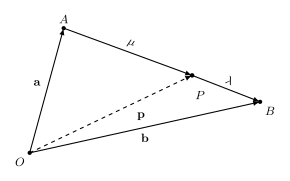
Points O, A, B and P. Solid arrows from O go to A and B, labelled a and b. A dashed arrow from O goes to P, labelled p. Along the segment from A to B, an arrow from A to P is labelled mu and an arrow from P to B is labelled lambda.
Points $A$, $B$ and $P$ with position vectors $\mathbf{a}$, $\mathbf{b}$ and $\mathbf{p}$, showing $P$ dividing $AB$ in the ratio $\mu:\lambda$ and the vector $\overrightarrow{AB}=\mathbf{b}-\mathbf{a}$.
Strategy — translate, then do algebra

Vector-proof questions reward a clear method: (1) write each relevant vector using $\mathbf{b} - \mathbf{a}$ and the given information; (2) express the two vectors you're comparing in terms of the same known vectors; (3) show one is a scalar multiple of the other (for parallel/collinear), or match components (to find an unknown). State your conclusion in words — "therefore parallel", "therefore collinear" — to secure the reasoning marks.

Worked example 1

Prove three points are collinear
Points $A$, $B$, $C$ have position vectors $\mathbf{a} = \begin{pmatrix} 1 \\ 2 \end{pmatrix}$, $\mathbf{b} = \begin{pmatrix} 3 \\ 5 \end{pmatrix}$, $\mathbf{c} = \begin{pmatrix} 7 \\ 11 \end{pmatrix}$. Show that $A$, $B$, $C$ are collinear.
MethodShow AB and BC are parallel; they share B
1
$\overrightarrow{AB} = \mathbf{b} - \mathbf{a} = \begin{pmatrix} 3 - 1 \\ 5 - 2 \end{pmatrix} = \begin{pmatrix} 2 \\ 3 \end{pmatrix}$.
First displacement.
2
$\overrightarrow{BC} = \mathbf{c} - \mathbf{b} = \begin{pmatrix} 7 - 3 \\ 11 - 5 \end{pmatrix} = \begin{pmatrix} 4 \\ 6 \end{pmatrix}$.
Second displacement.
3
$\overrightarrow{BC} = \begin{pmatrix} 4 \\ 6 \end{pmatrix} = 2\begin{pmatrix} 2 \\ 3 \end{pmatrix} = 2\,\overrightarrow{AB}$, so they're parallel.
One is a scalar multiple of the other.
4
Since $\overrightarrow{AB}$ and $\overrightarrow{BC}$ are parallel and share point $B$, the points $A$, $B$, $C$ are collinear.
Parallel + common point.
▪ collinear
Examiner's eye

The conclusion sentence earns marks: it's not enough to show $\overrightarrow{BC} = 2\overrightarrow{AB}$ — you must state why that proves collinearity (parallel and a shared point $B$). The scalar $k = 2$ also tells you $C$ is twice as far from $B$ as $B$ is from $A$, in the same direction.

Worked example 2

Divide a line in a given ratio
$A$ and $B$ have position vectors $\mathbf{a} = \begin{pmatrix} 2 \\ 1 \end{pmatrix}$ and $\mathbf{b} = \begin{pmatrix} 8 \\ 10 \end{pmatrix}$. Point $P$ divides $AB$ in the ratio $2 : 1$. Find the position vector of $P$.
MethodTravel the right fraction along AB from A
1
Ratio $2 : 1$ means $P$ is $\dfrac{2}{2+1} = \dfrac{2}{3}$ of the way from $A$ to $B$.
Fraction is μ/(μ+λ).
2
$\overrightarrow{AB} = \mathbf{b} - \mathbf{a} = \begin{pmatrix} 6 \\ 9 \end{pmatrix}$.
The full displacement.
3
$\overrightarrow{AP} = \tfrac23\begin{pmatrix} 6 \\ 9 \end{pmatrix} = \begin{pmatrix} 4 \\ 6 \end{pmatrix}$.
Two-thirds of the way.
4
$\mathbf{p} = \mathbf{a} + \overrightarrow{AP} = \begin{pmatrix} 2 \\ 1 \end{pmatrix} + \begin{pmatrix} 4 \\ 6 \end{pmatrix} = \begin{pmatrix} 6 \\ 7 \end{pmatrix}$.
Start at $A$, add the step.
▪ solved
The key insight

Two easy-to-confuse steps: the ratio $2:1$ gives the fraction $\tfrac{2}{3}$ (the $2$ over the total $2+1$), and you add $\overrightarrow{AP}$ to $\mathbf{a}$ — not to the origin. $P$ is found by starting at $A$ and stepping $\tfrac23$ of the way along. A sanity check: $P = (6,7)$ should be nearer $B$ than $A$, since $2:1$ puts it two-thirds along — and it is.

Worked example 3

Find an unknown to make vectors parallel
The vectors $\overrightarrow{PQ} = \begin{pmatrix} 3 \\ t \end{pmatrix}$ and $\overrightarrow{RS} = \begin{pmatrix} 12 \\ 20 \end{pmatrix}$ are parallel. Find the value of $t$.
MethodParallel means one is a scalar multiple of the other
1
Parallel: $\overrightarrow{RS} = k\,\overrightarrow{PQ}$ for some scalar $k$, so $\begin{pmatrix} 12 \\ 20 \end{pmatrix} = k\begin{pmatrix} 3 \\ t \end{pmatrix}$.
Set up the scalar-multiple condition.
2
First components: $12 = 3k \Rightarrow k = 4$.
Solve for k using the known pair.
3
Second components: $20 = kt = 4t$.
Apply the same k.
4
$\Rightarrow t = \dfrac{20}{4} = 5$.
So $t = 5$.
▪ solved
Look deeper — one scalar for all components

The whole method rests on there being a single $k$ that works for every component. The known component pair ($12$ and $3$) fixes $k = 4$; that same $k$ must then satisfy the unknown pair, giving $t = 5$. This "find $k$ from the known components, apply it to the unknown" pattern solves every "find the value that makes them parallel" question. You can check: $\begin{pmatrix} 12 \\ 20 \end{pmatrix} = 4\begin{pmatrix} 3 \\ 5 \end{pmatrix}$ ✓.

Common mistake

For ratio problems, $\mu : \lambda$ gives the fraction $\tfrac{\mu}{\mu+\lambda}$ — students often use $\tfrac{\mu}{\lambda}$ by mistake. And remember to add the step to the starting point's position vector, not to zero. For collinearity, don't stop at "parallel" — you must note the common point to conclude the points lie on one line. Each of these costs a mark if skipped.

Check yourself

Points $A(1, 1)$, $B(4, 3)$ and $C(10, 7)$ have those coordinates as position vectors. Show that $A$, $B$, $C$ are collinear, and state the ratio $AB : BC$.
(Hint: find $\overrightarrow{AB}$ and $\overrightarrow{BC}$, show one is a multiple of the other, then compare lengths.)

Method
1
$\overrightarrow{AB} = \begin{pmatrix} 4-1 \\ 3-1 \end{pmatrix} = \begin{pmatrix} 3 \\ 2 \end{pmatrix}$.
First displacement.
2
$\overrightarrow{BC} = \begin{pmatrix} 10-4 \\ 7-3 \end{pmatrix} = \begin{pmatrix} 6 \\ 4 \end{pmatrix} = 2\begin{pmatrix} 3 \\ 2 \end{pmatrix} = 2\,\overrightarrow{AB}$.
A scalar multiple — parallel.
3
Parallel and sharing point $B$, so $A$, $B$, $C$ are collinear.
Parallel + common point.
4
Since $\overrightarrow{BC} = 2\,\overrightarrow{AB}$, $BC$ is twice $AB$, so $AB : BC = 1 : 2$.
Compare the lengths.
▪ collinear

The scalar $2$ does double duty: it proves the vectors are parallel (hence collinear with the shared point $B$), and it gives the length ratio $AB : BC = 1 : 2$ directly.