Mechanics · Variable Acceleration · Year 1

Functions of Time

When acceleration changes with time, SUVAT stops working — but displacement, velocity and acceleration can still each be written as a function of $t$, and that's all the starting point this topic needs.

10 min read 2 worked examples

When acceleration is variable

Every SUVAT formula was derived assuming acceleration stays constant. If a problem instead gives acceleration — or velocity, or displacement — as an expression involving $t$, the motion is no longer a straight line on a velocity–time graph, and SUVAT no longer applies. Displacement, velocity and acceleration can still be described completely; they are just written as functions of time, $s(t)$, $v(t)$ and $a(t)$, rather than as single numbers.

Reading the shape of a velocity–time graph

The gradient of a velocity–time graph still represents acceleration, whether or not that acceleration is constant. A curve that bends upward more steeply as $t$ increases has increasing acceleration; a curve that flattens out has decreasing acceleration.
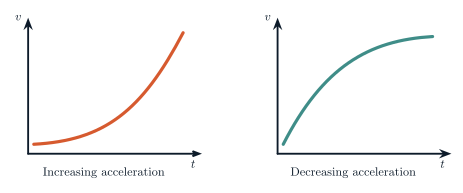
Two velocity-time graphs side by side. The left graph curves upward increasingly steeply, showing increasing acceleration. The right graph rises quickly then flattens out, showing decreasing acceleration.
Left: the gradient itself is increasing, so acceleration is increasing. Right: the gradient is shrinking toward zero, so acceleration is decreasing even though the particle is still speeding up.

Working with s(t): position, restrictions and return to origin

Displacement is often modelled by a polynomial in $t$. Two skills come up repeatedly: evaluating $s(t)$ at a given instant, and finding when the particle returns to its starting point by solving $s(t)=0$.

Worked example 1

Displacement and return to the origin
A particle moves in a straight line so that its displacement from a fixed point $O$ at time $t$ seconds is $s = t^3 - 4t$ metres, for $t>0$. Find: a the displacement when $t=1$; b the time at which the particle returns to $O$.
MethodSubstitute directly, then factorise s(t) = 0
a
$s(1) = 1^3 - 4(1) = 1 - 4 = -3\ \text{m}$.
Substitute $t=1$ into $s(t)$.
b
$t^3-4t=0 \Rightarrow t(t^2-4)=0 \Rightarrow t(t-2)(t+2)=0$.
Factorise fully.
So $t=0$, $t=2$ or $t=-2$. Since $t>0$, the particle returns to $O$ at $t=2$ seconds.
Reject $t=0$ (the start) and $t=-2$ (outside the domain).
▪ solved

Worked example 2

Justifying a restriction on t
A remote-control car travels along a straight track, leaving the start of the track at $t=0$ and later returning to it. Its distance from the start is modelled by $s = 6t^2 - t^3$ for $0 \le t \le T$. Find the largest possible value of $T$ for which this model makes sense, and justify your answer.
MethodDistance from the start can never be negative
1
Since $s$ is a distance from the start of the track, $s \ge 0$ is required throughout.
A negative "distance from the start" has no meaning.
2
$s = 6t^2-t^3 = t^2(6-t)$.
Factorise to see the sign clearly.
3
$t^2 \ge 0$ for every value of $t$, so the sign of $s$ is controlled entirely by $(6-t)$, which is $\ge 0$ exactly when $t \le 6$.
A product is non-negative here whenever the second factor is.
4
The motion begins at $t=0$, so combined with $t\le6$, the model is valid for $0 \le t \le 6$. Hence $T=6$.
Combine both ends of the restriction.
▪ solved
Common mistake

Forgetting that a displacement or distance model is only physically meaningful over a specific range of $t$ — plugging in a value outside where the model was derived (for instance, a negative time, or a time after the particle has already returned to its starting point and the scenario has ended) will still give a number, but that number no longer means anything in context.

Check yourself

A particle's displacement from $O$ is modelled by $s = 5t^2 - t^3$ metres for $0 \le t \le T$, where $s$ represents a distance from $O$. Find the largest possible value of $T$.
(Hint: factorise s(t) and decide where the product stays non-negative.)

$s = t^2(5-t)$. Since $t^2\ge0$ always, $s\ge0$ exactly when $5-t\ge0$, i.e. $t\le5$. Combined with the motion starting at $t=0$, the model is valid for $0\le t\le5$, so $T=5$.