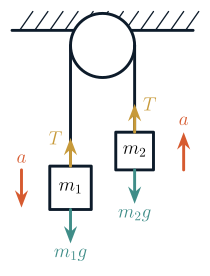
Two particles joined by a string over a single smooth pulley share the same acceleration and the same tension. That's the whole idea — two applications of F = ma, then solve together.
11 min read4 worked examples
A single smooth, light pulley
Picture two particles, of different mass, connected by a string that passes over a single fixed pulley. The heavier particle falls, the lighter one rises, and the string keeps them moving together.
Three assumptions do all the work
Smooth pulley — there is no friction where the string runs over it, so the pulley does not change the tension. Light pulley and string — they are treated as having no mass, so no force is needed to accelerate them. Inextensible string — it cannot stretch, so both particles move with the same magnitude of acceleration, one up and one down.
Put together, these give the two facts that make pulley problems solvable: the tension $T$ is the same throughout the string, and both particles have the same acceleration magnitude $a$ — directed downward for the heavier particle and upward for the lighter one.
The heavier mass $m_1$ accelerates down, the lighter mass $m_2$ accelerates up, both with the same magnitude $a$, connected by a string under the same tension $T$ throughout.
Setting up two equations
The method
(1) Draw each particle separately with its own weight and tension. (2) For each particle, choose its own direction of motion as positive. (3) Apply $F=ma$ to each particle in turn. (4) Solve the two equations simultaneously — usually by adding them, which eliminates $T$ and gives $a$ directly.
For two particles of mass $m_1 > m_2$ hanging on either side of the pulley: $m_1$ moves down, so $m_1g - T = m_1a$. Particle $m_2$ moves up, so $T - m_2g = m_2a$. Adding these eliminates $T$:
$$a = \dfrac{(m_1-m_2)g}{m_1+m_2}$$
Substituting this back into the $m_2$ equation, $T-m_2g=m_2a$, gives $T = m_2(g+a)$. Writing $g$ over the same denominator as $a$:
Both formulae are worth recognising on sight, but deriving them from $F=ma$ each time — as in the worked examples below — is far more reliable than trying to memorise them.
Worked example 1
Two hanging masses
Particles of mass $5\ \text{kg}$ and $3\ \text{kg}$ are connected by a light inextensible string passing over a smooth, fixed pulley. The system is released from rest. Find the acceleration of the system and the tension in the string. Take $g=9.8\ \text{m s}^{-2}$.
MethodApply F = ma to each particle, then add to eliminate T
1
For the $5\ \text{kg}$ mass (moving down): $5g - T = 5a$.
Weight exceeds tension.
2
For the $3\ \text{kg}$ mass (moving up): $T - 3g = 3a$.
Substitute into the second equation: $T = 3(9.8+2.45) = 3(12.25) = 36.75\ \text{N}$.
Solve for T.
▪ solved
Check with the other equation
Using the first equation instead: $5(9.8) - 36.75 = 49 - 36.75 = 12.25 = 5(2.45)$ ✓. Checking with the equation you did not use to find $T$ is a reliable way to catch arithmetic slips.
Worked example 2
One mass on a table, one hanging
A particle of mass $4\ \text{kg}$ lies on a smooth horizontal table. It is connected by a light inextensible string, passing over a smooth pulley fixed at the edge of the table, to a particle of mass $6\ \text{kg}$ hanging freely. Find the acceleration of the system and the tension in the string.
MethodThe table particle only has a horizontal equation; the hanging particle only a vertical one
1
For the $4\ \text{kg}$ mass on the table, the only horizontal force is the tension: $T = 4a$.
Table is smooth — no friction.
2
For the $6\ \text{kg}$ hanging mass: $6g - T = 6a$.
In the system from Worked Example 1, the $5\ \text{kg}$ mass starts $1.5\ \text{m}$ above the floor. Find the speed with which it hits the floor, and the time taken.
MethodUse the acceleration already found, then apply ordinary SUVAT
1
From Example 1, $a = 2.45\ \text{m s}^{-2}$. The $5\ \text{kg}$ mass starts from rest and falls $1.5\ \text{m}$.
$v = u+at$: $2.71 = 0 + 2.45t$, so $t = 1.11$ s (3 s.f.).
Now find the time.
▪ solved
A pulley question is often two questions in one
Once the acceleration is found, a pulley system behaves exactly like ordinary straight-line motion — the SUVAT formulae from the earlier topic apply directly. Finding $a$ from the forces is nearly always step one of a longer question.
Worked example 4
The force on the pulley's support
Particles of mass $3M$ and $5M$ are connected over a smooth, light, fixed pulley. Find, in terms of $M$ and $g$, the tension in the string and the force the pulley exerts on the support holding it up.
MethodFind T as usual, then consider the two string segments pulling down on the pulley
For the $3M$ mass: $T - 3Mg = 3Ma = \dfrac{3Mg}{4}$, so $T = 3Mg + \dfrac{3Mg}{4} = \dfrac{15Mg}{4}$.
Substitute a.
3
The string pulls down on the pulley with tension $T$ on each side, so the total downward force on the pulley is $2T = \dfrac{15Mg}{2} = 7.5Mg$.
Two string segments, each exerting T.
4
Since the pulley itself is light and in equilibrium, the support must exert an equal and opposite upward force: $7.5Mg$.
Newton's laws applied to the (massless) pulley.
▪ solved
Why it isn't just (m₁+m₂)g
If the system were in equilibrium, the support would carry exactly $(3M+5M)g = 8Mg$. Here it carries $7.5Mg$ — slightly less, because the system is accelerating rather than static. The support "feels" the tensions in the string, not the weights of the masses directly.
Common mistake
Writing the same sign convention for both particles is the classic error — each particle needs its own positive direction, matching the way it actually moves (down for the heavier one, up for the lighter one). Assuming the tension differs on the two sides of the pulley is another: it is identical throughout, provided the pulley is smooth and light. Finally, don't forget that "acceleration of the system" means both particles share the same magnitude, not the same velocity — one moves up, the other down.
Check yourself
Particles of mass $8\ \text{kg}$ and $2\ \text{kg}$ are connected by a light inextensible string over a smooth, fixed pulley and released from rest. Find the acceleration of the system and the tension in the string. (Hint: write F = ma for each mass separately, then add.)