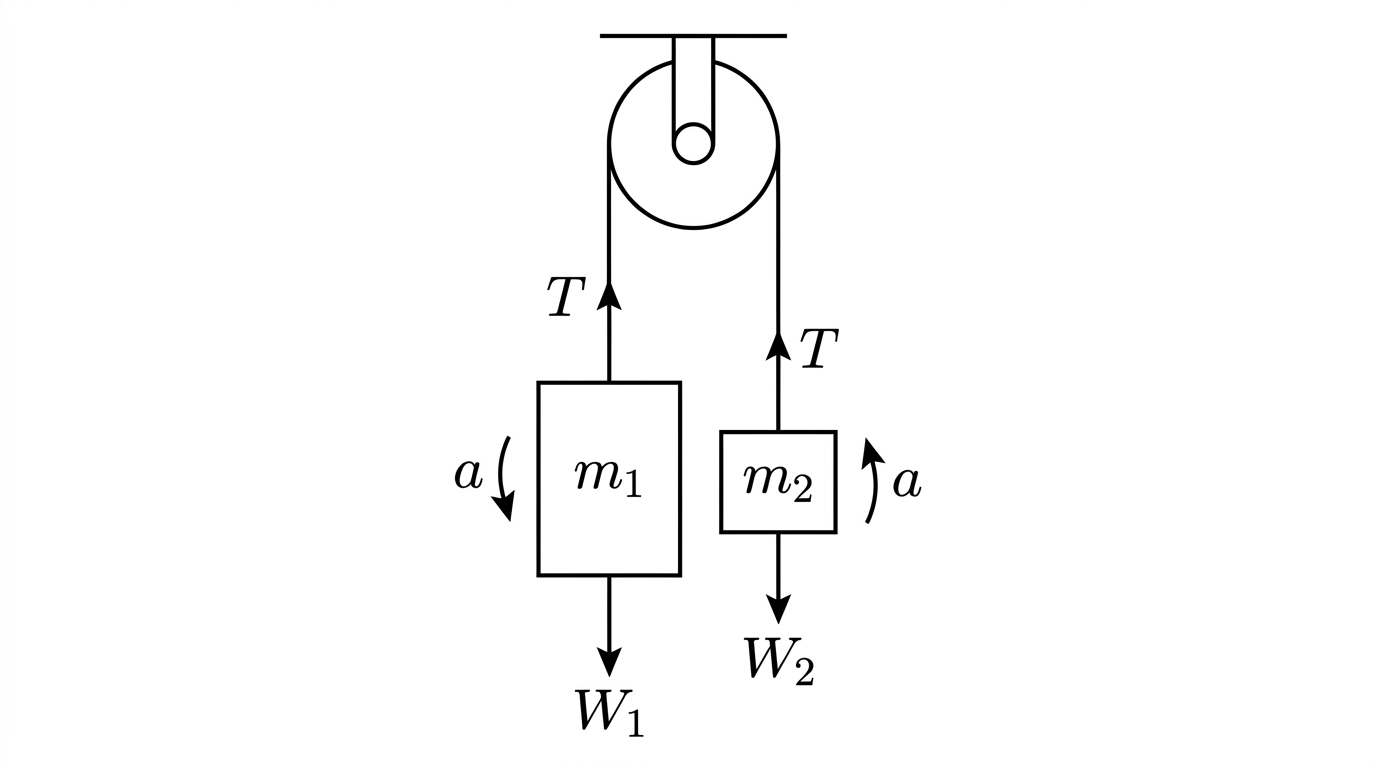
When two particles are joined by a light inextensible string, they share a single acceleration. That one fact turns two separate objects into one connected system, solvable with two applications of F = ma.
11 min read4 worked examples
What "connected" means
Two particles joined by a light, inextensible string share two important properties. The string being light means it has no mass of its own to accelerate, so the tension is transmitted along it unchanged. The string being inextensible means it cannot stretch, so the two particles always move with the same magnitude of acceleration — though not necessarily in the same direction in space, since the string can pass over a pulley or round a corner.
The method: separate diagrams, then combine
(1) Draw a force diagram for each particle separately. (2) Choose one consistent positive direction for the whole system — for example, "the direction the heavier mass moves". (3) Apply $F=ma$ to each particle in turn, using the same $a$ and the same $T$ in both equations. (4) Add or subtract the two equations to eliminate $T$ and solve for $a$; substitute back to find $T$.
Two configurations you'll meet often
In a straight line on a horizontal surface — one particle pulling or being pulled by another, connected by a string or rigid coupling — both particles move along the same line, so their accelerations point the same way. Hanging from a pulley — two particles connected by a string over a smooth, light, fixed pulley — one moves up as the other moves down, but both accelerate with the same magnitude, since the string is inextensible.
Two particles connected over a smooth, light, fixed pulley: the string constrains both particles to the same magnitude of acceleration, with the heavier one falling and the lighter one rising.
Worked example 1
Two trucks in a line
An engine of mass $2000\ \text{kg}$ pulls a truck of mass $500\ \text{kg}$ along a smooth horizontal track using a light, inextensible coupling. The engine's driving force is $5000\ \text{N}$. Find the acceleration of the system and the tension in the coupling.
MethodWhole system for acceleration, then isolate the truck for tension
1
Treating engine and truck as one system of total mass $2500\ \text{kg}$: $5000 = 2500a$.
The coupling tension is internal and cancels for the whole system.
2
$a = 2\ \text{m s}^{-2}$.
Solve.
3
Now isolate the truck alone: the only horizontal force on it is the tension $T$ pulling it forward. $T = 500 \times 2 = 1000\ \text{N}$.
Apply $F=ma$ to the truck only.
4
Check with the engine: $5000 - T = 2000a \Rightarrow 5000-1000 = 4000 = 2000(2)$. ✓
The tension pulls back on the engine, by Newton's third law.
▪ solved
Worked example 2
The classic pulley (Atwood machine)
Particles of mass $5\ \text{kg}$ and $3\ \text{kg}$ are connected by a light, inextensible string passing over a smooth, light, fixed pulley. The system is released from rest. Find the acceleration and the tension in the string. Take $g=9.8\ \text{m s}^{-2}$.
MethodWrite F = ma for each mass, taking the direction each one actually accelerates as positive
1
The heavier mass ($5\ \text{kg}$) will fall and the lighter mass ($3\ \text{kg}$) will rise; call this direction positive for each particle. For the $5\ \text{kg}$ mass: $5g - T = 5a$.
Weight down, tension up, resultant is $5g-T$.
2
For the $3\ \text{kg}$ mass, which accelerates upward: $T - 3g = 3a$.
Tension up, weight down, resultant $T-3g$.
3
Add the two equations to eliminate $T$: $5g - 3g = 5a+3a$, so $2g = 8a$.
Adding cancels $T$ and $-T$.
4
$a = \dfrac{2(9.8)}{8} = 2.45\ \text{m s}^{-2}$.
Solve for $a$.
5
Substitute into the second equation: $T = 3g+3a = 3(9.8)+3(2.45) = 29.4+7.35 = 36.75\ \text{N}$, so $T=36.8\ \text{N}$ (3 s.f.).
Use either equation to find $T$.
▪ solved
A useful shortcut
For two masses $m_1 > m_2$ hanging over a smooth pulley, adding the two equations always gives $a = \dfrac{(m_1-m_2)g}{m_1+m_2}$ directly. It's worth knowing this result to check your answer, but the two-equation method above is what you should show in full, since it is what generalises to every other connected-particle problem.
Worked example 3
A particle on a table, connected over a pulley at the edge
A particle of mass $4\ \text{kg}$ lies on a smooth horizontal table. It is connected by a light, inextensible string, passing over a smooth pulley fixed at the edge of the table, to a particle of mass $6\ \text{kg}$ hanging freely. Find the acceleration of the system and the tension in the string. Take $g=9.8\ \text{m s}^{-2}$.
MethodThe particle on the table only has a horizontal equation; the hanging particle only has a vertical one
1
For the $4\ \text{kg}$ particle on the table, the only horizontal force is the tension pulling it toward the pulley: $T = 4a$.
The table is smooth, so no friction, and vertically it is in equilibrium (not relevant here).
2
For the $6\ \text{kg}$ hanging particle, weight acts down and tension up: $6g - T = 6a$.
It accelerates downward as it falls.
3
Add the two equations to eliminate $T$: $6g = 4a+6a = 10a$.
A locomotive of mass $3000\ \text{kg}$ pulls two trucks, of mass $800\ \text{kg}$ and $600\ \text{kg}$, connected in a line by light inextensible couplings (locomotive–first truck–second truck), on a smooth horizontal track. The driving force is $4400\ \text{N}$. Find the acceleration of the train and the tension in each coupling.
MethodWhole system first, then isolate from the back forward
1
Total mass of the system: $3000+800+600 = 4400\ \text{kg}$. Whole-system equation: $4400 = 4400a$, so $a = 1\ \text{m s}^{-2}$.
Every internal coupling tension cancels for the system as a whole.
2
Isolate the back truck ($600\ \text{kg}$) alone: the only force on it is the tension $T_2$ in the coupling ahead of it. $T_2 = 600 \times 1 = 600\ \text{N}$.
Working from the back avoids needing the driving force yet.
3
Isolate the back two trucks together ($800+600=1400\ \text{kg}$): the only external force on this pair is $T_1$, the tension in the coupling to the locomotive. $T_1 = 1400 \times 1 = 1400\ \text{N}$.
Grouping trucks together is valid since they share the same acceleration.
4
Check with the locomotive alone: $4400 - T_1 = 3000a \Rightarrow 4400-1400=3000=3000(1)$. ✓
Confirms the whole-system value of $a$.
▪ solved
Grouping particles is the key idea
With three or more connected particles, isolating one at a time from whichever end is simplest — and grouping the rest together as a single object when convenient — turns a seemingly complicated system into a sequence of ordinary $F=ma$ equations. The tension is always largest in the coupling closest to the driving force, since it has to accelerate the most mass behind it.
Common mistake
Assuming the tension is the same throughout a system with more than two particles. It is only guaranteed equal on both sides of a single smooth, light pulley, or along one continuous light string with nothing else attached to it in between. In a multi-truck train, each coupling generally carries a different tension, as example 4 shows.
Check yourself
Particles of mass $4\ \text{kg}$ and $6\ \text{kg}$ are connected by a light, inextensible string over a smooth, light, fixed pulley, and released from rest. Find the acceleration of the system and the tension in the string. Take $g=9.8\ \text{m s}^{-2}$.
$6g-T=6a$ and $T-4g=4a$. Adding: $2g=10a$, so $a=1.96\ \text{m s}^{-2}$.