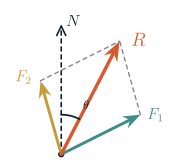
When several forces act on a particle at once, add them as vectors to get the resultant force — Newton's second law then turns that resultant directly into an acceleration vector, complete with its own magnitude and bearing.
12 min read3 worked examples
Newton's second law in vector form
Everything from $F=ma$ carries across to two dimensions unchanged — the only difference is that $\mathbf{F}$ and $\mathbf{a}$ are now vectors. If several forces act on a particle, first find the resultant force $\mathbf{F}_{\text{net}}$ by adding them as vectors, then divide by mass to get the acceleration.
The resulting acceleration $\mathbf{a}$ always points in the same direction as the resultant force $\mathbf{F}_{\text{net}}$ — never in the direction of any single force on its own. Throughout this lesson, $\mathbf{i}$ is the unit vector due east and $\mathbf{j}$ is the unit vector due north, so that a direction can be expressed either in $\mathbf{i}$–$\mathbf{j}$ form or as a compass bearing.
Add the individual forces as vectors to get the resultant $R$, then measure its bearing $\theta$ clockwise from north.
Resolving a bearing into components
A force is sometimes given as a magnitude and a bearing rather than in $\mathbf{i}$–$\mathbf{j}$ form. Since a bearing is measured clockwise from north, not anticlockwise from the usual horizontal axis, the sine and cosine swap roles compared with the resolving you've seen before:
Once every force is written in $\mathbf{i}$–$\mathbf{j}$ (east–north) form, add them component-by-component exactly as in the previous lesson.
Finding a magnitude and bearing from components
Going the other way — from components back to a bearing — is easiest by sketching the vector and reading off which quadrant it falls in (north-east, south-east, south-west or north-west), then using the acute angle $\alpha$ between the vector and the north–south line.
Method
For a resultant with east component $E$ and north component $N$, let $\alpha = \tan^{-1}\!\left(\dfrac{|E|}{|N|}\right)$. Then: bearing $=\alpha$ if $E,N \geq 0$ (NE); $180°-\alpha$ if $E\geq0,N<0$ (SE); $180°+\alpha$ if $E<0,N<0$ (SW); $360°-\alpha$ if $E<0,N\geq0$ (NW).
Worked example 1
Two forces in i–j form
Forces $\mathbf{F}_1 = (5\mathbf{i}+2\mathbf{j})\ \text{N}$ and $\mathbf{F}_2 = (-3\mathbf{i}+6\mathbf{j})\ \text{N}$ act on a particle of mass $2\ \text{kg}$. Find the acceleration of the particle, giving its magnitude and bearing.
MethodAdd the forces, divide by mass, then convert to magnitude and bearing
Both components positive (NE quadrant): $\alpha = \tan^{-1}(1/4) = 14.0°$, so the bearing is $\mathbf{014°}$ (3 s.f.).
E and N both ≥ 0.
▪ solved
Worked example 2
Combining i–j and bearing-form forces
A particle of mass $4\ \text{kg}$ is acted on by three forces: $10\ \text{N}$ due east, $8\ \text{N}$ on a bearing of $060°$, and $6\ \text{N}$ due south. Find the magnitude and bearing of the resultant force, and hence the acceleration of the particle.
MethodResolve every force into east–north components first
1
$10\ \text{N}$ due east $= (10,0)$; $6\ \text{N}$ due south $= (0,-6)$.
Along the compass axes already.
2
$8\ \text{N}$ at bearing $060°$: east $=8\sin60°=6.93$, north $=8\cos60°=4.00$.
East = Fsinθ, north = Fcosθ.
3
Resultant: east $=10+6.93+0=16.93$, north $=0+4.00-6=-2.00$.
$a = 17.05/4 = 4.26\ \text{m s}^{-2}$ (3 s.f.), on the same bearing $097°$ as the resultant force.
a is parallel to F_net.
▪ solved
Worked example 3
Working backwards from the accelerationChallenge
A particle of mass $3\ \text{kg}$ is acted on by forces $\mathbf{F}_1=(4\mathbf{i}-2\mathbf{j})\ \text{N}$ and $\mathbf{F}_2=(-\mathbf{i}+5\mathbf{j})\ \text{N}$, together with a third force $\mathbf{F}_3$. The resulting acceleration is exactly $2\ \text{m s}^{-2}$ due north. Find the magnitude and bearing of $\mathbf{F}_3$.
MethodFind the resultant needed for that acceleration, then subtract the known forces
The particle doesn't know which force is "third" — Newton's second law only cares about the total. So the required total $\mathbf{F}_{\text{net}}=m\mathbf{a}$ can be found first, and $\mathbf{F}_3$ is simply whatever needs adding to the known forces to reach it.
Common mistake
Adding a force given as a bearing directly into the $\mathbf{i}$–$\mathbf{j}$ sum without resolving it first is the most common slip — always convert to east/north components first. Mixing up $\sin\theta$ and $\cos\theta$ when resolving a bearing is another: because bearings are measured from north rather than from the horizontal, it's the east component that uses sine. Finally, remember the acceleration is parallel to the resultant force, never to one of the individual forces that make it up.
Check yourself
Forces $\mathbf{F}_1=(6\mathbf{i}-3\mathbf{j})\ \text{N}$ and $\mathbf{F}_2=(2\mathbf{i}+7\mathbf{j})\ \text{N}$ act on a particle of mass $5\ \text{kg}$. Find the magnitude and bearing of its acceleration. (Hint: find the resultant force first, then divide by mass.)