Newton's three laws govern every mechanics problem in this course. The second — resultant force equals mass times acceleration — does almost all of the work.
12 min read4 worked examples
The three laws
Newton's first law
An object remains at rest, or moves with constant velocity in a straight line, unless a resultant (non-zero, net) force acts on it. Equivalently: an object accelerates if and only if the forces on it do not balance.
Newton's second law
The resultant force on an object equals its mass multiplied by its acceleration: $F = ma$. Both $F$ and $a$ are vectors, and $F$ here means the resultant of every force acting — you must resolve and combine all the forces first, exactly as in the previous lesson.
Newton's third law
If object A exerts a force on object B, then B exerts an equal and opposite force on A. The two forces in a Newton's-third-law pair are always the same type, the same magnitude, opposite in direction, and act on two different objects — never on the same object.
The first law is really a special case of the second: if $F=0$ then $a=0$, meaning zero or constant velocity. The second law is the tool used in almost every calculation in mechanics from here on. The third law matters most when two objects interact directly — pushing against each other, or connected by a string — and is easy to misuse if the two forces in a pair are confused with a different, unrelated pair.
Applying F = ma
The method
(1) Draw a force diagram showing every force on the object. (2) Choose a positive direction — usually the direction of the acceleration. (3) Resolve all forces in that direction and sum them to get the resultant. (4) Set the resultant equal to $ma$ and solve. If forces act perpendicular to the direction of motion too, those directions are usually in equilibrium (resultant zero), which often supplies the value of a normal reaction.
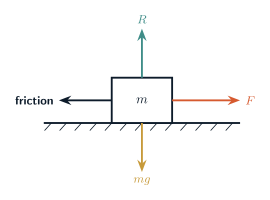
A force diagram for a mass $m$ on a surface: weight $mg$ down, normal reaction $R$ up, applied force and friction along the surface — the unbalanced direction gives $F=ma$, the balanced direction gives $R$.
Worked example 1
A single resultant force
A box of mass $8\ \text{kg}$ is pulled along a horizontal floor by a horizontal force of $30\ \text{N}$. A resistance force of $6\ \text{N}$ acts against the motion. Find the acceleration of the box.
MethodFind the resultant horizontal force, then apply F = ma
1
Taking the direction of motion as positive, the resultant force is $30 - 6 = 24\ \text{N}$.
The resistance opposes the driving force.
2
Apply $F=ma$: $24 = 8a$.
Substitute mass and resultant force.
3
$a = 3\ \text{m s}^{-2}$.
Solve.
▪ solved
Worked example 2
A force at an angle, and the normal reaction
A sledge of mass $12\ \text{kg}$ is pulled across smooth horizontal ice by a rope at $20°$ above the horizontal, with tension $50\ \text{N}$. Find the acceleration of the sledge and the normal reaction from the ice. Take $g = 9.8\ \text{m s}^{-2}$.
MethodResolve horizontally for acceleration, vertically for equilibrium
1
Horizontal component of tension: $50\cos 20° = 47.0\ \text{N}$ (3 s.f.). The ice is smooth, so this is the entire resultant horizontal force.
The rope's upward pull reduces the normal reaction below $mg$.
▪ solved
Why R is less than mg
The rope's tension has an upward component, which partly supports the sledge's weight, so the ice pushes back with a smaller force than it would if the rope were horizontal. If the angle were large enough, $R$ could even reach zero — the sledge would leave the ground.
Worked example 3
Newton's third law in contact
Two blocks, of mass $3\ \text{kg}$ and $5\ \text{kg}$, are in contact on a smooth horizontal surface, with the $3\ \text{kg}$ block behind the $5\ \text{kg}$ block. A horizontal force of $40\ \text{N}$ pushes the $3\ \text{kg}$ block from behind. Find the acceleration of the system and the force between the two blocks.
MethodTreat the whole system first, then isolate one block for the contact force
1
Treating both blocks as one system of total mass $8\ \text{kg}$: $40 = 8a$, so $a = 5\ \text{m s}^{-2}$.
The contact force is internal to the system and cancels.
2
Now isolate the $5\ \text{kg}$ block alone. The only horizontal force on it is the contact force $N$ from the $3\ \text{kg}$ block pushing it forward.
Isolating one block reveals the internal force.
3
Apply $F=ma$ to this block: $N = 5 \times 5 = 25\ \text{N}$.
Same acceleration, since they move together.
4
By Newton's third law, the $5\ \text{kg}$ block pushes back on the $3\ \text{kg}$ block with $25\ \text{N}$ in the opposite direction — consistent with the $3\ \text{kg}$ block's own equation, $40 - 25 = 3\times 5 = 15$. ✓
Check using the other block.
▪ solved
Worked example 4
A lift in two stagesChallenge
A person of mass $70\ \text{kg}$ stands on scales inside a lift. The lift first accelerates upward at $1.5\ \text{m s}^{-2}$, then later decelerates at $2\ \text{m s}^{-2}$ while still moving upward, as it comes to rest at the top floor. Find the reading on the scales during each phase. Take $g=9.8\ \text{m s}^{-2}$.
MethodThe scale reading is the normal reaction R, found from F = ma applied to the person
1
Two vertical forces act on the person: their weight $mg$ downward, and the normal reaction $R$ from the scales upward. Taking upward as positive, $R - mg = ma$.
Accelerating upward increases the reading above $mg$.
3
Phase 2 (still moving upward, but decelerating, so the acceleration vector points downward: $a=-2$): $R = 70(9.8-2) = 70(7.8) = 546\ \text{N}$.
Decelerating while moving up means the acceleration is downward, reducing $R$.
4
For comparison, the person's true weight is $mg = 70(9.8) = 686\ \text{N}$ — the scales read above this in phase 1 and below it in phase 2.
Neither phase reads the true weight.
▪ solved
Look deeper — the sign of a is about the acceleration, not the direction of travel
In phase 2 the lift is still moving upward, yet the acceleration is negative. This is the same distinction as decelerating a car: the velocity and the acceleration point in opposite directions. Always find the direction of the acceleration itself — from what the lift is doing to its speed — rather than assuming it matches the direction of motion.
Common mistake
Treating an object's weight and the normal reaction on it as a Newton's-third-law pair is a very common error — they are not, because both act on the same object. A genuine third-law pair always involves two different objects: the reaction paired with the weight is the gravitational pull the object itself exerts back on the Earth, which never appears in these problems at all.
Check yourself
A crate of mass $10\ \text{kg}$ experiences a resultant horizontal force of $25\ \text{N}$. Find its acceleration. If the resultant force instead acted at $2\ \text{m s}^{-2}$ opposing an existing rightward velocity, describe what is happening to the crate's speed.
$a = F/m = 25/10 = 2.5\ \text{m s}^{-2}$.
If the acceleration opposes an existing rightward velocity, the crate is decelerating — slowing down while still moving to the right, until (if the force continues) it eventually stops and may begin to move left.