A force acting at an angle can be split into two perpendicular components. Once every force is broken down this way, combining them — or checking they balance — is just vector addition.
12 min read4 worked examples
Resolving a force into components
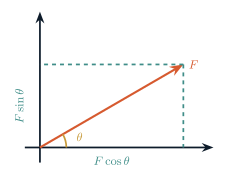
A force with magnitude $F$ acting at angle $\theta$ to the horizontal can be split into a horizontal and a vertical part — its components. Together, these two components have exactly the same effect as the original force.
The resolving formulae
$$F_x = F\cos\theta \qquad F_y = F\sin\theta$$
where $\theta$ is measured from the horizontal. In vector form, the force is $\mathbf{F} = F\cos\theta\,\mathbf{i} + F\sin\theta\,\mathbf{j}$. This is exactly the i–j notation from Working with Vectors — the new step here is generating the components yourself from a magnitude and an angle, rather than being given them.
Resolving a force into perpendicular components: the horizontal part is $F\cos\theta$, the vertical part is $F\sin\theta$.
Adding several forces
Once every force acting on a particle is written in $\mathbf{i}$–$\mathbf{j}$ form, the resultant is found the same way as any vector sum: add the $\mathbf{i}$ components together, add the $\mathbf{j}$ components together. The magnitude and direction of the resultant then follow from Pythagoras and $\tan^{-1}$, exactly as before.
Worked example 1
Resolving a single force
A rope pulls a sledge with tension $60\ \text{N}$, directed at $25°$ above the horizontal. Find the horizontal and vertical components of the tension.
As a vector, the tension is $(54.4\mathbf{i} + 25.4\mathbf{j})\ \text{N}$.
Combine into i–j form.
▪ solved
Worked example 2
Resultant of two forces at angles
Two forces act on a particle: $F_1 = 40\ \text{N}$ at $30°$ above the horizontal, and $F_2 = 25\ \text{N}$ at $120°$ measured anticlockwise from the same horizontal. Find the magnitude and direction of the resultant.
MethodResolve each force, add the components, then convert back
Direction: $\tan^{-1}\left(\dfrac{41.65}{22.14}\right) = 61.9°$ above the horizontal (3 s.f.).
Both components positive, so the angle is measured directly.
▪ solved
Equilibrium of forces
Equilibrium means the resultant is the zero vector
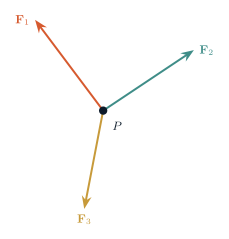
A particle in equilibrium has forces that sum to exactly zero: $\sum \mathbf{F} = \mathbf{0}$. This means the $\mathbf{i}$ components sum to zero and the $\mathbf{j}$ components sum to zero — two separate equations from one vector condition.
Three forces acting on a particle in equilibrium: whatever their individual directions, their vector sum must be zero.
Worked example 3
Finding an unknown force in equilibrium
A particle $P$ is held in equilibrium by three coplanar forces: $F_1 = 12\ \text{N}$ acting horizontally, $F_2 = 9\ \text{N}$ acting vertically upward, and a third force $F_3$. Find $F_3$ as a vector, and state its magnitude and direction.
MethodEquilibrium means the three forces sum to zero
1
Write the known forces in i–j form: $F_1 = 12\mathbf{i}$, $F_2 = 9\mathbf{j}$.
Direction: $\tan^{-1}(9/12) = 36.9°$, and since both components are negative, $F_3$ points $36.9°$ below the horizontal, on the opposite side to $F_1$ and $F_2$.
Sketch to fix the quadrant.
▪ solved
Worked example 4
Two unknown tensionsChallenge
A light is held in equilibrium by two ropes. Rope $A$ makes $50°$ with the horizontal and rope $B$ makes $35°$ with the horizontal on the other side, and the light has weight $40\ \text{N}$. Find the tensions $T_A$ and $T_B$.
MethodResolve horizontally and vertically to get two equations
1
Horizontal equilibrium: the two ropes pull in opposite horizontal directions, so $T_A\cos50° = T_B\cos35°$.
One equilibrium condition — the vector one — splits into two scalar equations, and here there were two unknowns ($T_A$ and $T_B$), so both were needed. This pairing is standard: two unknowns in a coplanar equilibrium problem almost always means resolving in two directions and solving simultaneously.
Common mistake
Mixing up $\cos$ and $\sin$ is the most common slip — always check against a sketch: the component adjacent to the angle uses $\cos$, the opposite one uses $\sin$. The other frequent error is forgetting a minus sign when a component points in the negative direction, which silently corrupts every equation that follows.
Check yourself
A force of $45\ \text{N}$ acts at $35°$ above the horizontal. Find its horizontal and vertical components. A second force, $28\mathbf{i} - 10\mathbf{j}$ N, also acts on the same particle. Find the resultant of the two forces. (Hint: resolve the first force into i–j form before adding.)
Method
1
$45\cos35° = 36.9\ \text{N}$, $45\sin35° = 25.8\ \text{N}$, so the first force is $(36.9\mathbf{i} + 25.8\mathbf{j})$ N.
Resolve.
2
Resultant: $(36.9+28)\mathbf{i} + (25.8-10)\mathbf{j} = (64.9\mathbf{i} + 15.8\mathbf{j})$ N.