Every mechanics problem starts with a correct picture. Once every force acting on an object is drawn and resolved into components, finding the resultant is just vector addition.
12 min read4 worked examples
The forces you'll meet
A force diagram (or free-body diagram) shows every force acting on one object, drawn as an arrow from the point where it acts, in the direction it acts, roughly proportional to its size. Almost every mechanics problem in this course uses some combination of the following:
Weight $W = mg$ — acts vertically downward from the object's centre of mass.
Normal reaction $R$ (or $N$) — acts perpendicular to a contact surface, pushing the object away from it.
Tension $T$ — acts along a string, or a rod being stretched, pulling the object toward the string.
Thrust (or compression) — acts along a rigid rod being compressed, pushing the object away from the rod.
Friction $F$ — acts along a contact surface, opposing relative sliding or the tendency to slide.
Applied / driving force — any push or pull stated in the problem.
Resistance — opposes motion, often used for air or rolling resistance.
A correct force diagram is the single biggest predictor of a correct answer. Drawing one — even for a question that seems to need only a quick calculation — is never wasted time.
Tension vs thrust: why the distinction matters
A string can only pull — it can be in tension, but it goes slack rather than pushing. A rigid rod can do either: if the object at its end tends to move away from it, the rod stretches slightly and pulls back with tension; if the object tends to move toward it, the rod resists being squashed and pushes back with thrust (also called compression). The arrow for tension points from the object toward the rod or string; the arrow for thrust points from the rod out toward the object — the opposite way.
Resolving a force into components
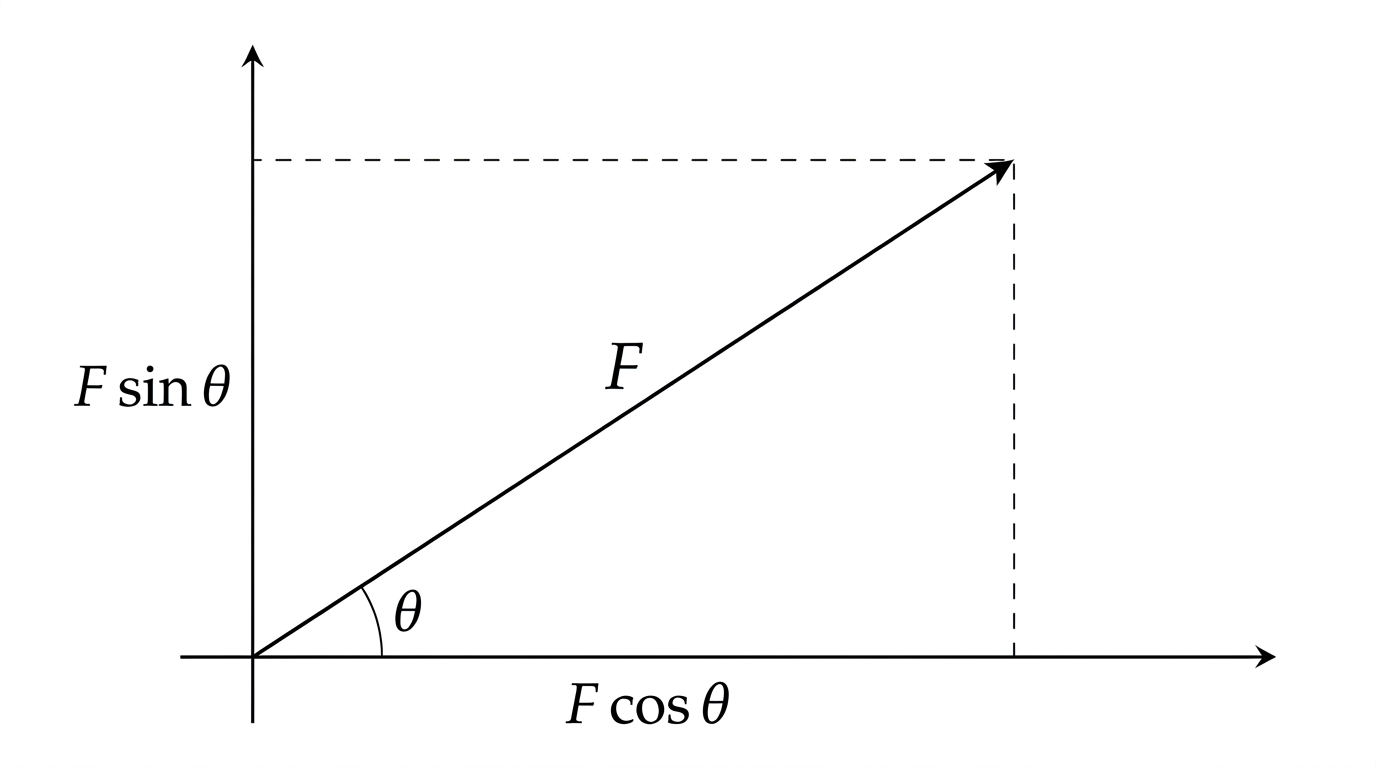
A force $F$ acting at an angle $\theta$ to the horizontal can be replaced, for every purpose, by two perpendicular forces: a horizontal component $F\cos\theta$ and a vertical component $F\sin\theta$. This works because a force is a vector, and any vector can be split into components along two perpendicular directions without changing its effect.
Resolving a force into horizontal and vertical components: the components are the two legs of a right-angled triangle with the force itself as the hypotenuse.
Finding a resultant force
The resultant of several forces is the single force that has the same overall effect as all of them combined. The method is always the same, however many forces are involved:
The method: resolve, sum, combine
(1) Resolve every force into components along two perpendicular directions (usually horizontal and vertical). (2) Add the horizontal components to get $\Sigma F_x$, and add the vertical components to get $\Sigma F_y$, taking care with signs. (3) The magnitude of the resultant is $\sqrt{(\Sigma F_x)^2 + (\Sigma F_y)^2}$, by Pythagoras, and its direction is $\arctan\left(\dfrac{\Sigma F_y}{\Sigma F_x}\right)$ measured from the horizontal.
Worked example 1
Two perpendicular forces
Forces of $8\ \text{N}$ due east and $6\ \text{N}$ due north act on a particle. Find the magnitude and direction of the resultant force.
MethodPythagoras for magnitude, trigonometry for direction
1
The two forces are already perpendicular, so treat east as $x$ and north as $y$: $F_x = 8$, $F_y = 6$.
Direction: $\theta = \arctan\left(\dfrac{6}{8}\right) = 36.9°$ (3 s.f.) measured from east, towards north.
Angle from the reference direction.
▪ solved
Recognise the triangle
$8$, $6$, $10$ is a scaled $3$–$4$–$5$ right-angled triangle. Spotting these Pythagorean triples early can save you a line of working, though the full calculation always gives the same answer.
Worked example 2
Resolving a single angled force
A force of $10\ \text{N}$ acts at $30°$ above the horizontal. Find its horizontal and vertical components.
MethodMultiply by cosine for horizontal, sine for vertical
Three forces act on a particle: $12\ \text{N}$ due east, $9\ \text{N}$ at $60°$ above the horizontal (north of east), and $5\ \text{N}$ due south. Find the resultant force.
MethodResolve each force separately, then sum each direction
1
Horizontal components: $12$, $9\cos 60° = 4.5$, and $0$ (the $5\ \text{N}$ force is purely vertical). Sum: $\Sigma F_x = 12+4.5+0 = 16.5\ \text{N}$.
Add every east–west contribution.
2
Vertical components: $0$, $9\sin 60° = 7.79$, and $-5$ (south is the negative direction). Sum: $\Sigma F_y = 0+7.79-5 = 2.79\ \text{N}$ (3 s.f.).
South opposes the chosen positive (north) direction.
Direction: $\arctan\left(\dfrac{2.79}{16.5}\right) = 9.6°$ above the horizontal (east).
Small positive $F_y$ gives a small angle above east.
▪ solved
Worked example 4
Equilibrium with an unknown forceChallenge
A particle is in equilibrium under three forces: $20\ \text{N}$ due east, $F$ newtons acting due north, and a third force of magnitude $25\ \text{N}$ acting at some angle. If the particle is in equilibrium, find $F$ and the direction of the $25\ \text{N}$ force.
MethodEquilibrium means every component sums to zero
1
In equilibrium, $\Sigma F_x = 0$ and $\Sigma F_y = 0$. The $25\ \text{N}$ force must exactly cancel the other two combined, so its horizontal component is $-20$ and its vertical component is $-F$.
The resultant of all three forces is zero.
2
Its magnitude is given as $25$, so $20^2 + F^2 = 25^2$, giving $F^2 = 625-400=225$.
Pythagoras on the unknown force's own components.
3
$F = 15\ \text{N}$ (taking the positive root, since it's a magnitude).
Solve for $F$.
4
The $25\ \text{N}$ force has components $(-20,-15)$, so it points south-west, at $\arctan\left(\dfrac{15}{20}\right)=36.9°$ south of west.
Interpret the sign of each component as a direction.
▪ solved
Equilibrium is two equations, not one
Whenever a particle is in equilibrium under several forces, resolving in two perpendicular directions gives two independent equations. With two unknowns — here $F$ and the direction of the third force — that is exactly enough information, provided you also use the given magnitude as a third piece of data, as in step 2.
Common mistake
Mixing up sine and cosine when resolving is the most frequent slip: the component adjacent to the stated angle uses cosine, and the component opposite it uses sine. Sketch the small right-angled triangle formed by the force and its two components every time, rather than trying to recall a rule — the triangle makes the correct choice obvious.
Check yourself
Forces of $5\ \text{N}$ due north and $12\ \text{N}$ due east act on a particle. Find the magnitude and direction of the resultant.
Magnitude: $\sqrt{5^2+12^2} = \sqrt{169} = 13\ \text{N}$ (the $5$–$12$–$13$ triple).
Direction: $\arctan\left(\dfrac{5}{12}\right) = 22.6°$ (3 s.f.) north of east.