Vertical Motion Under Gravity
Gravity gives a constant acceleration of 9.8 m s⁻², so the SUVAT formulae apply unchanged. The mathematics is familiar; the signs are where the marks go.
Gravity is just a constant acceleration
An object moving freely under gravity — thrown, dropped, or falling — has a constant acceleration of about $9.8\ \text{m s}^{-2}$ directed downwards. It is constant, so the SUVAT formulae apply unchanged. There is no new mathematics in this lesson. What there is, and what costs the marks, is signs.
The acceleration due to gravity is written $g$. Unless a question says otherwise, take $g = 9.8\ \text{m s}^{-2}$.
$g$ is not a fixed constant of nature the way, say, the speed of light is — it depends on location, varying slightly with altitude and with exactly where on Earth you are, and it would take a very different value on the Moon or another planet. The value $9.8\ \text{m s}^{-2}$ is simply a good approximation for the Earth's surface. Some questions instead specify $g = 10\ \text{m s}^{-2}$ for simpler arithmetic — always use whichever value the question gives you, and state it clearly in your working if it isn't the default.
That phrase is doing real work. It tells you the only force acting is weight, so the acceleration is exactly $g$ and nothing else. It also means the object's mass is irrelevant — a feather and a hammer released together would land together, because $g$ does not depend on mass. If a question mentions air resistance, the acceleration is no longer constant and SUVAT no longer applies.
Choose a positive direction and commit to it
Velocity, acceleration and displacement are all vectors, so each needs a sign. Before writing anything down, decide which direction is positive. Either choice works — but every quantity in the question must then follow it.
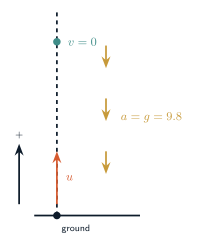
(1) State your positive direction — write it down, do not just think it. (2) List $s$, $u$, $v$, $a$, $t$ with signs to match. (3) Choose the formula that omits the quantity you neither know nor want. (4) Solve, then check the sign of your answer describes what physically happens. Two useful facts: at the highest point of a throw the velocity is momentarily zero (not the acceleration), and "dropped" or "released" means $u = 0$.
Worked example 1
Nothing in this problem moves upwards, so taking downwards as positive makes every quantity positive and removes any chance of a sign slip. Taking upwards as positive is equally valid but gives $s = -45$ and $a = -9.8$, and the two negatives must then cancel correctly in $v^2 = 0 + 2(-9.8)(-45) = 882$ — same answer, more opportunity to go wrong. Pick the convention that suits the motion.
Worked example 2
Setting $s = 0$ in step 4 catches people out. The ball has travelled $22.5$ m up and $22.5$ m down — a distance of $45$ m — but its displacement from the starting point is zero, because it is back where it started. SUVAT works in displacement, always. And note that $t=0$ appearing as a root is not a nuisance: the equation is describing every moment the ball is at ground level, and the throw is one of them.
Worked example 3
Signs cause nearly every lost mark here. Fix a positive direction, write it down, and make $s$, $u$, $v$ and $a$ all obey it — an upward throw with $a = +9.8$ is the classic error. Do not confuse distance with displacement: a ball returning to its starting point has $s = 0$. And at the top of a throw the velocity is zero, not the acceleration — gravity does not switch off, which is exactly why the ball comes back down.
Check yourself
A ball is thrown vertically upwards at $19.6\ \text{m s}^{-1}$ from ground level. Taking $g = 9.8\ \text{m s}^{-2}$, find the greatest height reached and the time taken to reach it.
(Hint: at the greatest height, $v = 0$.)
The height and the initial speed both come out as $19.6$ — a coincidence of the numbers, not a rule. Note the total flight time would be $4$ s: the rise and the fall take equal times, since the motion is symmetric.