Five quantities describe straight-line motion under constant acceleration, and five formulae connect them. Each one leaves out a different quantity — choosing well is most of the work.
11 min read3 worked examples
Five quantities, five formulae
When an object moves in a straight line with constant acceleration, five quantities describe the motion completely:
$s$ — displacement, in metres (m)
$u$ — initial velocity, in metres per second (m s⁻¹)
$v$ — final velocity, in m s⁻¹
$a$ — acceleration, in metres per second squared (m s⁻²)
$t$ — time, in seconds (s)
Their initials give the equations their usual name: the SUVAT formulae. There are five of them, and each one leaves out exactly one of the five quantities. That is the key to using them: work out which quantity you neither know nor want, and pick the formula that omits it.
$v = u + at \qquad s = ut + \tfrac12 at^2 \qquad s = \tfrac12(u+v)t \qquad v^2 = u^2 + 2as \qquad s = vt - \tfrac12 at^2$
These only work for constant acceleration
Every one of these formulae assumes $a$ does not change during the motion. If the acceleration varies, they are simply wrong, and you need calculus instead. Exam questions signal constant acceleration with phrases like "constant acceleration", "uniform acceleration", or by saying the object is moving freely under gravity. If a question gives you acceleration as a function of time, put the SUVAT formulae away.
Where they come from
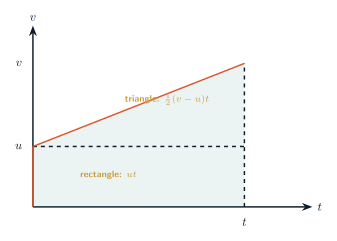
The first formula is just the definition of acceleration rearranged: acceleration is the rate of change of velocity, so $a = \dfrac{v-u}{t}$, which gives $v = u + at$. The rest follow from the area under a velocity–time graph.
Constant acceleration gives a straight line, so the area beneath is a trapezium with parallel sides u and v and width t. Every SUVAT formula comes from this one picture.
MethodDerive s = ½(u+v)t and v² = u² + 2as
1
For constant acceleration the velocity–time graph is a straight line from $u$ to $v$ over time $t$. The displacement is the area beneath it — a trapezium with parallel sides $u$ and $v$ and width $t$.
Area under a v–t graph is displacement.
2
Area of a trapezium $= \tfrac12(\text{sum of parallel sides}) \times \text{width}$, so $s = \tfrac12(u+v)t$.
That is the third formula.
3
To eliminate $t$, rearrange $v = u + at$ to give $t = \dfrac{v-u}{a}$.
Multiply through by $2a$: $2as = v^2 - u^2$, i.e. $v^2 = u^2 + 2as$.
The fourth formula.
▪ derived
You don't need to reproduce these derivations
They are here so the formulae are not five arbitrary lines to memorise — they all come from one straight-line graph. In the exam you will be given the formulae, and you use them.
The method: list, choose, substitute
(1) Write down $s$, $u$, $v$, $a$, $t$ and fill in what you know, putting a question mark against what you want. (2) Find the quantity that is neither known nor wanted, and choose the formula that omits it. (3) Substitute and solve. Listing the five first takes ten seconds and turns most questions into a one-line substitution.
Worked example 1
Choosing the right formula
A car accelerates uniformly from $5\ \text{m s}^{-1}$ to $23\ \text{m s}^{-1}$ in $6$ seconds. Find its acceleration and the distance travelled.
MethodList the five, then pick the formula that omits the odd one out
1
List what you have: $u = 5$, $v = 23$, $t = 6$, $a = ?$, $s = ?$.
Two unknowns, so two formulae.
2
For $a$: the quantity not involved is $s$, so use $v = u + at$. Substituting, $23 = 5 + 6a$.
The formula without $s$.
3
Solve: $6a = 18$, so $a = 3\ \text{m s}^{-2}$.
Acceleration.
4
For $s$: we now know $u$, $v$ and $t$, and $a$ is not needed, so use $s = \tfrac12(u+v)t = \tfrac12(5+23)(6)$.
The formula without $a$.
5
$s = \tfrac12(28)(6) = 84\ \text{m}$.
Distance travelled.
▪ solved
Why not use s = ut + ½at²?
You could — it gives $5(6) + \tfrac12(3)(36) = 30 + 54 = 84$ m, the same answer. But it relies on the value of $a$ you calculated in step 3. If that were wrong, the error would carry through. Using $s = \tfrac12(u+v)t$ works only from the numbers the question gave you, so a slip earlier cannot contaminate it. Where there is a choice, prefer the formula built from given data.
Worked example 2
When time is neither known nor wanted
A train decelerates uniformly from $30\ \text{m s}^{-1}$ to rest over a distance of $225\ \text{m}$. Find its deceleration.
MethodTime is the missing quantity, so use v² = u² + 2as
1
List: $u = 30$, $v = 0$ (comes to rest), $s = 225$, $a = ?$, $t$ is neither known nor wanted.
'To rest' always means $v=0$.
2
The formula without $t$ is $v^2 = u^2 + 2as$. Substituting: $0^2 = 30^2 + 2a(225)$.
Choose by what is missing.
3
So $0 = 900 + 450a$, giving $450a = -900$ and $a = -2\ \text{m s}^{-2}$.
Solve.
4
The acceleration is $-2\ \text{m s}^{-2}$, i.e. a deceleration of $2\ \text{m s}^{-2}$.
Interpret the sign.
▪ solved
The minus sign is doing real work
A negative acceleration here means the acceleration acts opposite to the direction of motion — the train is slowing. Your answer came out negative because you took the direction of travel as positive, which is the standard choice. Both "$a = -2\ \text{m s}^{-2}$" and "a deceleration of $2\ \text{m s}^{-2}$" are correct, but do not write "a deceleration of $-2\ \text{m s}^{-2}$" — that says it is speeding up.
Worked example 3
A quadratic in t
A particle starts from rest and accelerates uniformly at $4\ \text{m s}^{-2}$ in a straight line. Find the time taken to travel $50\ \text{m}$, giving your answer to 3 significant figures.
MethodUse the formula without v, then solve for t
1
List: $u = 0$ (starts from rest), $a = 4$, $s = 50$, $t = ?$, and $v$ is neither known nor wanted.
'From rest' means $u=0$.
2
The formula without $v$ is $s = ut + \tfrac12at^2$. Substituting: $50 = 0 \times t + \tfrac12(4)t^2$.
The $ut$ term vanishes.
3
So $50 = 2t^2$, giving $t^2 = 25$.
Solve for $t^2$.
4
$t = \pm5$, but time cannot be negative here, so $t = 5.00$ s (3 s.f.).
Reject the negative root.
▪ solved
Look deeper — rejecting roots
$s = ut + \tfrac12at^2$ is a quadratic in $t$, so it often gives two solutions and you must decide which is physical. Here the negative root is meaningless because the motion starts at $t=0$. In other questions both roots can be valid — a ball thrown upward passes a given height twice, once going up and once coming down. Do not reject a root just because there are two; reject it because it describes something that does not happen.
Common mistake
Using these formulae when the acceleration is not constant is the error that costs whole questions. Check the wording first. After that, the usual slips are sign errors — decide which direction is positive at the start and stay with it — and missing the standard phrases: "from rest" means $u = 0$, "comes to rest" means $v = 0$, and "dropped" means $u = 0$ too.
Check yourself
A cyclist accelerates uniformly from $4\ \text{m s}^{-1}$ to $10\ \text{m s}^{-1}$ over a distance of $42\ \text{m}$. Find the acceleration, and the time taken. (Hint: for the acceleration, $t$ is neither known nor wanted.)