Pure · Trigonometric Ratios · Year 1

Sine Rule

The sine rule links every side of a triangle to the angle facing it — the tool of choice whenever a question hands you a matching side–angle pair.

8 min read 3 worked examples

Extending trigonometry beyond right angles

Label a triangle so side $a$ is opposite angle $A$, side $b$ opposite $B$, and side $c$ opposite $C$ — each side paired with the angle facing it. The sine rule states that these ratios are all equal:

$\dfrac{a}{\sin A} = \dfrac{b}{\sin B} = \dfrac{c}{\sin C}$

Use it whenever you have a matching side–angle pair — one side and its opposite angle both known — together with one more piece of information (another angle, or the side opposite it). If instead you're given two sides and the angle between them, or three sides with no matching pair, the cosine rule from the previous lesson is the right tool.

Proving the sine rule from first principles

The sine rule comes straight from a dropped perpendicular. Take triangle $ABC$ and drop the perpendicular $CD$ from $C$ to the base $AB$, calling its length $h$. This creates two right-angled triangles that share the same height $h$ — and expressing $h$ two different ways is the whole trick.
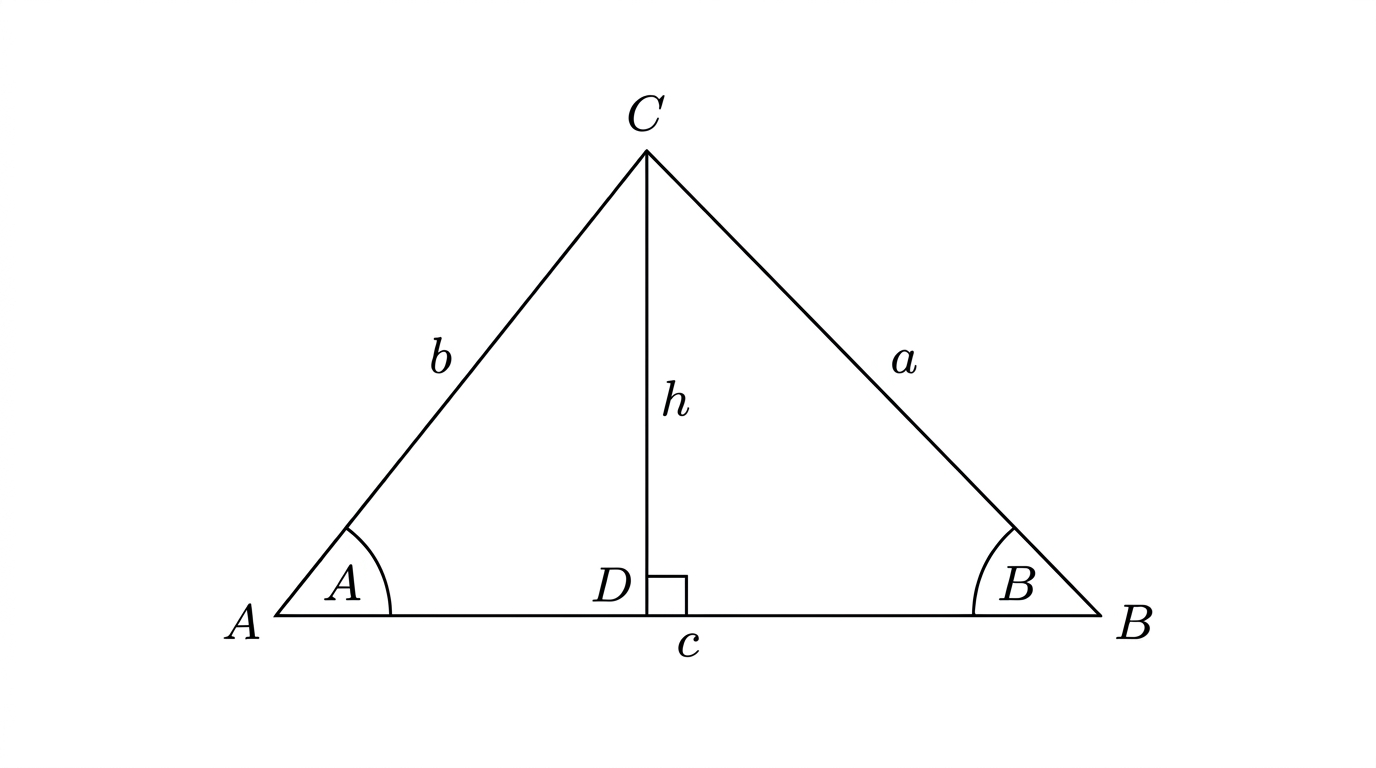
Triangle ABC with a perpendicular CD of length h dropped from C to the base AB at point D, forming a right angle at D. Angle A is at vertex A and angle B is at vertex B, side a is opposite A, side b is opposite B, and side c is the base AB.
The perpendicular h from C is shared by both right-angled triangles — writing it two ways gives the sine rule.
ProofDeriving a ⁄ sin A = b ⁄ sin B
1
In right-angled triangle $ACD$: $\sin A = \dfrac{h}{b}$, since $h$ is opposite $A$ and $b$ is the hypotenuse.
SOH in the left-hand triangle.
2
Rearrange for the height: $h = b\sin A$.
Multiply both sides by $b$.
3
In right-angled triangle $BCD$: $\sin B = \dfrac{h}{a}$, since $h$ is opposite $B$ and $a$ is the hypotenuse.
SOH in the right-hand triangle.
4
Rearrange: $h = a\sin B$.
The same height, expressed the other way.
5
Both equal $h$, so $b\sin A = a\sin B$.
The shared height links the two triangles.
6
Divide both sides by $\sin A \sin B$: $\dfrac{b}{\sin B} = \dfrac{a}{\sin A}$.
The sine rule (for this pair of angles).
7
Dropping a perpendicular from a different vertex repeats the argument for $c$ and $C$, giving $\dfrac{a}{\sin A} = \dfrac{b}{\sin B} = \dfrac{c}{\sin C}$.
By symmetry, the third ratio joins too.
▪ proven
What makes the proof work

The entire argument hinges on one shared quantity: the height $h$. Both right-angled triangles are built on it, so writing $h$ two ways — $b\sin A$ from the left, $a\sin B$ from the right — and setting them equal forces the two ratios together. That's why the sine rule pairs each side with the angle opposite it: the side is always the hypotenuse, and the opposite angle is the one whose sine reaches down to the shared height.

Strategy — spotting when to use it

Look for a matching pair: a side and the angle directly opposite it, both known. If you have that pair plus one more angle (to find a side) or one more side (to find an angle), the sine rule solves it in one line. No matching pair at all usually means the cosine rule instead.

Worked example 1

Finding a side · from a matching pair
In triangle $ABC$, angle $A = 40°$, angle $B = 75°$, and side $a = 8\,\text{cm}$. Find side $b$ to 3 s.f.
MethodMatch each side with its opposite angle, then apply the sine rule
1
We have the pair $a=8$ with $A=40°$, and we want $b$ with $B=75°$ — two matching side–angle pairs, so use the sine rule.
A matching pair signals the sine rule.
2
$\dfrac{a}{\sin A} = \dfrac{b}{\sin B}$, i.e. $\dfrac{8}{\sin 40°} = \dfrac{b}{\sin 75°}$.
Put the unknown on top.
3
Rearrange: $b = \dfrac{8 \sin 75°}{\sin 40°}$.
Multiply both sides by $\sin 75°$.
4
$b = \dfrac{8 \times 0.9659}{0.6428} = 12.0\,\text{cm}$ (3 s.f.).
Evaluate in degrees mode.
▪ solved
Examiner's eye

Keep the unknown on the top of its fraction — it makes the rearrangement a single multiplication. And the bigger angle ($75°$) faces the bigger side ($12.0 > 8$), which is a quick sanity check: in any triangle, larger angles sit opposite longer sides.

Worked example 2

Finding an angle · from a matching pair
In triangle $PQR$, $p = 9\,\text{cm}$, $q = 13\,\text{cm}$, and angle $P = 35°$. Find angle $Q$ to 1 d.p.

Here the matching pair is $p$ with $P$; the fourth piece of information is the other side $q$, and we want its opposite angle $Q$ — the sine rule rearranges directly for it.

MethodRearrange for sin Q, then invert
1
$\dfrac{p}{\sin P} = \dfrac{q}{\sin Q}$, i.e. $\dfrac{9}{\sin 35°} = \dfrac{13}{\sin Q}$.
Matching pair p–P, plus q, want Q.
2
Cross-multiply: $9\sin Q = 13\sin 35°$.
Clear the fractions.
3
$\sin Q = \dfrac{13\sin 35°}{9} = \dfrac{13 \times 0.5736}{9} = 0.8285$.
Evaluate the right-hand side.
4
$Q = \sin^{-1}(0.8285) = 55.9°$ (1 d.p.).
Invert to find the angle.
▪ solved
The key insight — why this case needs care

Whenever the sine rule is used to find an angle, remember that $\sin^{-1}$ only ever returns an acute angle by default — but the true angle could be obtuse instead ($180° - 55.9° = 124.1°$ also has sine $0.8285$). Here $124.1°$ is rejected because $Q$ and the given $P=35°$ would then sum to more than $180°$, which is impossible in a triangle. This "two candidate angles, check which fits" situation is explored fully as the ambiguous case in the next lesson.

Worked example 3

A three-angle problem · finding the third angle first
In triangle $XYZ$, angle $X = 52°$, angle $Y = 81°$, and side $y = 15\,\text{cm}$. Find side $x$ to 3 s.f.
MethodIdentify the matching pair directly, then apply the sine rule
1
The matching pair here is $y=15$ with $Y=81°$; we want $x$, opposite the known $X=52°$.
No need to find angle Z — the matching pair is already present.
2
$\dfrac{x}{\sin X} = \dfrac{y}{\sin Y}$, i.e. $\dfrac{x}{\sin 52°} = \dfrac{15}{\sin 81°}$.
Set up the sine rule.
3
$x = \dfrac{15\sin 52°}{\sin 81°} = \dfrac{15 \times 0.7880}{0.9877}$.
Rearrange for x and substitute.
4
$x = 11.97\ldots = 12.0\,\text{cm}$ (3 s.f.).
Evaluate.
▪ solved
Common mistake

Don't automatically find the third angle first — check whether a usable matching pair is already in front of you. Here $Y$ and $y$ were already paired, so the third angle $Z=180°-52°-81°=47°$ was never needed. Extra steps aren't wrong, but they waste time and introduce more chances for arithmetic slips.

Check yourself

In triangle $DEF$, angle $D = 48°$, angle $E = 63°$, and side $d = 10\,\text{cm}$. Find side $e$ to 3 s.f.
(Hint: d and D already form a matching pair — set up the sine rule directly for e.)

Method
1
$\dfrac{d}{\sin D} = \dfrac{e}{\sin E}$, so $e = \dfrac{d\sin E}{\sin D} = \dfrac{10\sin 63°}{\sin 48°}$.
2
$e = \dfrac{10 \times 0.8910}{0.7431} = 11.99\ldots$
Evaluate the fraction.
3
$e = 12.0\,\text{cm}$ (3 s.f.).
▪ solved