Cosine Rule
SOH–CAH–TOA only works in right-angled triangles. The cosine rule is Pythagoras' theorem with a correction term added in — and it handles any triangle where you know three sides, or two sides and the angle between them.
When SOH–CAH–TOA isn't enough
Most triangles you meet aren't right-angled, so the three ratios from the previous unit don't directly apply. Label a triangle so side $a$ is opposite angle $A$, side $b$ opposite $B$, and side $c$ opposite $C$ — each side paired with the angle facing it. The cosine rule then reads:
$a^2 = b^2 + c^2 - 2bc\cos A$
Use it whenever you're given three sides (to find an angle), or two sides and the angle between them (to find the third side). If neither of those applies — say you have a side matched with its opposite angle — the sine rule in the next lesson is the better tool.
Proving the cosine rule from first principles
The cosine rule isn't handed down from nowhere — it drops out of Pythagoras once you split the triangle with a perpendicular. Take any triangle $ABC$ and drop a perpendicular $CD$ from $C$ onto the base $AB$, meeting it at $D$. This cuts the triangle into two right-angled triangles, and Pythagoras on each does the rest.
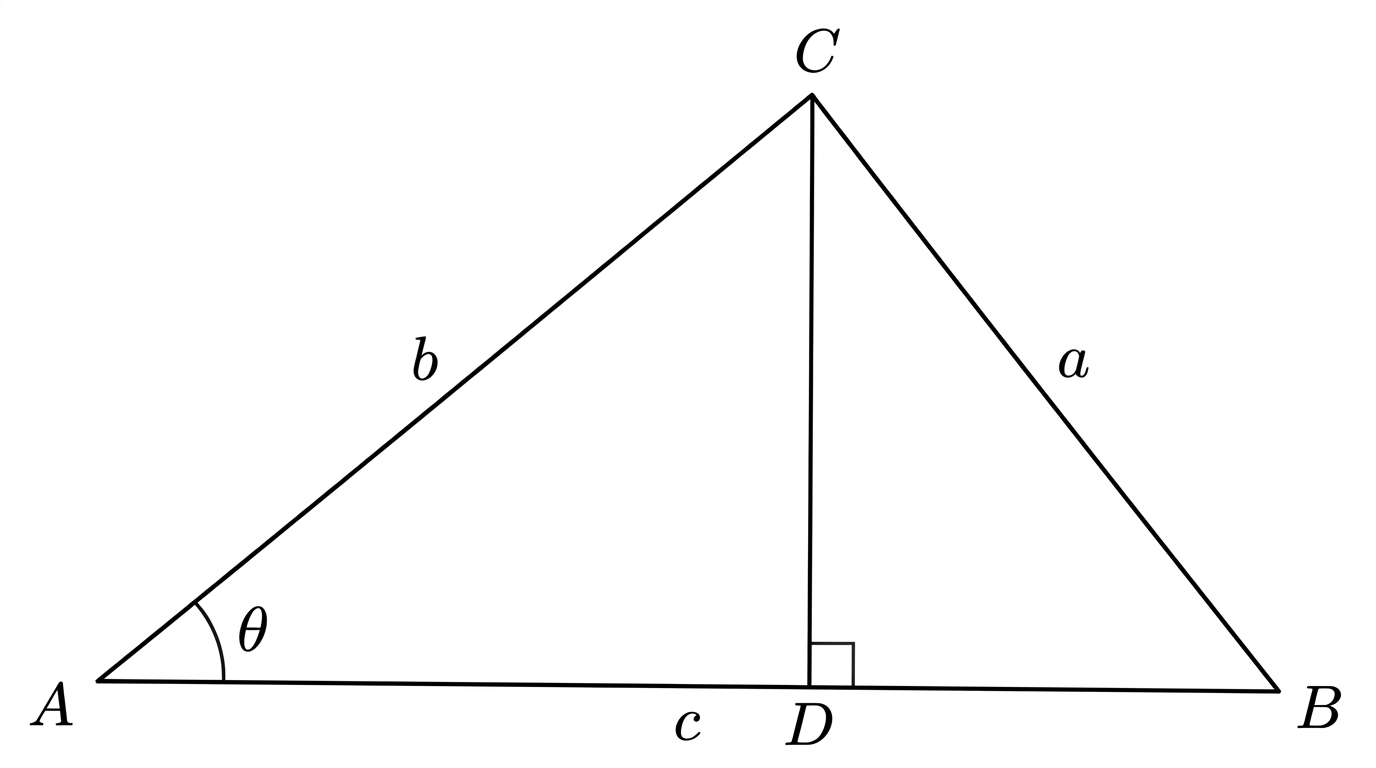
If $A = 90°$, then $\cos 90° = 0$ and the rule collapses to $a^2 = b^2+c^2$ — ordinary Pythagoras. The $-2bc\cos A$ term is what corrects for the angle not being a right angle: it shrinks $a$ when $A$ is acute, and grows it when $A$ is obtuse (since $\cos A$ turns negative, flipping the sign of the correction). The cosine rule isn't really a separate fact to memorise; it's Pythagoras generalised to any angle.
Rearranging to find an angle
When all three sides are known and you want an angle, rearrange the rule to make $\cos A$ the subject:
$\cos A = \dfrac{b^2+c^2-a^2}{2bc}$
This is the same formula, just solved differently — memorise one form and rearrange as needed, or learn both directly.
Worked example 1
There's no matching side–angle pair here, so the sine rule can't start. Two sides and the angle between them is the cosine rule's signal.
Always square-root last — squaring and rooting too early throws away the correction term's effect. And check the sign of $\cos A$: for an acute angle like $55°$ it's positive, so the term is subtracted, giving a shorter side than plain Pythagoras would.
Worked example 2
Three sides and no angles at all — the sine rule needs a matching pair to even start, so the cosine rule (rearranged for an angle) is the only way in.
A negative value of $\cos C$ signals an obtuse angle immediately — you don't need to finish the calculation to know $C$ is bigger than $90°$. This is one of the cosine rule's quiet advantages over the sine rule: $\cos^{-1}$ always returns a unique angle between $0°$ and $180°$, so there's no ambiguity about which triangle you've found, unlike the sine rule's ambiguous case.
Worked example 3
"Show a triangle is obtuse" questions are really just asking you to apply the cosine rule to the angle opposite the longest side and check the sign of $\cos$. If that comes out negative, you're done — every other angle in the triangle must be smaller, hence acute.
The cosine rule pairs side $a$ with the angle $A$ opposite it — not the angle it happens to sit next to on the page. Before substituting, always relabel so the side you want (or the angle you want) is matched correctly: $a$–$A$, $b$–$B$, $c$–$C$. Mixing up which side is "opposite" is the single most common slip in this topic.
Check yourself
A triangle has sides $p=9\,\text{cm}$, $q=14\,\text{cm}$ and included angle $R=68°$ between them. Find side $r$ to 3 s.f.
(Hint: two sides and the angle between them — go straight to the cosine rule.)