Two sides and the angle between them are all you need — the formula ½ ab sin C finds a triangle's area without ever needing to know its height.
7 min read3 worked examples
Area without a height
The familiar area formula $\tfrac12 \times \text{base} \times \text{height}$ needs a perpendicular height, which isn't always given directly. When you know two sides and the angle between them, trigonometry builds that height in for you:
$\text{Area} = \dfrac12 ab\sin C$
where $a$ and $b$ are two sides of the triangle and $C$ is the angle included between them — the angle at the vertex where those two sides meet.
Deriving the formula
The formula isn't new maths — it's the ordinary area formula with the height rewritten using sine.
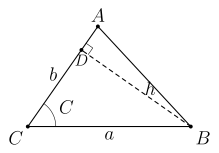
Triangle ABC with base b = CA. Dropping a perpendicular from B to the base at D gives the height h = BD, which sits opposite angle C in the right-angled triangle BDC.
ProofDeriving Area = ½ ab sin C
1
Take triangle $ABC$ with sides $a$ and $b$ meeting at the included angle $C$. Choose $b$ as the base.
Set up which side plays the role of base.
2
Drop a perpendicular from the vertex opposite $b$ down to the line containing $b$; call its length $h$. Ordinary area is $\text{Area} = \tfrac12 \times b \times h$.
The standard base-height formula.
3
The perpendicular $h$, together with side $a$ and the angle $C$, forms a right-angled triangle in which $h$ is opposite $C$ and $a$ is the hypotenuse.
Identify the right triangle hiding inside.
4
So $\sin C = \dfrac{h}{a}$, giving $h = a\sin C$.
SOH in that right triangle.
5
Substitute into step 2: $\text{Area} = \tfrac12 \times b \times a\sin C = \tfrac12 ab\sin C$.
Replace h with a sin C.
▪ proven
The one rule that matters
The angle in the formula must be included between the two sides you're using — not any angle you happen to know. If a question gives you two sides and a non-included angle instead, you can't apply the formula directly; you'd first need the sine or cosine rule to find the missing piece.
Worked example 1
Basic area calculation · two sides and the included angle
A triangle has two sides of length $9\,\text{cm}$ and $12\,\text{cm}$, with an angle of $50°$ between them. Find its area to 3 s.f.
MethodSubstitute directly into ½ ab sin C
1
Identify the two sides and the included angle: $a=9$, $b=12$, $C=50°$.
The angle must be the one between the two sides.
2
$\text{Area} = \dfrac12 ab\sin C = \dfrac12 (9)(12)\sin 50°$.
Substitute into the formula.
3
$= \dfrac12 (108)(0.7660) = 54 \times 0.7660$.
Multiply the sides and halve.
4
$= 41.4\,\text{cm}^2$ (3 s.f.).
The area.
▪ solved
Examiner's eye
Units matter: area is always in squared units. If the sides are in cm, the area is in cm². It's an easy mark to drop by writing "$41.4$" alone.
Worked example 2
Working backwards from the area · finding an angle
A triangle has sides of $6\,\text{cm}$ and $10\,\text{cm}$ with an area of $22.5\,\text{cm}^2$. Find the acute angle between the two given sides, to 1 d.p.
The area formula rearranges just as easily to find the angle, once the two sides are known.
MethodRearrange for sin C, then invert
1
$22.5 = \dfrac12 (6)(10)\sin C = 30\sin C$.
Substitute the known area and sides.
2
$\sin C = \dfrac{22.5}{30} = 0.75$.
Divide both sides by 30.
3
$C = \sin^{-1}(0.75) = 48.6°$ (1 d.p.).
Invert; the question asks for the acute angle, so take the principal value.
▪ solved
The key insight
Just as with the sine rule, $\sin^{-1}(0.75)$ actually has two valid solutions between $0°$ and $180°$: $48.6°$ and $180°-48.6°=131.4°$ — both give the same area, since $\sin(180°-C) = \sin C$. Two different-shaped triangles can share the same pair of sides and the same area; specifying "acute" is what pins down a single answer here.
Worked example 3
Splitting a quadrilateral into triangles
A quadrilateral $ABCD$ has diagonal $AC = 14\,\text{cm}$. In triangle $ABC$, $AB=8\,\text{cm}$ and angle $BAC=40°$. In triangle $ACD$, $AD=11\,\text{cm}$ and angle $CAD=55°$. Find the total area of $ABCD$ to 3 s.f.
A diagonal splits any quadrilateral into two triangles, and the area formula applies to each separately — as long as you can identify two sides and the included angle in each piece.
MethodArea formula on each triangle, then add
1
Triangle $ABC$: sides $AB=8$ and $AC=14$, included angle $BAC=40°$. Area $=\tfrac12(8)(14)\sin 40° = 56\sin 40°$.
The two sides meeting at A, with their included angle.
2
$= 56(0.6428) = 36.0\,\text{cm}^2$.
Evaluate triangle ABC's area.
3
Triangle $ACD$: sides $AC=14$ and $AD=11$, included angle $CAD=55°$. Area $=\tfrac12(14)(11)\sin 55° = 77\sin 55°$.
The two sides meeting at A on the other side of the diagonal.
4
$= 77(0.8192) = 63.1\,\text{cm}^2$.
Evaluate triangle ACD's area.
5
Total area $= 36.0 + 63.1 = 99.1\,\text{cm}^2$ (3 s.f.).
Add the two triangular pieces.
▪ solved
Common mistake
Both triangles share the diagonal $AC=14$ as a common side — it's easy to accidentally use the wrong pair of sides or the wrong included angle for one of the two pieces. Sketch the quadrilateral and mark both triangles separately before substituting into the formula twice.
Check yourself
A triangle has an area of $60\,\text{cm}^2$ and two sides of length $15\,\text{cm}$ and $10\,\text{cm}$. Find the obtuse angle between them, to 1 d.p. (Hint: rearrange for sin C, invert, then take $180°$ minus the principal value.)
Method
1
$60 = \dfrac12(15)(10)\sin C = 75\sin C$, so $\sin C = 0.8$.
2
Principal value: $\sin^{-1}(0.8) = 53.1°$ — this is acute, but the question wants the obtuse angle.