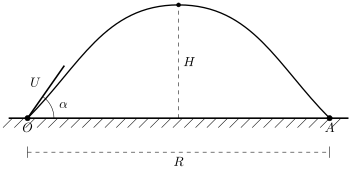
With the velocity resolved into components, a particle launched at an angle can be analysed exactly like horizontal projection — except the vertical motion now starts with an upward speed, so it rises before it falls.
13 min read4 worked examples
Greatest height, time of flight and range
Once a particle is launched at angle $\alpha$ with speed $U$, three quantities come up again and again:
Key moments of the flight
Greatest height — the particle is momentarily at rest vertically (its vertical velocity is zero), though it's still moving horizontally.
Time of flight — the total time until the particle returns to the same horizontal level it was launched from.
Range — the total horizontal distance travelled while the particle is at that same level.
Each of these is found the same way: set up the vertical SUVAT equation with $u_y=U\sin\alpha$ and $a=-g$ (taking upward as positive), and use the condition that defines the moment you want — $v=0$ for the greatest height, or $s=0$ for the time of flight (back at launch level).
The particle rises to greatest height H, then falls back to the launch level, landing a horizontal distance R (the range) from O.
Worked example 1
Greatest height, time of flight and range
A particle is projected from a point on horizontal ground with speed $32\ \text{m s}^{-1}$, at $30^\circ$ above the horizontal. Find, to 2 significant figures: (a) the greatest height reached, (b) the time of flight, and (c) the range.
MethodResolve, then treat height/time/range as three separate SUVAT conditions
1
Taking upward as positive: $u_y = 32\sin30^\circ = 16\ \text{m s}^{-1}$, and $a=-9.8\ \text{m s}^{-2}$.
Only the vertical component matters for height and time — resolve first.
At the highest point, the vertical velocity is momentarily zero.
3
Time of flight: $s=u_yt+\tfrac12at^2$ with $s=0$: $0=16t-4.9t^2=t(16-4.9t)$, so $t=0$ or $t=\dfrac{16}{4.9}=3.3\ \text{s}$ (2 s.f.).
$s=0$ means back at the launch height; $t=0$ is the launch instant itself, so take the other root.
4
Range: $u_x = 32\cos30^\circ = 27.71\ldots\ \text{m s}^{-1}$, so range $= u_x\times t = 27.71\times3.265\ldots = 90\ \text{m}$ (2 s.f.).
Use the full unrounded time of flight to avoid compounding rounding errors.
▪ solved
Working with a point above or below the launch point
Not every landing point is at the same level as the launch point. If a particle is thrown from a height, or lands on ground that's higher than where it started, you use $s$ equal to that vertical displacement (positive or negative, according to your sign convention) rather than $s=0$.
Worked example 2
Landing below the point of projection
A particle is projected from a point $O$ with speed $V\ \text{m s}^{-1}$ at an angle of elevation $\theta$, where $\tan\theta=\dfrac34$. The point $O$ is $10\ \text{m}$ above a horizontal plane. The particle strikes the plane at a point $A$, exactly $2\ \text{s}$ after projection. (a) Show that $V=8$. (b) Find the distance $OA$.
MethodSet up the vertical equation with s = −10, then use both components for OA
1
From $\tan\theta=\dfrac34$: $\sin\theta=\dfrac35$, $\cos\theta=\dfrac45$. Taking upward as positive, $u_y=V\sin\theta=\dfrac{3V}{5}$ and $a=-9.8$.
The 3–4–5 triangle gives exact values for sine and cosine.
2
$A$ is $10\ \text{m}$ below $O$, so taking $s=-10$, $t=2$: $-10 = \dfrac{3V}{5}(2)-\tfrac12(9.8)(2)^2$.
Landing below the start means $s$ is negative in an upward-positive convention.
$O$, $A$ and the point directly below $O$ form a right angle, so Pythagoras applies.
▪ solved
Time spent above a given height
A vertical SUVAT equation in $s=u_yt+\tfrac12at^2$ is quadratic in $t$, so setting it equal to a fixed height $H$ gives two times — the moments the particle passes through height $H$ on the way up, and again on the way down. The time spent above $H$ is the difference between these two roots.
Worked example 3
Time spent above a given height
A particle is projected from a point $O$ on horizontal ground with speed $49\ \text{m s}^{-1}$, at $30^\circ$ above the horizontal. Find the length of time for which the particle is $19.6\ \text{m}$ or more above $O$.
MethodSolve the quadratic in t for the two crossing times
This is the same vertical SUVAT equation, now solved for a fixed height rather than $s=0$.
2
Rearranging: $4.9t^2-24.5t+19.6=0$. Dividing by $4.9$: $t^2-5t+4=0$.
Dividing through by the coefficient of $t^2$ makes the quadratic easier to factorise.
3
$(t-1)(t-4)=0 \Rightarrow t=1$ or $t=4$.
These are the two instants the particle is exactly at height $19.6\ \text{m}$: once rising, once falling.
4
Between these times the particle is above $19.6\ \text{m}$, so the duration is $4-1=3\ \text{s}$.
The particle is highest at $t=2.5\ \text{s}$ (the midpoint), consistent with being above $19.6\ \text{m}$ for $t\in(1,4)$.
▪ solved
Speed and direction at a given point
To find the speed or direction of motion at some point during the flight, find the horizontal and vertical velocity components at that instant ($v_x$ is always $U\cos\alpha$; $v_y$ comes from $v=u_y+at$), then combine them with Pythagoras and $\tan\theta=\dfrac{v_y}{v_x}$, exactly as in the last lesson.
Worked example 4
Speed and angle at landing
A ball is struck from a point $1.25\ \text{m}$ above horizontal ground. Immediately after being struck, its velocity is $(12\mathbf{i}+9\mathbf{j})\ \text{m s}^{-1}$, where $\mathbf{i}$ and $\mathbf{j}$ are horizontal and vertical unit vectors. Find, to 2 significant figures: (a) the greatest height of the ball above the ground, (b) the speed of the ball as it lands, and (c) the angle its velocity makes with the ground at that instant.
MethodTrack the vertical motion to the peak, then to the ground
1
Taking upward as positive: $u_y=9$, $a=-9.8$. Greatest height above the launch point: $v^2=u_y^2+2as$ with $v=0$: $0=81-19.6s \Rightarrow s=4.1\ \text{m}$ (2 s.f.).
Same "vertical velocity zero" condition as before.
2
Height above the ground: $1.25+4.1\approx5.4\ \text{m}$ (2 s.f.).
Add the launch height, since "above the ground" is measured from ground level, not from the launch point.
3
At landing, the ball is $1.25\ \text{m}$ below the launch point, so $s=-1.25$: $v_y^2=u_y^2-2as=81+2(9.8)(1.25)=81+24.5=105.5$.
Use $v^2=u^2+2as$ again, now with the displacement to the ground.
Combine both components at the instant of landing, not the launch components.
5
Angle with the ground: $\tan\theta=\dfrac{\sqrt{105.5}}{12}=0.856\ldots \Rightarrow \theta=41^\circ$ (2 s.f.).
The angle below the horizontal at landing uses the same ratio as the launch angle, just with the landing components.
▪ solved
Common mistake
Forgetting that the landing speed is not the same as the launch speed unless the particle lands at the same height it was launched from. If there's a change in height between launch and landing, the vertical component of velocity — and hence the speed and angle — will be different at the two ends of the flight.
Check yourself
A particle is projected from a point on horizontal ground with speed $24\ \text{m s}^{-1}$, at $\theta$ above the horizontal, where $\sin\theta=\dfrac45$. Find (a) the greatest height reached, and (b) the time of flight.