Horizontal and Vertical Components
When a particle is launched at an angle rather than straight sideways, its initial velocity has both a horizontal and a vertical part. Resolving into these two components is what lets you apply everything from the last lesson.
Resolving velocity into components
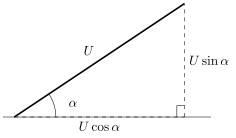
When a particle is projected with speed $U$ at an angle $\alpha$ above the horizontal, it's useful to think of that single velocity as two separate velocities happening at the same time: one horizontal, one vertical. This is exactly the same idea as resolving a force, applied to a velocity vector instead.
Drawing $U$ as the hypotenuse of a right-angled triangle, with $\alpha$ measured from the horizontal:
Horizontal component: $\;u_x = U\cos\alpha$
Vertical component: $\;u_y = U\sin\alpha$
Once you have $u_x$ and $u_y$, the particle behaves exactly as in horizontal projection — except the vertical motion now starts with $u=u_y$ instead of $u=0$, and it may be moving upward before it starts to fall.
Worked example 1
Working backwards: from a vector to speed and angle
You'll also meet the reverse problem — given the velocity as a vector, find the launch speed and angle. Since $u_x=U\cos\alpha$ and $u_y=U\sin\alpha$, it follows that $U=\sqrt{u_x^2+u_y^2}$ (Pythagoras) and $\tan\alpha=\dfrac{u_y}{u_x}$ (dividing one equation by the other).
Worked example 2
$9,40,41$ is another Pythagorean triple ($9^2+40^2=81+1600=1681=41^2$), which is why $U$ came out as a whole number. Exam questions are often built around these deliberately — it's worth having 3–4–5, 5–12–13 and 9–40–41 in mind.
Mixing up which component uses sine and which uses cosine. If $\alpha$ is measured from the horizontal, the component along the horizontal is always $U\cos\alpha$ and the component perpendicular to it (vertical) is always $U\sin\alpha$ — regardless of how the triangle happens to be drawn.
Check yourself
A particle is projected from a point on horizontal ground with speed $26\ \text{m s}^{-1}$, at an angle $\alpha$ above the horizontal, where $\tan\alpha=\dfrac{5}{12}$. Express the initial velocity in the form $(a\mathbf{i}+b\mathbf{j})\ \text{m s}^{-1}$.
From $\tan\alpha=\dfrac{5}{12}$: $\sin\alpha=\dfrac{5}{13}$, $\cos\alpha=\dfrac{12}{13}$.
$u_x = 26\times\dfrac{12}{13}=24$, $\;u_y=26\times\dfrac{5}{13}=10$, so the velocity is $(24\mathbf{i}+10\mathbf{j})\ \text{m s}^{-1}$.