Horizontal Projection
A particle launched sideways from a height doesn't fall straight down — gravity pulls it downward while it keeps drifting horizontally at a constant speed. Treating these two motions separately is the key to the whole topic.
Splitting the motion into two independent parts
Imagine a ball rolling off the edge of a table. The instant it leaves the table, two things happen at once: gravity starts pulling it downward, and it keeps travelling horizontally at whatever speed it had when it left the edge. The remarkable thing — and the whole basis of this topic — is that these two motions don't affect each other.
We model the object as a particle (so we can ignore its size and shape) moving freely under gravity, with air resistance ignored. Throughout, take $g=9.8\ \text{m s}^{-2}$ unless told otherwise.
Horizontal: no force acts horizontally, so the horizontal velocity stays constant. Horizontal distance is just $x = Ut$, where $U$ is the (constant) horizontal speed.
Vertical: the particle starts with zero vertical velocity and accelerates downward at $g$. This is an ordinary SUVAT problem with $u=0$ and $a=g$.
Because the two directions are independent, you almost always work through a horizontal-projection question in the same order: use the vertical equation to find the time of flight $t$ (since that's the direction with the acceleration), then substitute $t$ into the horizontal equation to find distance.
Worked example 1
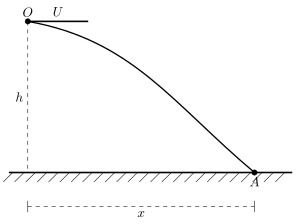
Distance from the point of projection
Sometimes you're asked how far the particle is from where it started — not just how far it's travelled sideways, or how far it's fallen, but the straight-line distance. Since the horizontal and vertical displacements are perpendicular to each other, you find this using Pythagoras' theorem on the horizontal and vertical distances travelled up to that moment.
Worked example 2
Notice $d=31\ \text{m}$ is bigger than either $x=24\ \text{m}$ or $y=19.6\ \text{m}$ on their own — that's exactly what Pythagoras guarantees for a right-angled triangle, and it's a quick way to check an answer looks sensible.
Using the launch speed $U$ as the initial vertical speed. In horizontal projection, $U$ only ever appears in the horizontal equation $x=Ut$ — the vertical motion always starts from $u=0$, because the particle has no vertical velocity at the instant it's launched.
Check yourself
A particle is projected horizontally with speed $U\ \text{m s}^{-1}$ from a point $19.6\ \text{m}$ above a horizontal plane. It lands at a horizontal distance of $60\ \text{m}$ from the point directly below the point of projection. Find the value of $U$ and the time of flight.
Vertically: $19.6 = \tfrac12(9.8)t^2 = 4.9t^2 \Rightarrow t^2=4 \Rightarrow t=2\ \text{s}$.
Horizontally: $60 = U(2) \Rightarrow U = 30\ \text{m s}^{-1}$.