Every surface so far has been smooth. Real surfaces resist sliding — and that resistance, friction, turns out to be surprisingly simple to model with a single number: the coefficient of friction.
13 min read3 worked examples
The friction force
When a particle is in contact with a rough surface and moving (or about to move), a friction force $F$ acts at the point of contact, opposing the motion or the tendency to move. Friction is a self-adjusting force: it takes whatever value is needed to prevent motion, up to a maximum value.
That maximum value is called limiting friction, and it's proportional to the normal reaction: $F_{\max}=\mu R$, where $\mu$ (mu) is the coefficient of friction between the two surfaces. If a particle is actually sliding, friction takes exactly this maximum value, $F=\mu R$, always acting to oppose the sliding.
The friction inequality
At any point of contact between a particle and a rough surface, $F\le\mu R$, where $R$ is the normal reaction and $\mu$ is the coefficient of friction. If the particle is on the point of sliding or is actually sliding, friction is limiting and $F=\mu R$ exactly, directed to oppose the (impending) motion.
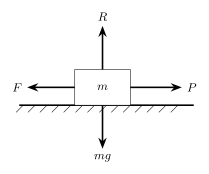
Friction F opposes the applied force P, always acting along the surface, opposite to the direction of motion or impending motion.
Worked example 1
Finding the acceleration on a rough surface
A block of mass $8\ \text{kg}$ lies on a rough horizontal surface, where the coefficient of friction between the block and the surface is $0.3$. A horizontal force of magnitude $30\ \text{N}$ is applied to the block, causing it to slide. Find the acceleration of the block.
MethodFind R, then use F = μR in Newton's second law
1
Resolving vertically, since there's no vertical acceleration: $R=mg=8\times 9.8=78.4\ \text{N}$.
On a horizontal surface, the normal reaction simply balances the weight.
2
The block is sliding, so friction is limiting: $F=\mu R=0.3\times 78.4=23.52\ \text{N}$, acting to oppose the motion (i.e. opposing $P$).
Once sliding occurs, friction always takes its maximum possible value.
3
Resolving horizontally, using Newton's second law: $P-F=ma \Rightarrow 30-23.52=8a$.
$P$ acts in the direction of motion, $F$ opposes it.
Divide the resultant horizontal force by the mass.
▪ solved
Limiting equilibrium
If a particle is on the point of sliding but hasn't started moving, it's said to be in limiting equilibrium. Friction is still at its maximum value $\mu R$, but the particle's acceleration is zero — so this is an equilibrium problem, not a Newton's-second-law one, even though friction is limiting.
Worked example 2
Finding the coefficient of friction
A block of mass $12\ \text{kg}$ lies on a rough horizontal surface. A horizontal force of magnitude $40\ \text{N}$ is applied to the block, which is on the point of sliding. Find the coefficient of friction between the block and the surface.
Again, on a horizontal surface $R$ simply balances the weight.
2
"On the point of sliding" means the block is in limiting equilibrium, so friction takes its maximum value and the block has zero acceleration: $F=40\ \text{N}$.
Resolving horizontally with zero acceleration gives $P=F$ directly.
3
Since friction is limiting, $F=\mu R \Rightarrow 40=\mu\times 117.6$.
This is exactly the condition that defines limiting friction.
4
$\mu=\dfrac{40}{117.6}=0.340$ (3 s.f.).
Solve for the one unknown, $\mu$.
▪ solved
Friction on a slope
The same ideas apply to an inclined plane once it's rough: friction acts along the surface of the slope, opposing motion or impending motion, with magnitude $\mu R$ when limiting. The normal reaction $R$ is found exactly as before — by resolving perpendicular to the plane — but now the parallel equation includes both $mg\sin\alpha$ and the friction term.
Worked example 3
Friction on an inclined plane
A particle of mass $4\ \text{kg}$ slides down a rough plane inclined at $25^\circ$ to the horizontal, with acceleration $0.6\ \text{m s}^{-2}$. Find the coefficient of friction between the particle and the plane.
MethodResolve perpendicular for R, then use Newton's second law parallel to the plane
1
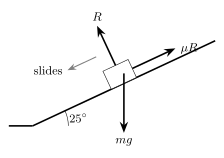
The particle slides down, so friction acts up the slope, opposing the motion.
Friction always opposes the direction of actual sliding.
2
Resolving perpendicular to the plane: $R=mg\cos 25^\circ$.
There's no acceleration perpendicular to the plane, so these components balance.
3
Resolving parallel to the plane (down-slope positive), using Newton's second law: $mg\sin 25^\circ-\mu R=ma$, so $mg\sin 25^\circ - \mu mg\cos 25^\circ = ma$.
Substituting $R=mg\cos 25^\circ$ leaves $\mu$ as the only unknown.
Friction μR acts up the slope, directly opposing the particle's motion down the plane.
Common mistake
Assuming friction always points "backwards" along a fixed direction rather than checking the actual (or impending) motion each time. On a slope in particular, always ask: which way is the particle moving, or trying to move? Friction acts exactly opposite to that — not simply "up the slope" or "down the slope" by default.
Check yourself
A block of mass $10\ \text{kg}$ lies on a rough horizontal surface, where the coefficient of friction is $0.25$. A horizontal force of magnitude $35\ \text{N}$ is applied to the block, causing it to slide. Find the acceleration of the block, to 3 significant figures.
$R=mg=98\ \text{N}$, so $F=\mu R=0.25\times 98=24.5\ \text{N}$. Then $35-24.5=10a \Rightarrow a=1.05\ \text{m s}^{-2}$.