On a slope, "up" and "down" stop being the natural directions to resolve in. Working parallel and perpendicular to the slope itself turns a tilted problem back into one you already know how to solve.
12 min read3 worked examples
Resolving on a slope
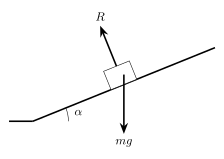
For a particle on an inclined plane, it's far more natural to resolve parallel and perpendicular to the slope than horizontally and vertically — the normal reaction $R$ already acts perpendicular to the slope, so working in these directions keeps $R$ out of the equation you actually want to use.
The one force that doesn't naturally point along either of these directions is the weight, $mg$, which always acts vertically downward. Resolved against the slope at angle $\alpha$ to the horizontal, its component down the slope is $mg\sin\alpha$, and its component into the slope (balanced by $R$) is $mg\cos\alpha$.
Weight on a slope
For a particle of mass $m$ on a plane inclined at angle $\alpha$ to the horizontal, the weight $mg$ has component $mg\sin\alpha$ down the line of greatest slope, and component $mg\cos\alpha$ perpendicular to the plane (into the surface).
On a smooth plane, only R and mg act on the block — resolving parallel and perpendicular to the slope separates them cleanly.
Worked example 1
A particle released on a smooth slope
A particle of mass $5\ \text{kg}$ is released from rest on a smooth plane inclined at $30^\circ$ to the horizontal. Find the acceleration of the particle and the normal reaction between the particle and the plane.
MethodResolve parallel and perpendicular to the plane
1
The plane is smooth, so the only forces on the particle are its weight $mg$ and the normal reaction $R$.
"Smooth" means there is no friction force to include.
2
Resolving parallel to the plane (down-slope positive): $mg\sin 30^\circ = ma$.
$R$ has no component parallel to the plane, so it drops out of this equation entirely.
The mass cancels — acceleration down a smooth slope never depends on mass.
4
Resolving perpendicular to the plane: $R=mg\cos 30^\circ = 5\times 9.8\times\cos 30^\circ = 42.4\ \text{N}$ (3 s.f.).
Perpendicular to the plane, there's no acceleration, so these components balance exactly.
▪ solved
Adding a second force along the slope
If another force acts along the line of greatest slope, it simply adds to (or subtracts from) $mg\sin\alpha$ in the parallel equation. The perpendicular equation for $R$ is often unaffected, since a force parallel to the slope has no perpendicular component.
Worked example 2
A force acting along the slope
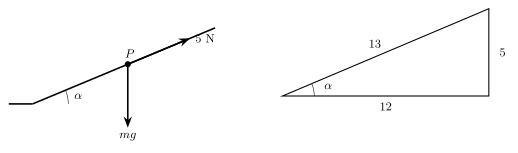
A particle $P$ of mass $3\ \text{kg}$ lies on a smooth plane inclined at angle $\alpha$ to the horizontal, where $\tan\alpha=\dfrac{5}{12}$. A force of magnitude $5\ \text{N}$, acting up the line of greatest slope, is applied to $P$, which is then released from rest. Find the magnitude of the initial acceleration of $P$, and the normal reaction between $P$ and the plane.
MethodUse the 5-12-13 triangle, then resolve
1
Since $\tan\alpha=\dfrac{5}{12}$, the angle $\alpha$ fits a $5$-$12$-$13$ triangle, so $\sin\alpha=\dfrac{5}{13}$ and $\cos\alpha=\dfrac{12}{13}$.
Using the exact fraction avoids rounding error in every later step.
2
Resolving parallel to the plane (down-slope positive): $mg\sin\alpha - 5 = ma$.
The $5\ \text{N}$ force acts up the slope, so it opposes the down-slope weight component.
The weight component down the slope is larger than the applied force, so $P$ accelerates down the slope despite the $5\ \text{N}$ push.
4
Resolving perpendicular to the plane: $R=mg\cos\alpha=3\times 9.8\times\dfrac{12}{13}=27.1\ \text{N}$ (3 s.f.).
The $5\ \text{N}$ force is parallel to the plane, so it has no effect on $R$.
▪ solved
A quick sanity check
It's tempting to assume a force pushing "up the slope" must mean the particle accelerates up the slope — but here the weight component down the slope ($11.3\ \text{N}$) is bigger than the applied force ($5\ \text{N}$), so the particle actually accelerates down the plane. Always compare magnitudes before deciding on a direction.
The 5-12-13 triangle gives exact values for sin α and cos α, avoiding rounding until the final answer.
Equilibrium on a slope
A particle can also be held at rest on a smooth slope by a force that isn't parallel to the plane at all — for example, a horizontal force. In that case you still resolve parallel and perpendicular to the plane; it's just that the extra force now has a component in both directions.
Worked example 3
Held in equilibrium by a horizontal force
A particle of mass $4\ \text{kg}$ rests in equilibrium on a smooth plane inclined at $30^\circ$ to the horizontal, held in place by a horizontal force of magnitude $P$ newtons. Find the value of $P$ and the normal reaction between the particle and the plane.
MethodResolve the horizontal force along and perpendicular to the plane
1
$P$ is horizontal, so relative to the slope it has component $P\cos 30^\circ$ up the plane, and component $P\sin 30^\circ$ into the plane.
A horizontal force resolved against a slope at angle $\alpha$ splits the same way weight does, just rotated by $90^\circ$.
2
Resolving parallel to the plane, using equilibrium: $P\cos 30^\circ = mg\sin 30^\circ$.
For equilibrium, the components up and down the slope must balance exactly.
Dividing the two equations turns the ratio into a single tangent.
4
Resolving perpendicular to the plane: $R = mg\cos 30^\circ + P\sin 30^\circ = 33.948+11.313=45.3\ \text{N}$ (3 s.f.).
Both the weight and the horizontal force now push into the plane, so both terms add to $R$.
▪ solved
Common mistake
Forgetting that a force which isn't parallel or perpendicular to the slope — like the horizontal force above — still needs resolving into both directions relative to the plane. It's easy to only account for its effect along the slope and forget it also changes the normal reaction.
Check yourself
A particle of mass $6\ \text{kg}$ is released from rest on a smooth plane inclined at $25^\circ$ to the horizontal. Find the acceleration of the particle and the normal reaction between the particle and the plane, both to 3 significant figures.
Parallel to the plane: $a=g\sin 25^\circ=9.8\times\sin 25^\circ=4.14\ \text{m s}^{-2}$. Perpendicular to the plane: $R=mg\cos 25^\circ=6\times 9.8\times\cos 25^\circ=53.3\ \text{N}$.