A force doesn't have to point along an axis to be useful. By splitting it into perpendicular components, you can combine it with any other force in the problem — the basis for almost everything else in this unit.
13 min read4 worked examples
Splitting a force into components
Any force can be replaced by two perpendicular components that have the same combined effect as the original force. This is called resolving the force. It's almost always done horizontally and vertically, or — on a slope — parallel and perpendicular to the slope.
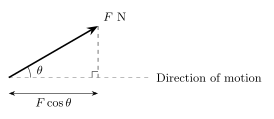
If a force of magnitude $F$ acts at angle $\theta$ to a chosen direction, then its component along that direction is $F\cos\theta$, and its component perpendicular to it is $F\sin\theta$.
Resolving a force
A force $F$ acting at angle $\theta$ to a reference direction has component $F\cos\theta$ along that direction and $F\sin\theta$ perpendicular to it. The two components are equivalent to the original force — you can work with them separately and combine the results at the end.
The force F splits into a component F cos θ along the direction of motion and a perpendicular component F sin θ (not shown).
Worked example 1
Resolving a single force
A force of magnitude $40\ \text{N}$ acts on a particle at an angle of $35^\circ$ above the horizontal. Find the horizontal and vertical components of the force, giving your answers to 3 significant figures.
MethodResolve horizontally and vertically
1
The horizontal direction is the reference direction, so the horizontal component is $F\cos\theta$.
The component along the reference direction always uses cosine.
The vertical component is perpendicular to the reference direction, so it uses sine: $40\sin 35^\circ = 22.9\ \text{N}$ (3 s.f.).
The perpendicular component always uses sine.
▪ solved
Combining resolved forces
Resolving pays off once there's more than one force. Resolve every force in the same two directions, add up the components in each direction separately, then recombine the two totals with Pythagoras' theorem and trigonometry to get the magnitude and direction of the overall resultant.
Worked example 2
Resultant of two perpendicular forces
Two forces act on a particle: $24\ \text{N}$ due east and $18\ \text{N}$ due north. Find the magnitude of the resultant force, and the angle it makes with the east direction.
MethodPythagoras' theorem and trigonometry
1
The two forces already act in perpendicular directions, so no resolving is needed — just combine them directly.
The resultant of two perpendicular components is the hypotenuse of the right triangle they form.
3
Direction: $\theta=\tan^{-1}\!\left(\dfrac{18}{24}\right)=36.9^\circ$ (3 s.f.) above the east direction.
$\tan\theta$ = opposite over adjacent, measured from the east direction.
▪ solved
Worked example 3
Resultant of two forces at an angle
Two forces, $P=50\ \text{N}$ and $Q=35\ \text{N}$, act on a particle. $P$ acts at $20^\circ$ above the horizontal and $Q$ acts at $65^\circ$ above the horizontal, both to the same side. Find the magnitude of the resultant force and the angle it makes with the horizontal.
Direction: $\theta=\tan^{-1}\!\left(\dfrac{48.822}{61.776}\right)=38.3^\circ$ (3 s.f.) above the horizontal.
$\tan\theta = R_y/R_x$.
▪ solved
Equilibrium and unknown forces
If a particle is in equilibrium, the resultant of all the forces acting on it is zero — so the sum of the components in each direction must separately be zero. This lets you find an unknown force from the other forces present, rather than finding a resultant.
Worked example 4
Equilibrium of three forces
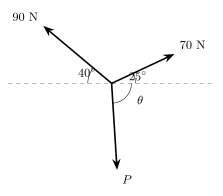
Three forces act on a particle in equilibrium: $90\ \text{N}$ at $40^\circ$ above the horizontal (to the left), $70\ \text{N}$ at $25^\circ$ above the horizontal (to the right), and a third force $P$. Find the magnitude of $P$ and the angle it makes with the horizontal.
MethodResolve horizontally and vertically, using equilibrium
1
Let $P$ have horizontal component $P\cos\theta$ and vertical component $P\sin\theta$. Since the particle is in equilibrium, resolving in each direction gives zero overall.
Equilibrium means the components in every direction sum to zero.
2
Resolving horizontally (taking right as positive): $P\cos\theta+70\cos 25^\circ-90\cos 40^\circ=0$, so $P\cos\theta=90\cos 40^\circ-70\cos 25^\circ=68.941-63.439=5.502\ \text{N}$.
The $90\ \text{N}$ force points left, so its horizontal component is negative in this convention.
3
Resolving vertically (taking up as positive): $P\sin\theta+90\sin 40^\circ+70\sin 25^\circ=0$, so $P\sin\theta=-(90\sin 40^\circ+70\sin 25^\circ)=-87.434\ \text{N}$.
Both given forces point upward, so $P$ must have a downward component to balance them.
Combine the two components of $P$ with Pythagoras.
5
Direction: $\theta=\tan^{-1}\!\left(\dfrac{87.434}{5.502}\right)=86.4^\circ$ (3 s.f.) below the horizontal.
$P$'s components are small-positive-horizontal and large-negative-vertical, so it points almost straight down, slightly to the right.
▪ solved
For the particle to be in equilibrium, P must balance the combined horizontal and vertical pull of the other two forces.
Common mistake
Mixing up which component gets $\cos\theta$ and which gets $\sin\theta$. Always check against the diagram: the component along the direction the angle is measured from uses cosine, and the component perpendicular to it uses sine. Also be careful with signs — draw a clear diagram and fix a positive direction before resolving.
Check yourself
A force of magnitude $54\ \text{N}$ acts on a particle at $42^\circ$ above the horizontal. Find the horizontal and vertical components of the force, to 3 significant figures.