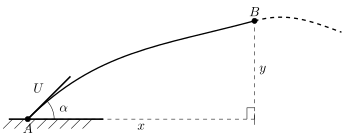
Every projectile question so far has been solved from first principles with SUVAT. This lesson derives general formulae for time of flight, range and the trajectory itself — useful for spotting shortcuts, but only once you understand where they come from.
11 min read2 worked examples
Deriving the standard formulae
Consider a particle projected from a point on horizontal ground with speed $U$ at angle $\alpha$ above the horizontal, where $u_x=U\cos\alpha$ and $u_y=U\sin\alpha$. The results below follow directly from the SUVAT approach used throughout this topic — they're worth deriving once so you know exactly what conditions they assume.
DerivationTime of flight and range, from first principles
1
Vertically, taking upward as positive: $s=u_yt+\tfrac12at^2$ with $a=-g$. The particle returns to launch height when $s=0$.
"Time of flight" always means back at the same level it was launched from.
2
$0 = U\sin\alpha\,t - \tfrac12gt^2 = t\left(U\sin\alpha-\tfrac12gt\right)$, so $t=0$ or $t=\dfrac{2U\sin\alpha}{g}$.
Factorise and discard the trivial root $t=0$ (the launch instant).
3
So the time of flight is $T=\dfrac{2U\sin\alpha}{g}$.
This is the key formula the rest of the derivation builds on.
4
The range is the horizontal distance travelled in that time: $R = u_x T = U\cos\alpha\cdot\dfrac{2U\sin\alpha}{g} = \dfrac{2U^2\sin\alpha\cos\alpha}{g}$.
Horizontal speed is constant, so range is simply speed × time of flight.
5
Using $2\sin\alpha\cos\alpha=\sin2\alpha$: $R=\dfrac{U^2\sin2\alpha}{g}$.
The double-angle identity turns this into the compact form usually quoted.
▪ derived
Standard results (horizontal ground, launch = landing height)
Time of flight: $\;T=\dfrac{2U\sin\alpha}{g}$
Range: $\;R=\dfrac{U^2\sin2\alpha}{g}$
These only apply when the particle lands at the same height it was launched from. If it doesn't, go back to SUVAT from first principles instead.
Worked example 1
Applying the formulae directly
A particle is projected from a point on horizontal ground with speed $14\ \text{m s}^{-1}$, at $45^\circ$ above the horizontal. Find, to 2 significant figures, (a) the time of flight, and (b) the range.
At $\alpha=45^\circ$, $\sin2\alpha=\sin90^\circ=1$ — this angle gives the maximum possible range for a given speed.
▪ solved
The trajectory equation
Sometimes you need to know whether a projectile passes through a specific point $(x,y)$, without working out the time it gets there. Eliminating $t$ between the horizontal and vertical displacement equations gives the trajectory equation — the Cartesian equation of the path itself.
Substitute for $t$ and simplify, using $\frac{\sin\alpha}{\cos\alpha}=\tan\alpha$.
4
Since $\sec^2\alpha=1+\tan^2\alpha$, this is often written $y = x\tan\alpha - \dfrac{gx^2}{2U^2}\left(1+\tan^2\alpha\right)$.
This version is more convenient when $U$, $x$ and $y$ are known and $\alpha$ is the unknown, since it's a quadratic in $\tan\alpha$.
▪ derived
The trajectory equation gives y directly in terms of x, without needing to find the time taken to reach B.
Worked example 2
Finding two possible angles of projection
A particle is projected from a point $O$ on horizontal ground with speed $21\ \text{m s}^{-1}$, at an angle of elevation $\alpha$. The particle passes through a point $B$, which is at a horizontal distance of $30\ \text{m}$ from $O$ and at a height of $10\ \text{m}$ above $O$. Find the two possible values of $\alpha$, to the nearest degree.
MethodSubstitute into the trajectory equation and solve the quadratic in tanα
1
Using $y=x\tan\alpha-\dfrac{gx^2}{2U^2}(1+\tan^2\alpha)$ with $x=30$, $y=10$, $U=21$, $g=9.8$: let $T=\tan\alpha$.
Set up the equation with all the known values substituted in.
2
$\dfrac{gx^2}{2U^2}=\dfrac{9.8(900)}{2(441)}=\dfrac{8820}{882}=10$, so $10 = 30T - 10(1+T^2)$.
Compute the coefficient first to keep the algebra manageable.
A low, flat trajectory and a high, looping one can both pass through the same point — this is the algebraic reason why.
▪ solved
Why two answers?
For almost any point within range, there are generally two launch angles that reach it: a flatter, faster-arriving trajectory, and a steeper, higher one. The trajectory equation is quadratic in $\tan\alpha$ precisely because it's capturing both possibilities at once.
Common mistake
Using $T=\dfrac{2U\sin\alpha}{g}$ or $R=\dfrac{U^2\sin2\alpha}{g}$ when the particle doesn't land back at launch height — for instance, when it's thrown from a cliff, or lands on raised ground. Both formulae are derived assuming $s=0$ vertically; if that's not the case in the question, you must return to SUVAT from first principles, exactly as in the previous lesson.
Check yourself
A particle is projected from a point on horizontal ground with speed $35\ \text{m s}^{-1}$, at $\alpha=30^\circ$ above the horizontal. Using the standard formulae, find (a) the time of flight, and (b) the range, both to 3 significant figures.