A particle is in equilibrium when the forces on it balance completely. This lesson builds the resolving technique you'll use throughout the rest of the chapter — including the option to resolve along axes that aren't simply horizontal and vertical.
11 min read2 worked examples
Equilibrium of a particle
A particle is in equilibrium when the forces acting on it sum to zero. For a particle acted on by several forces in a plane, this means the total force resolved in any direction is zero — most conveniently, resolved horizontally and vertically, giving two independent equations.
With three or more forces, the strategy doesn't change: resolve in two perpendicular directions, set each sum to zero, and solve the resulting equations simultaneously.
Equilibrium condition
A particle acted on by forces $\mathbf{F}_1,\mathbf{F}_2,\ldots,\mathbf{F}_n$ is in equilibrium if and only if $\sum \mathbf{F}_i = \mathbf{0}$. Resolving in two perpendicular directions turns this single vector equation into two scalar equations, $\sum F_x=0$ and $\sum F_y=0$.
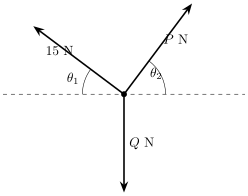
Three concurrent forces holding a particle in equilibrium. Resolving horizontally and vertically gives two equations in the two unknowns P and Q.
Worked example 1
Three concurrent forces
A particle is in equilibrium under the action of three forces: a force of $15\ \text{N}$ acting at $\theta_1$ above the horizontal, a force of $P\ \text{N}$ acting at $\theta_2$ above the horizontal on the other side, and a force of $Q\ \text{N}$ acting vertically downward, where $\cos\theta_1=\tfrac{4}{5}$, $\sin\theta_1=\tfrac{3}{5}$, $\cos\theta_2=\tfrac{3}{5}$ and $\sin\theta_2=\tfrac{4}{5}$. Find $P$ and $Q$.
MethodResolve horizontally and vertically
1
Resolving horizontally: the $15\ \text{N}$ force pulls left with component $15\cos\theta_1$, and $P$ pulls right with component $P\cos\theta_2$. For equilibrium, $P\cos\theta_2=15\cos\theta_1$.
The horizontal components of the two slanted forces must cancel exactly.
Resolving horizontally and vertically isn't compulsory — it's just usually simplest. When a particle sits on an inclined surface, it's often far more efficient to resolve parallel and perpendicular to that surface instead, since several of the forces (normal reactions, in particular) already act along one of those two directions.
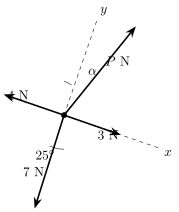
Resolving along a rotated pair of axes x and y, chosen to align with the geometry of the problem rather than with the horizontal and vertical.
Worked example 2
Four forces on rotated axes
A particle is in equilibrium under four forces, resolved relative to a pair of perpendicular axes $Ox$ and $Oy$: a force $P\ \text{N}$ acting at angle $\alpha$ to $Oy$, a force of $4\ \text{N}$ acting in the negative $x$-direction, a force of $3\ \text{N}$ acting in the positive $x$-direction, and a force of $7\ \text{N}$ acting at $25^\circ$ to the negative $y$-direction, tilted towards the negative $x$-direction. Find $P$ and $\alpha$, to 3 significant figures.
MethodResolve along Ox and Oy, then combine
1
Resolving in the $x$-direction: $P\sin\alpha - 4 + 3 - 7\sin25^\circ = 0$, so $P\sin\alpha = 1+7\sin25^\circ$.
$P$ contributes $P\sin\alpha$ in the $x$-direction since it's measured from the $y$-axis; the $7\ \text{N}$ force contributes $-7\sin25^\circ$ since it tilts towards negative $x$.
2
Resolving in the $y$-direction: $P\cos\alpha - 7\cos25^\circ = 0$, so $P\cos\alpha = 7\cos25^\circ$.
Only $P$ and the $7\ \text{N}$ force have components along $Oy$.
This is exactly the same trick as combining two perpendicular components into a resultant magnitude.
5
Dividing the two equations: $\tan\alpha=\dfrac{3.958}{6.344} \Rightarrow \alpha=32.0^\circ$ (3 s.f.).
Dividing the $x$-equation by the $y$-equation eliminates $P$, leaving $\tan\alpha$ directly.
▪ solved
Common mistake
Forgetting that a slanted force contributes to both resolved directions, not just the one it "looks like" it belongs to. Always sketch the component triangle for each force before writing down the resolved equations — it's easy to swap a $\sin$ and a $\cos$ under pressure.
Check yourself
A particle is in equilibrium under three forces: $12\ \text{N}$ acting due north, $5\ \text{N}$ acting due east, and a third force $\mathbf{F}$. Find the magnitude of $\mathbf{F}$, and its direction relative to north.
For equilibrium, $\mathbf{F}$ must be exactly opposite to the resultant of the other two forces: $|F|=\sqrt{12^2+5^2}=\sqrt{169}=13\ \text{N}$.
The resultant of $12\ \text{N}$ north and $5\ \text{N}$ east lies at $\arctan\!\left(\tfrac{5}{12}\right)=22.6^\circ$ east of north, so $\mathbf{F}$ acts at $22.6^\circ$ east of south (i.e. directly opposite).