Real strings, pegs and pulleys are idealised with a standard set of assumptions. This lesson applies them to two classic setups — a bead threaded on a string, and a block held in place by a pulley system on an inclined plane.
12 min read2 worked examples
Modelling assumptions
Real physical setups — strings, rods, pulleys, beads — are idealised in mechanics problems using a standard set of assumptions: light means zero mass, inextensible means constant length, and smooth means zero friction. Each assumption removes one complication so the underlying forces can be analysed cleanly.
One assumption is easy to apply incorrectly: when a single string passes through a smooth bead, ring, or over a smooth pulley, the tension is the same throughout its entire length. This is different from two separate strings tied to a particle, which can carry different tensions.
Constant tension through a smooth bead or pulley
If a single light inextensible string passes through a smooth bead or over a smooth peg or pulley, the tension is the same on both sides — smoothness means there's no friction to create a difference in tension as the string slides through.
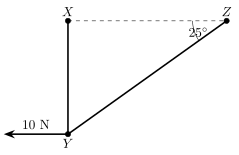
A bead threaded on a string with both ends fixed. Because the bead is smooth, the tension is identical in both XY and YZ.
Worked example 1
A bead on a string, held by a horizontal force
A small smooth bead of weight $W$ is threaded on a light inextensible string, with its ends attached to two fixed points $X$ and $Z$, where $XZ$ is horizontal. The bead hangs in equilibrium at $Y$, with $XY$ vertical, under a horizontal force of $10\ \text{N}$ applied at $Y$. Given that angle $XZY=25^\circ$, find the tension in the string and the weight $W$, each to 3 significant figures.
MethodUse the constant tension, then resolve at Y
1
Since the bead is smooth and the string is one continuous piece, the tension $T$ is the same in $YX$ and $YZ$.
This is what distinguishes "a bead on a string" from "two strings attached to a particle" — it halves the number of unknown tensions.
2
Since $XZ$ is horizontal and $XY$ is vertical, triangle $XYZ$ has a right angle at $X$, so $YZ$ makes an angle of $25^\circ$ with the horizontal at $Y$ (equal to angle $XZY$, by the geometry of the right-angled triangle).
This gives the direction of the tension along $YZ$ without needing any side lengths.
3
Forces on the bead: $T$ straight up along $YX$, $T$ at $25^\circ$ above horizontal along $YZ$, weight $W$ down, and $10\ \text{N}$ horizontal (towards $X$'s side, away from $Z$).
Setting up all four forces clearly before resolving avoids sign errors.
Both string tensions have upward vertical components supporting the weight, since $YX$ is entirely vertical.
▪ solved
Connected particles: a pulley on an inclined plane
Another classic setup connects two masses by a string over a smooth pulley fixed at the top of an inclined plane. Provided the pulley is smooth and the string light and inextensible, the tension throughout the string is the same — including on the hanging side, where it must simply balance the weight of the hanging mass if that mass is in equilibrium.
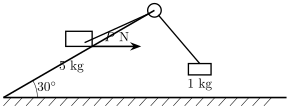
A mass on a smooth incline, connected via a pulley to a hanging mass, held in equilibrium by an additional horizontal force P.
Worked example 2
Mass on a smooth incline, held by a pulley system and a horizontal force
A block of mass $5\ \text{kg}$ rests on a smooth plane inclined at $30^\circ$ to the horizontal. A light inextensible string runs from the block, up the line of greatest slope, over a smooth pulley fixed at the top of the plane, and down to a mass of $1\ \text{kg}$ hanging freely. A horizontal force of magnitude $P\ \text{N}$ is applied to the block, directed away from the plane, and the system is in equilibrium. Find $P$ and the normal reaction $R$ on the block, each to 3 significant figures. Take $g=9.8\ \text{m s}^{-2}$.
MethodFind T from the hanging mass, then resolve for the block along and perpendicular to the slope
1
For the hanging $1\ \text{kg}$ mass, resolving vertically: $T=1\times g=9.8\ \text{N}$.
The hanging mass is in equilibrium under just its weight and the tension, so they're equal.
2
For the block, resolve along the slope (up-slope positive): $T + P\cos30^\circ - 5g\sin30^\circ = 0$.
$T$ pulls up-slope towards the pulley; the horizontal force $P$ has an up-slope component $P\cos30^\circ$; gravity pulls down-slope with component $5g\sin30^\circ$.
Solve the along-slope equation for the one remaining unknown.
4
Resolve perpendicular to the slope: $R = 5g\cos30^\circ + P\sin30^\circ$, since the horizontal force $P$ also presses the block slightly into the surface.
Both the weight and the horizontal force have components perpendicular to the incline; the tension does not, since the string runs parallel to the slope.
Assuming the tension is the same throughout a pulley system and assuming it equals the weight of the hanging mass are two separate facts — the first comes from the pulley being smooth, the second only holds because the hanging mass itself is in equilibrium. If the hanging mass were accelerating instead, $T\ne mg$.
Check yourself
A small smooth bead of weight $W$ is threaded on a string with ends fixed at $X$ and $Z$, where $XZ$ is horizontal and $XY$ is vertical (as in Worked Example 1). A horizontal force of $8\ \text{N}$ is applied at $Y$, and angle $XZY=30^\circ$. Find the tension $T$ and the weight $W$, each to 3 significant figures.