Friction adds one more wrinkle to equilibrium problems: it always opposes the direction of impending motion, which can change from one part of a question to the next. This lesson works through comparing forces at different angles, and friction on a slope.
13 min read2 worked examples
Friction, revisited
Recall that friction opposes sliding or impending sliding, with magnitude up to a maximum of $\mu R$, where $\mu$ is the coefficient of friction and $R$ the normal reaction. When a particle is on the point of moving — limiting equilibrium — friction takes exactly this maximum value, $F=\mu R$.
This lesson applies that idea to two richer situations: comparing how the direction of an applied force changes the force needed to move an object, and combining friction with the resolving techniques from the previous two lessons on an inclined plane.
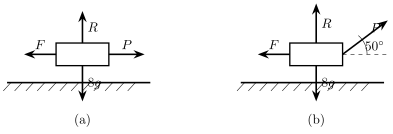
The same block, pulled by a force P applied horizontally (a) versus at an angle above the horizontal (b). The angle changes both the normal reaction and the force needed to overcome friction.
Worked example 1
Horizontal force versus a force at an angle
A box of mass $8\ \text{kg}$ rests on rough horizontal ground, where the coefficient of friction between the box and the ground is $0.4$. Find the magnitude of the force $P$, to 3 significant figures, needed to make the box just start to slide, when $P$ is applied (a) horizontally, and (b) at $50^\circ$ above the horizontal. Take $g=9.8\ \text{m s}^{-2}$.
Method (a)Horizontal push
1
Resolving vertically, $R=8g=78.4\ \text{N}$, since $P$ has no vertical component.
A purely horizontal force doesn't affect the normal reaction.
2
On the point of sliding, $F=\mu R = 0.4\times78.4=31.36\ \text{N}$, and resolving horizontally, $P=F=31.4\ \text{N}$ (3 s.f.).
Limiting equilibrium horizontally means the applied force exactly equals the maximum friction.
Pulling upward usually reduces the force needed, since it lightens the normal reaction and hence the friction — but only up to a point. There's an optimal angle, $\arctan\mu \approx 21.8^\circ$ here, beyond which too much of $P$ is "wasted" lifting rather than pulling, and the required force climbs again. At $50^\circ$, well past that optimum, more force is needed than pulling horizontally.
Friction on an inclined plane, in two stages
On a slope, the same limiting-friction condition applies, but the direction friction acts in depends entirely on which way the particle is on the point of sliding — a fact that's easy to get backwards if you don't stop to think about it each time.
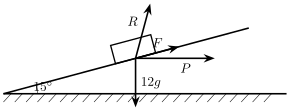
A box on a rough 15° incline. Friction first opposes sliding down (finding μ), then a horizontal force P is introduced and friction switches to oppose sliding up.
Worked example 2
Finding μ, then a horizontal force to reverse the tendency to slide
A box of mass $12\ \text{kg}$ rests in limiting equilibrium on a rough plane inclined at $15^\circ$ to the horizontal, on the point of sliding down. (a) Find the coefficient of friction $\mu$ between the box and the plane. (b) A horizontal force of magnitude $P\ \text{N}$, directed into the slope, is now applied to the box, which is on the point of sliding up the plane instead. Find $P$, to 3 significant figures. Take $g=9.8\ \text{m s}^{-2}$.
Method (a)On the point of sliding down
1
Since the box tends to slide down, friction acts up the slope. Resolving perpendicular to the plane: $R=12g\cos15^\circ$.
There's no applied force yet, so only weight and the normal reaction act perpendicular to the plane.
2
Resolving along the slope, with friction limiting: $F=12g\sin15^\circ$ and $F=\mu R$, so $\mu=\dfrac{12g\sin15^\circ}{12g\cos15^\circ}=\tan15^\circ=0.268$ (3 s.f.).
The mass cancels entirely — the limiting angle depends only on the incline and the surfaces in contact, not the weight.
Method (b)On the point of sliding up
1
Now the tendency is to slide up, so friction acts down the slope instead. Resolving perpendicular to the plane: $R=12g\cos15^\circ+P\sin15^\circ$.
The horizontal force $P$, directed into the slope, now contributes to the normal reaction too.
2
Resolving along the slope: $P\cos15^\circ = 12g\sin15^\circ + \mu R = 12g\sin15^\circ+\mu(12g\cos15^\circ+P\sin15^\circ)$.
Friction now opposes the upward tendency, so it acts down-slope alongside gravity's component.
3
Using $\mu=\tan15^\circ$ from part (a): $P(\cos15^\circ-\tan15^\circ\sin15^\circ)=12g(\sin15^\circ+\tan15^\circ\cos15^\circ)=12g(2\sin15^\circ)$.
Since $\tan15^\circ\cos15^\circ=\sin15^\circ$, the right-hand side simplifies to exactly $2\sin15^\circ$.
4
Similarly, $\cos15^\circ-\tan15^\circ\sin15^\circ=\dfrac{\cos^215^\circ-\sin^215^\circ}{\cos15^\circ}=\dfrac{\cos30^\circ}{\cos15^\circ}$, so $P = \dfrac{24g\sin15^\circ\cos15^\circ}{\cos30^\circ}=\dfrac{12g\sin30^\circ}{\cos30^\circ}=12g\tan30^\circ$.
Two standard identities — the double-angle formula and $\cos^2\theta-\sin^2\theta=\cos2\theta$ — collapse the whole expression to a single clean term.
A satisfying simplification, given how messy the equation looked at the start.
▪ solved
Common mistake
Keeping friction pointing "up the slope" throughout part (b) because that's the direction it had in part (a). Always re-examine which way the object is now tending to move before assigning friction's direction — it can, and often does, switch between parts of the same question.
Check yourself
A box of mass $5\ \text{kg}$ lies on rough horizontal ground, where the coefficient of friction is $0.3$. Find the horizontal force $P$, to 3 significant figures, needed to make the box just start to slide. Take $g=9.8\ \text{m s}^{-2}$.
$R=5g=49\ \text{N}$, so $P=\mu R=0.3\times49=14.7\ \text{N}$.